A Walima dress often needs to achieve something surprisingly difficult.
It should feel softer than the bride’s main wedding look without becoming ordinary. It should look elegant rather than overly dramatic, but it must still be unmistakably bridal when she enters the reception.
That balance is what makes choosing a Walima outfit different from simply buying another formal dress.
For many UK brides, the Walima becomes an opportunity to move away from the deeper reds, stronger metallics and heavier visual language associated with the main wedding day. Ivory, champagne, powder blue, blush, sage, silver and other refined shades naturally come into consideration.
But colour alone cannot make a dress bridal.
The silhouette, fabric, hand embroidery, dupatta, jewellery and overall scale all determine whether a softer outfit still carries enough presence for the bride.
This Walima dress guide explains how to bring those elements together so that your reception outfit feels polished, personal and clearly distinct from both your Baraat look and ordinary formal party wear.
Brides beginning their search can explore Abdullah Bin Shahbaz’s hand embroidered bridal wear for UK weddings, where Walima pieces are developed through made to order sizing, premium fabrics and traditional hand embellishment.
Walima Dress Guide UK Brides Can Use Before Choosing a Design
Before saving dozens of pastel outfits, decide what you want your Walima to feel like.
Is it a formal evening reception in a large ballroom?
A smaller daytime celebration?
A hotel event with strong artificial lighting?
An elegant dinner where you will spend much of the evening greeting guests?
These details affect the dress more than many brides initially expect.
A large evening reception can support stronger embroidery and a more architectural silhouette because the outfit needs enough visual presence to hold its own across the venue.
A smaller celebration can allow quieter craftsmanship to become more noticeable.
The most useful starting point is therefore not:
“What colour should I wear?”
It is:
“What kind of bridal presence should this reception look create?”
Once that is clear, decisions around colour, fabric and handwork become much easier.
What Should a Bride Wear for Her Walima?
A Walima bride can wear a lehenga, gown-inspired silhouette, pishwas, sharara, gharara, long formal shirt or another couture ensemble that suits her personal style.
There is no required shape.
What usually distinguishes Walima styling is refinement.
The silhouette may feel more fluid.
The colours may become softer.
Embroidery can remain detailed while appearing more controlled than the stronger ceremonial look often chosen for Baraat.
This does not mean the dress needs to be simple.
A heavily hand embroidered Walima outfit can still feel perfectly appropriate when the colour palette and overall composition create elegance rather than visual heaviness.
The bride should remain the most important person in the room.
The goal is simply to achieve that through polish rather than excess.
How Should a Walima Dress Differ From a Baraat Dress?
The two outfits should feel intentionally different.
A Baraat dress often carries stronger ceremony.
Red, maroon, deep jewel colours and dense metallic work can create a powerful traditional bridal identity.
The Walima gives the bride room to shift the mood.
She might move from red into powder blue.
From dense gold handwork into silver detailing.
From a highly structured lehenga into a softer flowing silhouette.
Or she may keep a substantial level of embroidery while changing the colour and fabric completely.
The contrast does not need to come from making the Walima outfit dramatically lighter.
It can come from changing the design language.
This is particularly important when planning the complete wedding wardrobe.
Each event should have its own personality rather than looking like the same bridal dress recreated in another colour.
Best Walima Dress Colours for UK Brides
Pastels work beautifully for Walima because they create an immediate visual shift from the deeper palettes often associated with the main wedding event.
Powder blue can feel fresh and refined.
Sage green offers softness without becoming overly delicate.
Dusty rose introduces warmth.
Champagne and ivory create timeless elegance.
Silver-grey can look especially sophisticated during an evening reception.
Lilac and muted mauve offer another contemporary direction.
But these colours are not rules.
Emerald, deeper blue or other jewel tones can also create a striking reception look when the bride prefers stronger colour.
The important question is whether the shade feels different enough from the rest of your bridal wardrobe and whether it supports the embroidery you want.
For a broader comparison of event-specific palettes, read our bridal dress colours guide for UK weddings.
How to Make a Pastel Walima Dress Look Bridal
This is where many brides become uncertain.
A pastel outfit can easily move from bridal couture into high-end formalwear if it does not have enough design structure.
The solution is not simply adding more embellishment everywhere.
Instead, focus on the areas that establish bridal identity.
The neckline should feel considered.
The sleeves should carry enough detail to appear intentional in close photographs.
The lower silhouette needs enough volume or structure to feel significant.
The dupatta should frame the bride rather than behaving like an ordinary formal scarf.
Borders can also create a stronger bridal finish.
The embroidery then connects these areas.
A pastel Walima dress becomes visibly bridal when all of its elements feel designed around the bride rather than assembled as a formal outfit.
Powder Blue for a Walima Bride
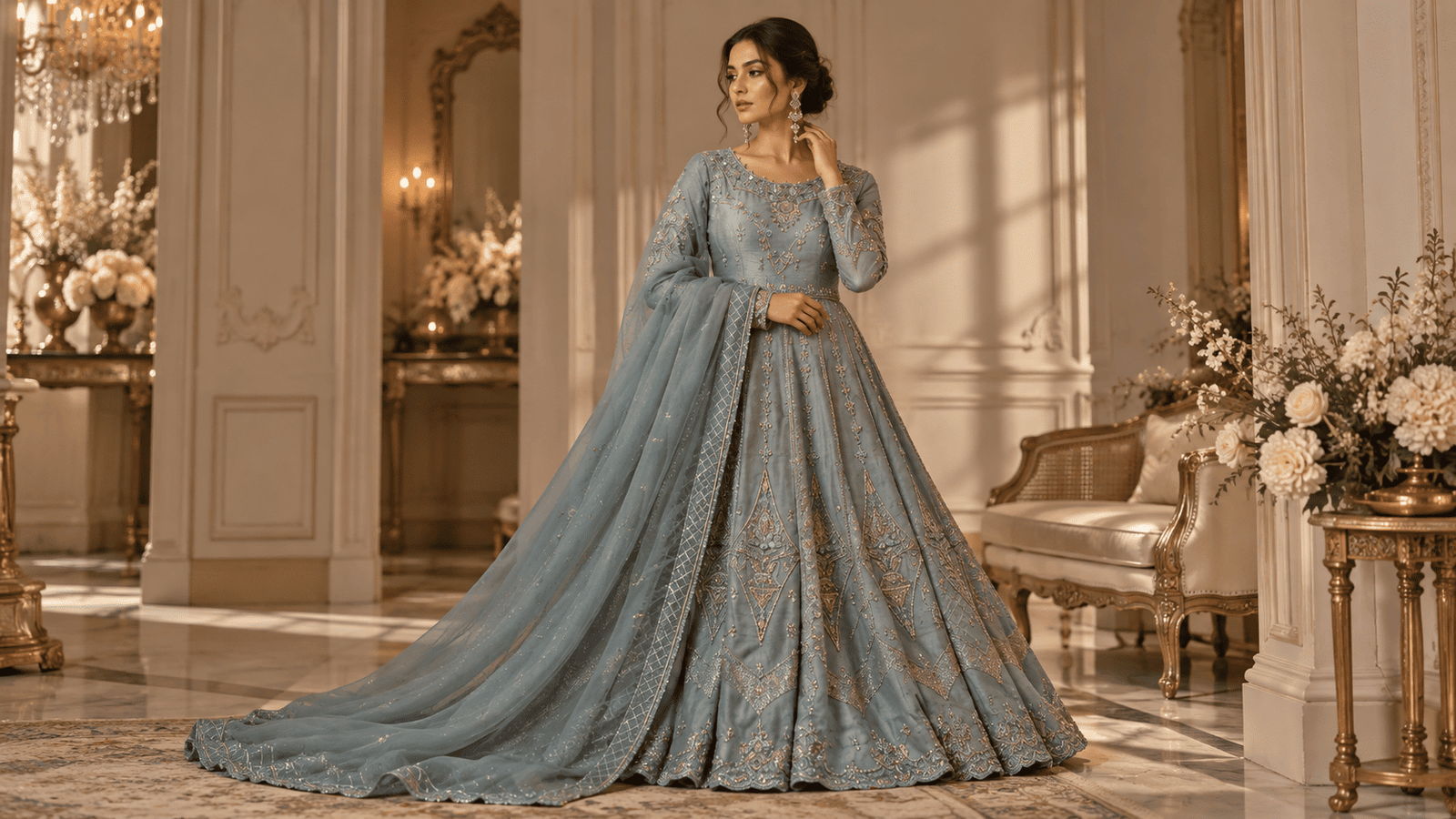
Powder blue has become a natural reception colour because it combines softness with enough distinction to remain memorable.
It works particularly well with silver, pearl and cooler metallic handwork.
Under evening lighting, reflective embellishment can make the colour appear richer without changing its restrained character.
The fabric matters significantly.
A powder blue silk dress feels more grounded.
Organza can create lighter layers and movement.
Tissue can add luminosity.
Embroidery can range from delicate resham to stronger cutdana, crystal and metallic work depending on how formal the reception will be.
The final outfit should still have enough contrast and structure that the bride does not disappear into an extremely pale palette.
Sage Green for Walima
Sage is another useful choice for brides who want softness without choosing a conventional blush or ivory.
Its slightly muted quality can work beautifully with antique metallics, pearls and delicate threadwork.
The shade also provides enough colour to remain visible under venue lighting.
A sage Walima look can lean traditional through zardozi and dabka or feel more contemporary through fine motifs and restrained embellishment.
This flexibility makes it particularly suitable for brides who want an elegant reception outfit that does not look like a conventional white or pastel gown.
The Naqsh collection is especially useful for exploring softer formal palettes, smaller motifs and more delicate hand embellishment. The collection is designed for occasions including Walima and formal receptions. Abdullah Bin Shahbaz
Can a Walima Bride Wear Ivory?
Yes.
Ivory can create a highly sophisticated Walima look when the bride wants a neutral, luminous palette.
However, the outfit needs enough distinction from ordinary ivory formalwear.
Fabric becomes particularly important.
Tissue can create natural light reflection.
Silk provides richer structure.
Organza can add softer movement through a dupatta or overlay.
Metallic embroidery can then define the bridal character without requiring a dramatic colour contrast.
Zarveen provides a useful example of ivory tissue paired with hand-applied metallic detailing and measured formal proportions. Abdullah Bin Shahbaz
For a Walima bride, this type of restrained richness can form an excellent starting point when adapted to the desired level of bridal formality.
Should Walima Embroidery Be Lighter Than Baraat Embroidery?
Not necessarily.
The Walima can carry substantial handwork.
What often changes is how that embroidery is expressed.
Baraat embroidery may use dense gold zardozi, stronger borders and deeper colour contrast.
A Walima outfit may instead use silver metallics, crystals, pearls, resham or more tonal work.
The density can still be significant.
The visual effect simply becomes more refined.
This distinction matters because reducing embroidery too far can make the bride look like a guest at her own reception.
Think in terms of different embroidery character, not automatically less embroidery.
Best Embroidery Techniques for a Walima Dress
Zardozi can still work beautifully on a Walima dress when the metallic tone complements the colour palette.
Dabka introduces physical depth.
Resham can soften the embroidery and bring colour into floral or ornamental motifs.
Cutdana and crystals become particularly effective during evening receptions because they respond strongly to venue lighting.
Mukesh can create more subtle reflected light across a dupatta or quieter areas of the garment.
Pearls can also fit naturally into a softer Walima aesthetic.
The strongest design often combines several techniques rather than relying on only one.
If you want to understand how each form of handwork behaves, read our guide to Pakistani bridal embroidery techniques.
Fabric Can Change the Entire Walima Look
The same pastel shade can create completely different bridal moods depending on the fabric.
Silk provides depth and elegant structure.
Organza creates sheer movement and works especially well for dupattas and layered silhouettes.
Tissue contributes luminosity and can make metallic embroidery feel naturally connected to the fabric.
A bride who wants a flowing reception look may require a different fabric strategy from someone choosing a highly structured formal silhouette.
The amount of embroidery also influences the decision.
Dense handwork requires sufficient support.
Delicate threadwork leaves greater freedom for lighter materials.
For more detailed guidance, use our bridal fabrics UK guide before finalising the Walima dress.
Walima Lehenga or Gown: Which Is Better?
Neither is automatically better.
A lehenga maintains a strong connection with South Asian bridal tradition.
It can be particularly effective when the bride wants the Walima to remain visibly connected to the rest of her wedding wardrobe.
A gown-inspired silhouette creates a more contemporary reception mood.
The long vertical line can make handwork appear elegant rather than heavily traditional.
A pishwas sits somewhere between those directions, maintaining South Asian design identity while creating fluid movement.
Shararas and ghararas offer another alternative.
The decision should reflect the bride rather than the current trend cycle.
Ask which silhouette makes you feel like yourself while still providing enough bridal presence for a formal reception.
When a Long Shirt Works for Walima
A long shirt can create an extremely elegant Walima outfit when the lower silhouette and embroidery are handled carefully.
Pairing it with an izaar, flowing trousers, sharara or richly worked lower garment creates several different moods.
The shirt can carry detailed embroidery around the neckline and sleeves while the lower half contributes movement.
This can be especially useful for brides who do not want another voluminous skirt after wearing a lehenga during another wedding event.
The result can feel contemporary without abandoning traditional hand craftsmanship.
Your Walima Dress Should Photograph From Across the Room
Reception venues can be large.
This means the outfit has to work at more than one viewing distance.
Close embroidery matters.
But so does the complete silhouette.
A garment with extraordinary detail but very little visual structure may disappear in wide reception photographs.
Think about shape.
Think about the dupatta.
Think about how the embroidery is distributed across the garment.
The outfit should remain recognisably bridal from the entrance, not only once the photographer moves close enough to capture the workmanship.
But It Should Also Reward Close Photography
Walima photographs often include detailed portraits.
Jewellery.
Hands.
Sleeves.
Dupatta edges.
Close views of the neckline.
This is where genuine handwork becomes particularly valuable.
Zardozi, dabka, resham, pearls and individually placed reflective details have physical texture that reveals itself under close photography.
The strongest bridal garment therefore operates at two levels.
It has enough silhouette and colour presence to work across a ballroom.
And enough artisan detail to remain beautiful when the camera is only a few feet away.
Choosing Jewellery for a Walima Dress
Jewellery should respond to the neckline and embroidery.
A silver-toned powder blue outfit may naturally support cooler jewellery.
An ivory or champagne dress with antique gold work can move in another direction.
Pearls can work beautifully with softer reception palettes.
If the neckline is heavily embroidered, large jewellery may compete with it.
A more open neckline creates room for a statement necklace.
The important thing is to decide which element should dominate around the face.
The dress and jewellery should not both fight for first place.
How the Walima Dupatta Should Work
A Walima dupatta often benefits from feeling lighter and more fluid than the main garment.
Organza can work particularly well because it holds embroidered borders while remaining relatively manageable.
Mukesh or scattered embellishment can create light throughout the centre without making the complete piece dense.
A bride can also choose a more substantial dupatta if it is intended to become one of the focal points of the outfit.
The key question is how it will actually be worn.
Over the head?
Across one shoulder?
Draped more loosely for the reception?
Decide this before the embroidery layout is finalised.
A beautiful border can lose its effect when the drape places it somewhere the design never anticipated.
Consider the Reception Lighting
Walima receptions are frequently held in venues with strong artificial lighting.
That changes how fabric and embroidery behave.
Crystals and cutdana can become much more visible.
Metallic handwork reflects warm venue lights differently from natural daylight.
Pastels can appear warmer or cooler depending on the room.
If possible, look at the dress under more than one lighting condition before finalising colours.
This is particularly important for ivory, silver-grey and pale blue shades, where subtle changes in lighting can produce noticeable differences.
UK Summer Walima Dressing
Summer receptions can still take place in warm indoor venues.
Several layers of fabric, dense embroidery and professional lighting can increase discomfort even when the outside temperature feels mild.
A lighter dupatta and controlled layering can make a significant difference.
You do not need to remove bridal richness.
Instead, concentrate it where it has the greatest visual value.
The bodice, sleeves and borders can carry strong craftsmanship while other sections remain lighter.
This creates enough formal impact without making the dress unnecessarily exhausting to wear.
Winter Walima Dressing in the UK
Winter gives brides more freedom to explore richer fabrics and structured silhouettes.
However, most receptions still take place inside heated venues.
Do not choose an excessively heavy garment purely because the wedding is in December.
Think about the complete evening.
Arriving.
Photographs.
Sitting.
Greeting guests.
Dancing or moving around the venue.
A winter Walima dress should look seasonally appropriate while remaining wearable once you are indoors for several hours.
The Walima Dress Should Fit the Bride, Not a Standard Size
Fit has an enormous effect on how couture appears.
A beautifully embroidered neckline can lose its impact when the shoulders do not sit correctly.
A skirt or long dress can appear poorly proportioned when the length does not work with the bride’s height and footwear.
Sleeves must allow natural movement.
The waist should remain comfortable while seated during dinner and photographs.
This becomes especially important with heavily hand embroidered clothing because significant alterations after production may interfere with motifs or borders.
If your Walima dress will be made to order, review our bridal dress measurements guide before confirming final sizing.
Made to Order Can Be Especially Valuable for Walima
A Walima bride often has a very specific vision.
She may love an existing design but want it in powder blue instead of ivory.
She may prefer silver embroidery rather than warm gold.
The sleeves may need additional coverage.
The neckline may need adjusting.
She may want another dupatta or a different embroidery density.
Made to order construction allows these decisions to be considered before the dress is completed.
This creates a more coherent result than buying a finished garment and attempting to transform several major areas later.
If you are still comparing both processes, read our guide to ready made vs made to order bridal wear in the UK.
Naqsh or Zarposh for Walima?
Both can work, but they represent different levels of visual intensity.
Naqsh has a softer language built around delicate motifs, fine resham, pastel tones and refined formal silhouettes. That naturally suits brides who want a quieter Walima direction. Abdullah Bin Shahbaz
Zarposh moves towards stronger metallic embroidery, richer handwork and more pronounced couture presence. The collection is explicitly designed across formal occasions including Walima and reception dressing. Abdullah Bin Shahbaz
The better choice depends on how prominent you want the Walima dress to feel.
A softer bride does not need to force herself into heavily worked couture.
Likewise, a bride who wants a strong formal reception look should not reduce the embroidery simply because Walima styling is often described as “lighter”.
Do Not Let the Walima Look Become Guest Wear
This is one of the most important decisions in the entire outfit.
A soft colour, elegant fabric and delicate embroidery can create beautiful formalwear.
But the bride needs one level more.
That may come from silhouette.
It may come from the richness of the dupatta.
It may come from stronger embroidery around the upper body.
Or from the complete scale of the garment.
You do not need to add everything.
You simply need enough intentional bridal signals that the outfit cannot be mistaken for wedding guest clothing.
The distinction should remain clear even before jewellery and makeup are added.
How the Walima Dress Should Relate to Your Nikkah and Mehndi Looks
Wedding wardrobes become much stronger when each outfit performs a different role.
If your Nikkah look is ivory and restrained, choosing ivory again for Walima may make the two sets of photographs feel too similar.
If your Mehndi uses strong green or mustard, a powder blue or champagne reception look creates immediate contrast.
Silhouette offers another opportunity.
A sharara for Mehndi, refined Nikkah ensemble and flowing Walima dress naturally create more variety than repeating one lehenga structure three times.
You can still connect the outfits through jewellery tones, embroidery techniques or other smaller details.
The goal is continuity without repetition.
What Should You Discuss During a Walima Consultation?
Start with the wedding date.
Then discuss the venue, time of day and general scale of the reception.
Bring examples of colours you genuinely like, but remain open to seeing how they behave on different fabrics.
Explain your preferred silhouette.
Discuss how bridal you want the outfit to feel relative to your Baraat dress.
Confirm the embroidery direction, neckline, sleeves and dupatta.
If you already own important jewellery, show it.
Ask about final garment weight.
And make sure the designer understands the level of movement and comfort you expect through the evening.
Our bridal wear consultation guide covers these questions in greater detail before a made to order commission begins.
When Should You Order Your Walima Dress?
Do not assume that a pastel dress automatically takes less time to create than a heavily coloured Baraat outfit.
Fine handwork still requires artisan time.
Custom colour changes may affect thread and embellishment selection.
A detailed dupatta can involve considerable work even when the overall dress looks visually soft.
Start the conversation early enough that the design can be decided thoughtfully rather than under unnecessary time pressure.
Our guide to how early to order a bridal dress in the UK explains the planning considerations in more detail.
A Walima Dress Checklist Before You Order
Before confirming the dress, make sure you have decided:
- the reception venue and time of day
- your preferred colour family
- how different the Walima should feel from Baraat
- silhouette
- fabric
- embroidery density and metallic tone
- neckline
- sleeves
- measurements
- dupatta style
- jewellery direction
- footwear height
- production timeline
- whether the complete outfit reads clearly as bridal
If these decisions are reasonably clear, the designer has a much stronger foundation for creating the final look.
FAQs About Walima Dresses for UK Brides
What should a bride wear for her Walima?
A Walima bride can wear a lehenga, gown-style ensemble, pishwas, sharara, gharara or elegant long formal outfit. The best choice is one that feels formal, clearly bridal and distinct from the Baraat look.
What colour is best for a Walima dress?
Powder blue, ivory, champagne, blush, sage, silver-grey, lilac and dusty rose are popular Walima colours. Deeper shades can also work when they suit the bride and reception.
Should a Walima dress be lighter than a Baraat dress?
It often has a softer colour palette or more refined visual character, but it does not have to contain less craftsmanship. A Walima outfit can still carry extensive hand embroidery.
Can a bride wear ivory for Walima?
Yes. Ivory can work beautifully when fabric, embroidery, silhouette and dupatta give the outfit enough bridal presence.
Can I wear a lehenga for Walima?
Yes. A lehenga remains a strong Walima option, particularly when the colour and embroidery create a clear contrast with the bride’s Baraat look.
Which fabric works best for a Walima dress?
Silk, organza and tissue can all work depending on the silhouette and embroidery. Silk provides structure, organza introduces lightness and tissue adds luminosity.
Which embroidery is best for Walima?
Zardozi, dabka, resham, mukesh, cutdana, pearls and crystals can all work. The best combination depends on the fabric, colour and desired level of formality.
Should Walima jewellery be lighter than Baraat jewellery?
It can be, particularly when the dress already contains detailed embroidery. The jewellery should complement the neckline and colour palette rather than competing with them.
Can a Walima dress be made to order?
Yes. Made to order bridalwear can allow custom sizing and agreed changes to colour, neckline, sleeves, dupatta and embroidery depending on the design.
Conclusion
The best Walima dress is not simply the palest outfit in the bridal wardrobe.
It is the dress that changes the mood of the wedding without reducing the bride’s presence.
Colour may become softer.
The silhouette may become more fluid.
Metallic embroidery may move from rich gold into silver, pearl or tonal detailing.
But the craftsmanship should still make the bride feel unmistakably dressed for her own reception.
For UK brides, this balance becomes especially important in large formal venues where the outfit needs to look elegant from across the room and still reveal beautiful workmanship in close photography.
At Abdullah Bin Shahbaz, Walima couture is developed through made to order sizing, premium fabrics and traditional hand embellishment. Explore the UK bridal collection, discover the softer Naqsh collection or richer Zarposh collection, and contact the team to discuss your Walima date, colour, silhouette and customisation requirements.