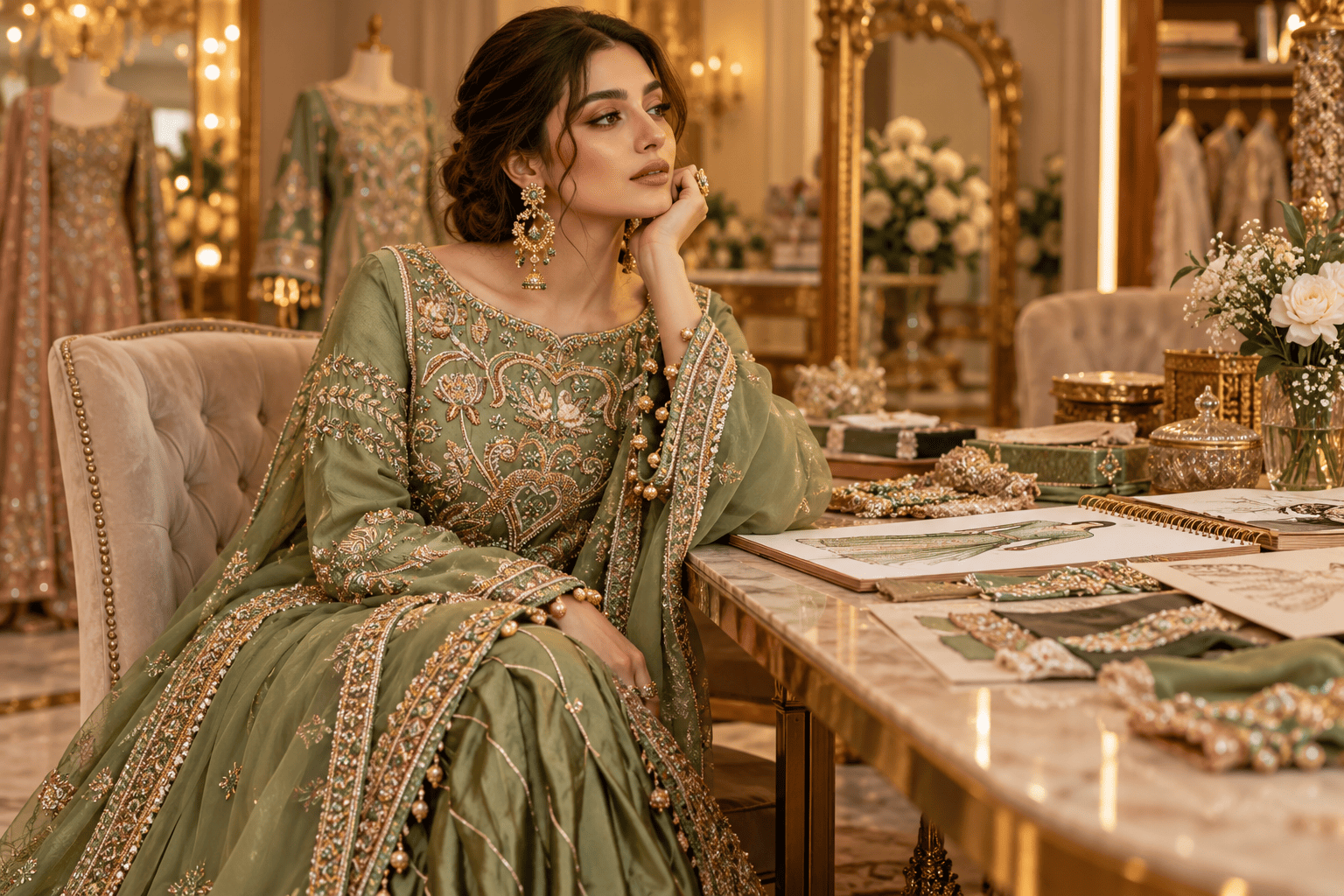
A formal wear consultation UK guests rely on should give you more than an opportunity to look at beautiful outfits. It should help you understand exactly what you are commissioning, how the garment will be created and whether the design suits your wedding event, your measurements and your personal style.
This becomes particularly important when choosing hand embroidered or made to order formal wear. Unlike purchasing an existing garment from a rail, commissioning formal couture involves decisions about fabric, fit, embroidery, colour, sleeves, neckline, dupatta styling and production requirements. Each of those decisions can influence the final outfit.
For UK guests attending a Nikkah, Mehndi, Dholki or Walima, asking the right questions early can make the process considerably clearer. It allows expectations to be established before production begins and gives you an opportunity to understand the craftsmanship behind the garment rather than making a decision from photographs alone.
A good consultation should leave you feeling informed about what is being created, what can be customised and what needs to be confirmed before your order moves forward.
What Should You Prepare Before a Formal Wear Consultation?
You do not need to arrive with every detail decided.
In fact, part of the purpose of a formal wear consultation is to help refine your ideas. However, having a few essentials ready makes the conversation far more productive.
Start with the wedding date and the event for which you need the outfit. A designer needs to know whether you are dressing for a daytime Mehndi, an evening Walima or a formal Nikkah ceremony, because each occasion carries different expectations for colour, coverage and embroidery.
It is also useful to know which colours and silhouettes you are naturally drawn towards.
You may already know that you prefer a lehenga, gharara, sharara, pishwas or another formal silhouette. Sharing a few reference images can help the designer understand your taste quickly.
Think about coverage as well.
Sleeve length, neckline depth, blouse length and dupatta styling are all easier to discuss before production begins than to adjust afterwards.
Your consultation should begin with the wedding event and your role as a guest rather than simply with a dress.
Ask Whether the Formal Outfit Is Ready Made or Made to Order
One of the first questions should establish exactly how the garment will be produced.
A ready made outfit already exists in a predetermined design and size. A made to order piece is created after you confirm your chosen design, measurements and customisation requirements.
This distinction affects fitting, customisation and timing.
At Abdullah Bin Shahbaz, formal pieces are created on a made to order basis, allowing guests to discuss hand embroidery, fabric and fit before production begins. You can explore the Zarposh collection before beginning that conversation.
If you are still deciding which purchasing route suits you, read our guide to ready made vs made to order formal wear in the UK.
Understanding the production model before anything else makes the remaining consultation questions more meaningful.
Ask Exactly What Can Be Customised
Made to order does not necessarily mean that every element of a garment can be changed without affecting its design integrity.
Ask specifically which customisations are available.
Colour may be adjustable. Sleeve length or neckline shape may be changed. Dupatta detailing, garment length and embroidery density may all be open to discussion.
More extensive changes can involve a different level of design work.
For example, changing the colour of an existing outfit is very different from changing its silhouette. One is a surface adjustment, the other requires rethinking proportions and embroidery placement.
A useful formal wear consultation should establish where personalisation adds value and where preserving the original design serves you better.
The objective should not be to change as much as possible. It should be to create an outfit that feels considered and coherent.
Ask Which Hand Embroidery Techniques Are Used
If hand craftsmanship is one of the reasons you are considering luxury formal wear, ask about it directly.
Terms such as handcrafted and hand embellished can be used broadly in fashion, so understanding the specifics matters.
Traditional South Asian formal embroidery may include zardozi, dabka, resham, mukesh, cutdana and other heritage techniques.
Each creates a different effect.
Zardozi can introduce rich metallic dimension. Dabka gives embroidery raised texture. Resham allows for fine, colourful threadwork, while mukesh adds subtle shimmer.
The more useful question is not simply, “Is this dress hand embroidered?”
Ask which techniques are used, where they appear on the garment and how they contribute to the overall design.
This helps distinguish genuine craftsmanship from decorative language used only for marketing. For guidance on assessing handwork, see our guide to choosing hand embroidered formal wear in the UK.
Ask How Heavy the Embroidery Will Feel When Worn
Embroidery has visual weight and physical weight.
A dress may look spectacular in photographs while still feeling very different once it is worn for several hours.
Ask how the embroidery affects the garment’s overall weight and movement.
This is particularly relevant for a Walima outfit with dense metallic work or a heavily bordered dupatta.
For a Mehndi or Dholki, movement may become even more important, since these celebrations often involve dancing and long evenings.
A richly detailed outfit can still be comfortable when the embroidery placement, fabric and construction are planned with wearability in mind.
The consultation is the right time to explain how you expect to wear the garment rather than discovering its weight on the day.
Ask Which Fabric Best Suits the Design
Choosing fabric should not be treated as a separate decision from choosing embroidery.
Silk, organza, tissue, chiffon and other formal fabrics respond differently to embellishment. Some provide structure, others offer fluidity.
Ask why a particular fabric has been selected for the outfit you are considering.
A heavily embellished garment needs a material capable of supporting its surface work. A flowing silhouette needs a fabric that moves gracefully.
For UK weddings, this can be particularly useful because celebrations take place across very different seasons and venues.
A winter evening reception may support heavier layering and richer fabric choices, while a summer daytime event may call for lighter materials.
The best fabric is the one that supports the design rather than simply the material with the most luxurious name.
Ask How Your Measurements Will Be Taken
Fit should be discussed before production rather than treated as an issue to solve afterward.
Ask which measurements are required and how they should be taken.
Formal wear may require more detailed measurements than everyday clothing because the shoulder line, bodice structure and sleeve setting all affect how embroidery sits.
The silhouette also matters.
A lehenga requires different considerations from a gharara, pishwas or straight formal ensemble.
Do not assume that your normal clothing size provides enough information for a made to order formal outfit.
If the designer provides a measurement guide or specific instructions, follow those carefully. Accurate measurements are the foundation of a good fit.
Ask What Happens if Your Measurements Change
Wedding celebrations can be planned over several months, and body measurements may change during that period.
This is worth discussing during the consultation rather than assuming adjustments will always be straightforward.
Ask when the final measurements need to be confirmed and what the process is if your measurements change after that point.
Minor adjustments may be manageable, while larger changes to heavily embroidered sections can become complicated.
If you already expect your measurements to change, communicate that early.
It allows the designer to advise you according to the particular garment and production schedule rather than leaving it to chance.
Ask Whether the Colour Can Be Customised
Colour is one of the most personal decisions in formal dressing.
Rich jewel tones, soft pastels and classic metallics all have their place in South Asian formal wear, and the right choice depends on the event, the season and your complexion.
If you love a design but would prefer another colour, ask whether the fabric and embroidery can support the change.
Not every embroidery composition looks identical on every background colour.
Gold handwork placed over deep emerald creates a different level of contrast from the same metallic detailing over blush pink.
A successful colour customisation therefore involves more than replacing one fabric shade with another.
The designer should consider how the complete surface of the garment will respond. As a guest, it is also courteous to avoid the exact shade the couple has chosen for their own outfits.
Ask What Is Included in the Complete Formal Outfit
Never assume that everything visible in a styled campaign photograph is automatically included.
Ask which individual pieces form part of the outfit.
A formal look may include a blouse or kameez, lehenga or trousers, one dupatta, a second dupatta, detachable sleeves or additional finishing details.
Understanding exactly what is included avoids confusion later.
This question becomes particularly important if you want an additional dupatta.
A second dupatta can require its own fabric, borders and embroidery, which means it should be discussed as a separate element.
Similarly, if the outfit includes a heavily embellished lower garment or separate handcrafted accessories, confirm whether these are part of the commission.
Clarity at this stage makes both design planning and the final quotation easier to understand.
Ask How the Dupatta Should Be Planned
The dupatta can transform the complete formal silhouette.
Ask how it has been designed to be worn and whether its length, fabric and embroidery work with your plans for styling.
A dupatta draped over the head needs different practical consideration from one intended mainly over the shoulder.
If you want a double dupatta look, tell the designer during the consultation.
The two pieces should work together rather than compete. One may carry richer borders while the other remains lighter.
You should also consider how the dupatta interacts with the neckline and jewellery.
A heavily embroidered border positioned near an already detailed neckline can create a very rich appearance, so balance matters.
These are styling decisions, but they begin with how the formal outfit itself has been designed.
Ask About the Production Timeline Before Confirming the Order
The wedding date should be discussed before the order is confirmed.
Hand embroidered formal wear is not produced according to one universal timeframe. The amount of handwork, the complexity of the design and the number of customisations all influence the schedule.
A heavily embellished Walima ensemble may require a different schedule from a refined Nikkah guest outfit.
Do not assume that because one garment appears visually lighter it will automatically be quicker to produce.
Ask whether your preferred design can realistically be produced within the available period before anything is finalised.
If you are still planning your schedule, our guide on how early to order formal wear in the UK explains how embroidery, measurements and customisation can affect the planning process.
Please also check our Shipping Policy page for current making times.
An honest conversation about timing is more valuable than choosing an outfit first and discussing the schedule afterwards.
Ask What Can Affect the Final Formal Wear Quotation
A formal wear quotation should make sense in the context of the garment being commissioned.
Ask what design elements influence it.
Fabric choice, embroidery technique, embroidery density, silhouette, additional pieces and customisation requirements all play a part.
This is particularly important when comparing two visually similar outfits.
A dress with intricate hand embroidery may involve considerably more artisan workmanship than another that looks similar in photographs.
Likewise, adding a heavily embellished second dupatta or substantially modifying an existing silhouette can change the scope of the work.
You do not need the designer to reduce every decision to an individual cost. The objective is simply to understand what drives the quotation.
For a deeper explanation, read our guide to what affects the hand embroidered formal wear cost.
Ask to See the Embroidery Up Close
Full length photographs show the complete formal silhouette, but close detail reveals the workmanship.
Ask to see detailed images or video of embroidery, borders, sleeves, neckline and dupatta work when making your decision.
This allows you to examine how the embellishment sits on the fabric and how motifs are constructed.
Look for texture.
Hand embroidery should reveal depth when viewed from different angles. Metallic elements, beads, threadwork and sequins should sit securely and evenly.
Also look beyond the most heavily photographed area.
The quality of a luxury formal garment should continue through the cuffs, borders, hem and less prominent sections.
A dress should remain convincing when viewed closely, not only from across a room.
Ask How the Outfit Will Move
Movement is rarely visible in a static product photograph.
During a consultation, ask how the selected silhouette behaves when walking and sitting.
This matters for formal lehengas, ghararas, shararas and pishwas because volume, fabric and embellishment all affect how the garment moves.
If possible, look at video of the outfit or a similar silhouette.
A guest should understand whether the skirt has significant structure, whether the dupatta is particularly heavy and whether the sleeves allow comfortable movement.
A wedding celebration is not a photoshoot that lasts ten minutes.
You may be wearing the outfit for several hours, moving between photographs, ceremonies and dinner.
The most successful formal wear combines presence with wearability.
Ask Whether the Design Suits Your Specific Wedding Event
Do not choose formal wear only because the design itself is beautiful.
Ask whether its weight, embroidery, fabric and silhouette suit the event you are attending as a guest.
A Nikkah may call for a softer, more refined interpretation of formal dressing. A Mehndi or Dholki can prioritise movement and colour.
These are not rules.
A guest can choose richer embroidery for a Walima or something more restrained for a daytime family event.
The value of discussing the occasion is that it gives the designer context.
You are not asking what guests traditionally “must” wear. You are helping the designer understand the setting so the outfit feels appropriate.
Ask How Jewellery Should Work With the Neckline
Jewellery does not need to be chosen before the formal outfit, but it should not be forgotten during the consultation.
If you already own a significant family necklace or a set you definitely plan to wear, mention it early.
The neckline can then be considered alongside that piece.
A densely embroidered high neckline may not need the same jewellery as an open neckline with more visible skin.
This does not mean the outfit must be designed around accessories.
It simply prevents important visual elements from being considered independently when they will ultimately be worn together.
Ask What You Should Avoid Changing After Production Begins
This is one of the most useful questions a guest can ask.
Some decisions are easy to reconsider early and much more difficult once production has progressed.
Changing embroidery placement, garment length, neckline or silhouette can affect work that has already been completed by artisans.
Ask which parts of your order need to be treated as final once approved.
This helps you understand when you still have room to reconsider and when further changes could affect the timeline or the design.
A formal wear consultation should establish these expectations clearly.
The aim is not to make the process rigid. It is to prevent avoidable last minute decisions from compromising the result.
Ask About the Designer’s Craftsmanship and Design Philosophy
A luxury formal wear commission involves more than choosing one photograph.
Understanding the brand’s design language can help you decide whether its approach genuinely suits your taste.
Ask how the collections are developed and what inspires the embroidery, silhouettes and materials.
At Abdullah Bin Shahbaz, Zarposh explores a richer expression of hand embellishment and formal dressing, while Naqsh moves towards more delicate motifs and a softer visual language.
The Abdullah Bin Shahbaz story also provides greater context around the brand’s emphasis on artisan handwork and made to order formal wear.
Understanding these differences helps a guest choose a design because she connects with its aesthetic, not only because it photographs well.
What Should You Know Before Leaving the Consultation?
By the end of a productive formal wear consultation, you should understand the direction of the garment.
You should know which design you are considering, whether it is made to order, which measurements are required and how they will be collected.
You should also understand the proposed fabric, colour direction, embroidery level and included garment pieces.
The wedding date should have been mentioned, along with a realistic sense of the production timeline.
Any significant additional requirements, such as a second dupatta or major neckline change, should also have been discussed.
You do not necessarily need every final detail confirmed during the first consultation.
However, you should leave with fewer questions than you arrived with.
The purpose of the consultation is to create clarity before commitment.
Read Also: Choosing Between Ready Made and Made to Order Formal Wear
If you have not yet decided whether a custom commission is the right approach for you, start with our guide to ready made vs made to order formal wear for UK guests.
It explains the differences in fit, personalisation, timing and embroidery planning so you can enter your consultation with a clear understanding of both routes.
FAQs About Formal Wear Consultations
What should I bring to a formal wear consultation?
Bring the wedding date, event details and any useful inspiration for colours, silhouettes or styling. Photographs of outfits you admire help the designer understand your taste quickly.
What should I ask a formal wear designer before ordering?
Ask whether the garment is made to order, how measurements are handled, which customisations are available and what the production timeline looks like.
Should I know my exact formal dress design before the consultation?
No. It is useful to understand your general preferences, but the consultation can help refine the final direction.
Can I ask for colour changes during a formal wear consultation?
Colour changes may be possible depending on the design and production process. The designer should confirm whether the fabric and embroidery will support your preferred shade.
Should I discuss the wedding date at the first formal wear consultation?
Yes. The wedding date helps the designer assess whether your chosen design, embroidery level and customisation requirements can be completed in time. Please check the Shipping Policy page for current making times.
Can I customise the neckline and sleeves of a made to order formal dress?
This may be possible depending on the garment. These changes are best discussed before production begins.
Should I ask about formal wear pricing during the consultation?
Yes. Rather than focusing only on a number, ask what is included in the quotation and which elements influence it.
Is a formal wear consultation useful if I have not chosen between Nikkah, Mehndi, Dholki or Walima styling?
Yes. Discussing the event, venue and level of formality can help establish the right fabric, silhouette and embroidery direction for your role as a guest.
Conclusion
A formal wear consultation is one of the most useful opportunities to understand a garment before committing to it.
The most important questions go beyond whether the outfit is beautiful. Ask how it will be made, which elements can be personalised and what the timeline requires.
Those conversations create clarity.
They also allow the designer to understand the guest rather than treating the commission as a standard order.
For UK guests considering made to order formal wear, Abdullah Bin Shahbaz creates hand embroidered pieces using custom sizing and heritage techniques. Explore the Zarposh and Naqsh collections and then speak with the team about your wedding event, preferred design and customisation requirements.
A considered consultation gives both guest and designer the same goal before the first stage of production begins.