Choosing between ready made and made to order formal wear is one of the first decisions many guests face when they begin looking for a wedding outfit in the UK. Both options can produce a beautiful result, but they offer very different levels of flexibility, fit, craftsmanship and involvement in the design process.
For a UK guest attending a Nikkah, Mehndi, Dholki or Walima, the right choice depends on more than convenience. The wedding event, preferred silhouette, measurements, embroidery expectations, timeline and level of customisation should all be considered before deciding which route suits you best.
A ready made formal outfit allows you to choose from a garment that already exists. Made to order formal wear, by contrast, is produced after the order is confirmed and can often be developed around personal measurements and agreed design details.
Neither option is automatically better for every guest.
The important question is whether you want to select an existing garment that already meets your requirements or commission an outfit that can be shaped more closely around your measurements, the wedding event and your design preferences.
What Is Ready Made Formal Wear?
Ready made formal wear refers to garments that have already been produced in predetermined designs and sizes. A guest can view the finished outfit, try the available sizes and decide whether it suits the wedding event before buying.
The main advantage is immediacy. A guest can see the finished outfit, understand its colour and embroidery in person and take it home or have it delivered without waiting for production.
This can be useful when the wedding date is approaching or when a guest finds a design that already matches her requirements.
Ready made formal wear may include everything from lightly embellished occasionwear to heavily worked festive pieces. The range is broad, and quality varies, so inspection matters.
The level of alteration available depends on the garment. Small changes may be possible, but substantial adjustments to an embroidered bodice, neckline or fit may be limited by the existing construction.
What Is Made to Order Formal Wear?
Made to order formal wear is produced after the guest confirms her chosen design and requirements. The garment may be created according to personal measurements rather than relying entirely on a standard size.
This approach is particularly relevant for hand embroidered couture. For guidance on assessing handwork before ordering, read our guide to choosing hand embroidered formal wear in the UK.
When techniques such as zardozi, dabka, resham, mukesh and cutdana are being developed directly onto fabric, producing the garment around the wearer allows the designer to position the embroidery with the final fit in mind.
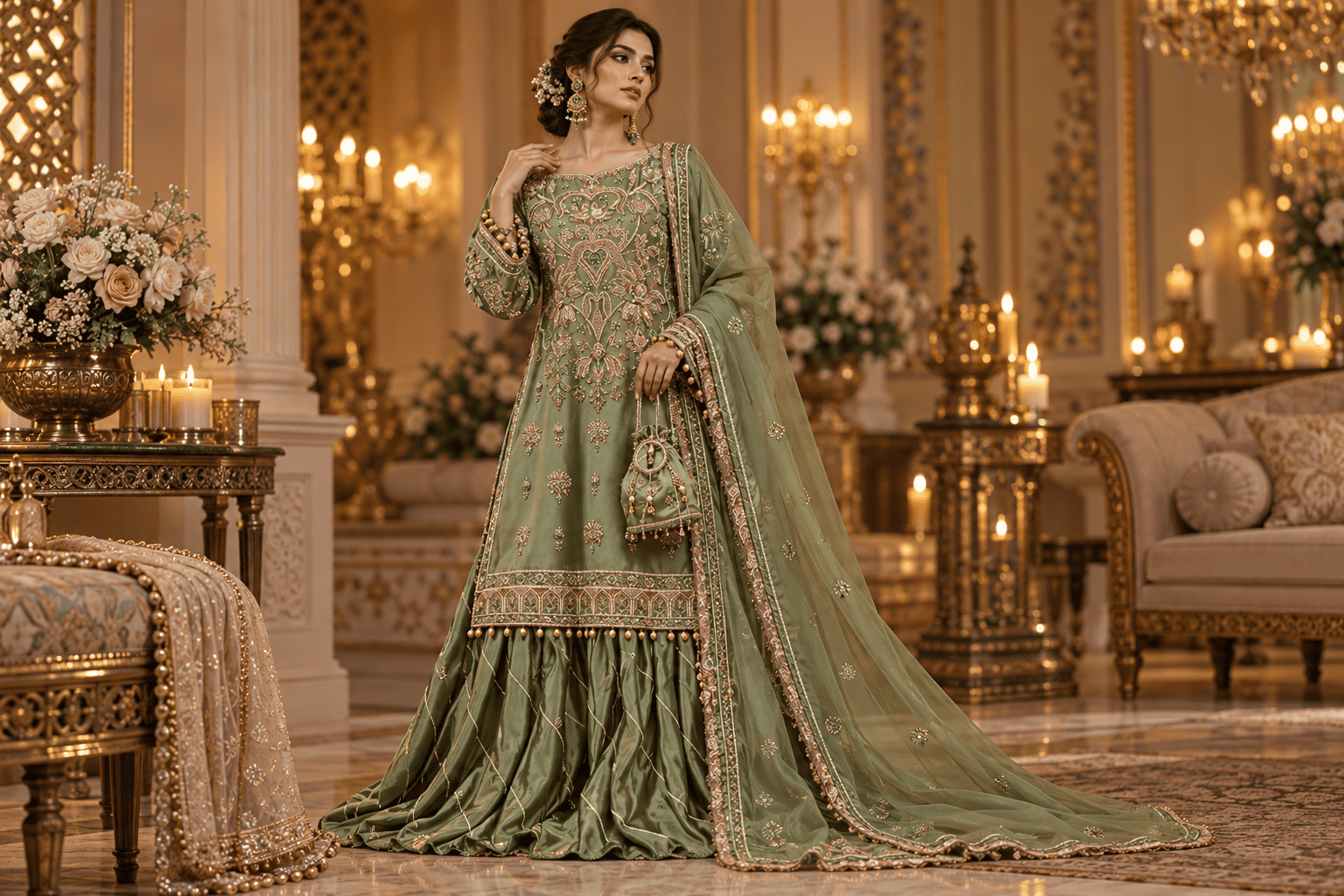
Abdullah Bin Shahbaz creates hand embroidered formal wear for UK wedding guests on a made to order basis, combining traditional artisan techniques with custom sizing and individual design decisions.
Ready Made vs Made to Order Formal Wear: A Quick Comparison
The differences become easier to understand when the two options are compared directly.
| Feature | Ready Made Formal Wear | Made to Order Formal Wear |
|---|---|---|
| Production | Garment already exists before purchase | Garment is produced after the order is confirmed |
| Sizing | Based mainly on standard sizes | Can be developed around personal measurements |
| Customisation | Usually limited | May include colour, sleeves, neckline, dupatta or embroidery changes |
| Embroidery Planning | Already completed | Can be considered alongside the final garment requirements |
| Timeline | Usually faster if the correct size is available | Requires production time |
| Design Flexibility | Guest chooses from existing options | Greater opportunity to personalise an existing design |
| Fitting | Alterations may be required | Fit can be considered before construction |
| Best For | Guests who find the right existing outfit or have a shorter timeline | Guests prioritising fit, craftsmanship and personalisation |
The most important point is that convenience and customisation sit at opposite ends of the comparison.
Ready made garments offer speed and certainty because the finished design already exists. Made to order garments offer flexibility, but they require more planning and patience.
Which Option Gives a Better Formal Wear Fit?
Fit is one of the strongest reasons a guest may prefer made to order formal wear.
A standard size must accommodate a wide range of body proportions. Two guests may both wear the same size on paper yet find that the shoulders, waist or sleeve length sit very differently.
These differences become more noticeable in structured formal wear.
A heavily embroidered bodice needs to sit correctly across the shoulders and waist. Sleeve embroidery should fall at the right point on the arm, and a lehenga or gharara waistband should feel secure without pulling.
Made to order construction allows measurements to influence the garment before it is completed. This can reduce the need for major alterations later, particularly in areas where embroidery has already been placed.
Ready made formal wear can still work beautifully when the guest finds a size that suits her proportions and needs only minor adjustments.
How Hand Embroidery Changes the Decision
The distinction between ready made and made to order becomes particularly important when hand embroidery is involved.
Hand embellished formal wear is developed gradually. Artisans apply motifs, metallic work, beads and thread detailing by hand, and each stage builds on the one before it.
If the garment is being produced around the wearer’s measurements, the designer can consider how the embroidery will sit on the finished outfit.
For example, the neckline embroidery can be positioned according to the final bodice. Borders can be balanced against the wearer’s height. Motifs can be scaled so they flatter rather than overwhelm.
With a ready made heavily embroidered garment, major alterations may be more complicated because changing the construction can disturb the embroidery placement.
This does not make alteration impossible, but it is worth considering before purchase.
How Much Customisation Do You Actually Need?
Not every guest who chooses made to order formal wear needs a completely original design.
In many cases, the guest already loves an existing collection piece and simply wants it adapted more closely to her requirements.
Useful customisation might include a different colour, adjusted sleeve length, an alternative neckline, a softer dupatta or a change in embroidery density.
These adjustments can make a significant difference without replacing the central identity of the garment.
The key is to decide which changes have a genuine purpose.
If you like the silhouette, embroidery and colour of a ready made dress exactly as they are and the fit works, there may be no reason to commission a made to order version.
If you love a design but need changes to its proportions, coverage, colour or overall level of handwork, made to order gives you the chance to shape it before production begins.
Ready Made vs Made to Order for Different Wedding Events
The wedding occasion can also influence which option feels more appropriate.
| Wedding Event | Ready Made May Suit You If | Made to Order May Suit You If |
|---|---|---|
| Nikkah | You find a refined outfit in the right colour and fit | You want a specific neckline, colour or delicate embroidery direction |
| Mehndi | You need an existing colourful outfit with comfortable movement | You want personalised colour combinations or embellishment |
| Dholki | You find a festive ready made look that matches the mood of the evening | You want playful detailing, custom colour or easier movement |
| Walima | You find an elegant finished design that coordinates with your styling | You want a particular pastel, fabric, silhouette or embroidery balance |
These are practical examples rather than strict rules.
A made to order Nikkah guest dress can be heavily embellished, while a Walima guest may deliberately choose a simpler ready made outfit that suits a quieter celebration.
The guest’s own style should remain more important than convention.
When Ready Made Formal Wear Makes Sense
Ready made formal wear can be the right choice when three things already align: the design, fit and timing.
If you discover a completed formal outfit that reflects your personal style, suits the wedding event and fits well, buying it ready made saves the planning that made to order requires.
Ready made can also be useful when the wedding is relatively close and there is insufficient time for production.
Another advantage is certainty. You can usually see exactly how the finished embroidery, fabric and colour work together before committing.
The important step is to inspect the outfit carefully. Look at the handwork, seams, lining, borders and dupatta. Assess how much alteration is required and whether the garment will sit comfortably through a long celebration.
When Made to Order Formal Wear Makes More Sense
Made to order becomes particularly useful when fit and personalisation matter as much as the original design.
A guest may love the embroidery of a collection piece but want another colour. She may require longer sleeves, a different neckline or a dupatta in a softer shade.
These are all situations where planning the garment before production can offer greater flexibility.
Made to order formal wear is also relevant when the guest is investing in extensive hand craftsmanship. If detailed embroidery is going to require significant artisan work, developing the garment around the wearer helps the design sit as intended.
Guests drawn to richer formal handwork can explore the Zarposh collection, while those who prefer a softer design language can explore Naqsh.
Does Made to Order Mean Bespoke?
Made to order and bespoke are sometimes used interchangeably, but they do not necessarily describe the same process.
A made to order garment is generally produced after the order has been placed, often using an existing design as the starting point with selected measurements and customisations applied.
A fully bespoke garment usually involves a more extensive design process in which the outfit is developed from a blank page around the individual.
The exact meaning depends on the designer, so guests should ask what is included rather than relying on the label alone.
If you are selecting an existing formal design but changing the colour, measurements or certain details, you are choosing made to order. Clarity is more important than the label.
Which Option Is Better for Formal Dress Alterations?
Ready made garments may require alterations after purchase, while made to order garments aim to reduce them.
However, neither process guarantees that no final checking will ever be needed.
Formal wear is more complex than everyday clothing. The weight of embroidery, fabric structure, footwear and movement all affect how a garment behaves at a celebration.
The important difference is where the major fitting decisions occur.
With made to order formal wear, measurements become part of the production brief.
With ready made clothing, the garment has already been constructed and must be adjusted around the wearer.
For lightly decorated garments, those changes may be straightforward. For heavily hand embroidered pieces, alterations need to be planned with care.
Does Made to Order Formal Wear Take Longer?
Yes, made to order formal wear generally requires more planning because the garment still needs to be produced after the order is confirmed.
The timeframe depends on the embroidery density, silhouette, fabric, customisation and number of garments in the order.
A heavily worked formal ensemble involving detailed embroidery across a lehenga, bodice and dupatta will naturally involve more artisan hours than a simpler design.
This is why the wedding date should be discussed before the commission is confirmed.
Read also: If you are beginning your formal wear planning, see our guide on how early to order formal wear in the UK to understand how production, embroidery and customisation can affect your timeline.
Please check our Shipping Policy page for current making times before committing to a deadline.
Is Made to Order Formal Wear Always More Expensive?
Not necessarily.
The final cost of formal wear depends on considerably more than whether the garment is ready made or made to order.
Fabric, embroidery technique, embroidery density, silhouette, additional pieces, finishing and customisation all shape the price.
A very heavily embellished ready made couture piece can involve more craftsmanship than a relatively simple made to order design.
This is why guests should avoid comparing formal dresses using a single label.
Instead, compare what is actually included in the garment.
Consider the quality of the fabric, whether the embroidery is worked by hand, how much customisation is included and how the garment is finished.
Read also: Learn more about what affects the hand embroidered formal wear cost before comparing formal wear quotations.
How to Decide Which Option Is Right for You
A useful decision begins with your priorities rather than with terminology.
Ask yourself whether you already know exactly what you want or whether you need flexibility.
If your ideal garment exists in the right size, colour and silhouette, ready made formal wear may prove the simplest route.
If the design is close but not quite right, made to order gives you more opportunity to refine it.
Also think about how important precise fit is to you. Consider whether you want authentic hand embroidery and how the garment needs to feel through a long day of celebrations.
Your wedding date matters too. The most beautiful made to order option is not useful if the production requirements cannot realistically be met before the event.
The strongest decision is the one that balances design, craftsmanship, fit and practical planning.
Questions to Ask Before Buying Ready Made Formal Wear
Before buying a ready made formal dress, inspect the garment rather than judging it from photographs alone.
Ask whether the displayed piece is the exact garment you will receive and whether any alterations have already been made.
Find out which areas can safely be adjusted. If the bodice is heavily embroidered, changing its size significantly may affect the motif placement.
You should also confirm what is included. A photograph may show jewellery, an additional dupatta or styling accessories that are not part of the purchase.
Knowing exactly what you are buying makes comparison easier.
Questions to Ask Before Ordering Made to Order Formal Wear
Made to order formal wear requires a different conversation.
Ask how your measurements will be collected and which customisations are available.
Confirm the fabric, colour, neckline, sleeves, dupatta and embroidery level before production begins.
Discuss your wedding date at the beginning rather than at the end.
You should also understand which garment pieces are included in the commission and whether any requested changes would affect the quotation.
A clear design brief creates a smoother process and gives the designer a better understanding of what you want to wear.
Why the Designer’s Craftsmanship Matters in Either Option
Whether you choose ready made or made to order formal wear, craftsmanship remains important.
The garment should be evaluated through its fabric, embroidery, finishing and overall construction.
Look at how borders align, how the neckline has been finished and whether the sleeve embroidery feels balanced on both sides.
Examine the dupatta closely. These areas often reveal the level of attention given to the garment more clearly than the main front panel.
Luxury formal wear should remain convincing when viewed from close range.
You can explore the collections at Abdullah Bin Shahbaz to see how hand embellishment and design philosophy come together across different formal styles.
FAQs About Ready Made vs Made to Order Formal Wear
What is the main difference between ready made and made to order formal wear?
Ready made formal wear is produced before purchase and normally follows standard sizing, while made to order formal wear is created after the order is confirmed, often around personal measurements.
Is made to order formal wear better than ready made?
Neither option is automatically better. Ready made suits guests who find a design and size that already work, while made to order suits guests who want a closer fit, specific customisation or detailed hand embroidery.
Can a ready made formal dress be altered?
Many ready made garments can be altered, but the amount of adjustment depends on the construction and embroidery. Heavily hand embroidered areas may limit what can be changed safely.
Can I change the colour of a made to order formal dress?
Colour customisation may be available depending on the designer and the garment. Any change should be confirmed before production begins.
Does made to order formal wear take longer?
Made to order formal wear requires production time because the garment is created after the order is confirmed. Please check our Shipping Policy page for current making times and plan around your wedding date.
Is made to order the same as bespoke formal wear?
Not always. Made to order often begins with an existing design that is produced according to selected measurements and customisations, while bespoke usually involves a more extensive individual design process.
Which option is better for heavily embroidered formal dresses?
Made to order can be particularly useful for heavily embroidered garments, because measurements and customisation can be considered before the embroidery work is completed.
Conclusion
The choice between ready made and made to order formal wear is ultimately a choice between selecting an existing garment and commissioning one that is shaped around you.
Ready made formal wear offers convenience, a visible finished result and a shorter purchasing process.
Made to order formal wear offers greater flexibility around measurements, colour, embroidery and other design details.
For UK guests attending a Nikkah, Mehndi, Dholki or Walima, neither option should be chosen simply because it sounds more prestigious.
At Abdullah Bin Shahbaz, formal pieces are created on a made to order basis using custom sizing, premium fabrics and traditional hand embroidery. Explore the Zarposh and Naqsh collections and speak with the team about your preferred design, measurements and wedding event before commissioning your guest look.