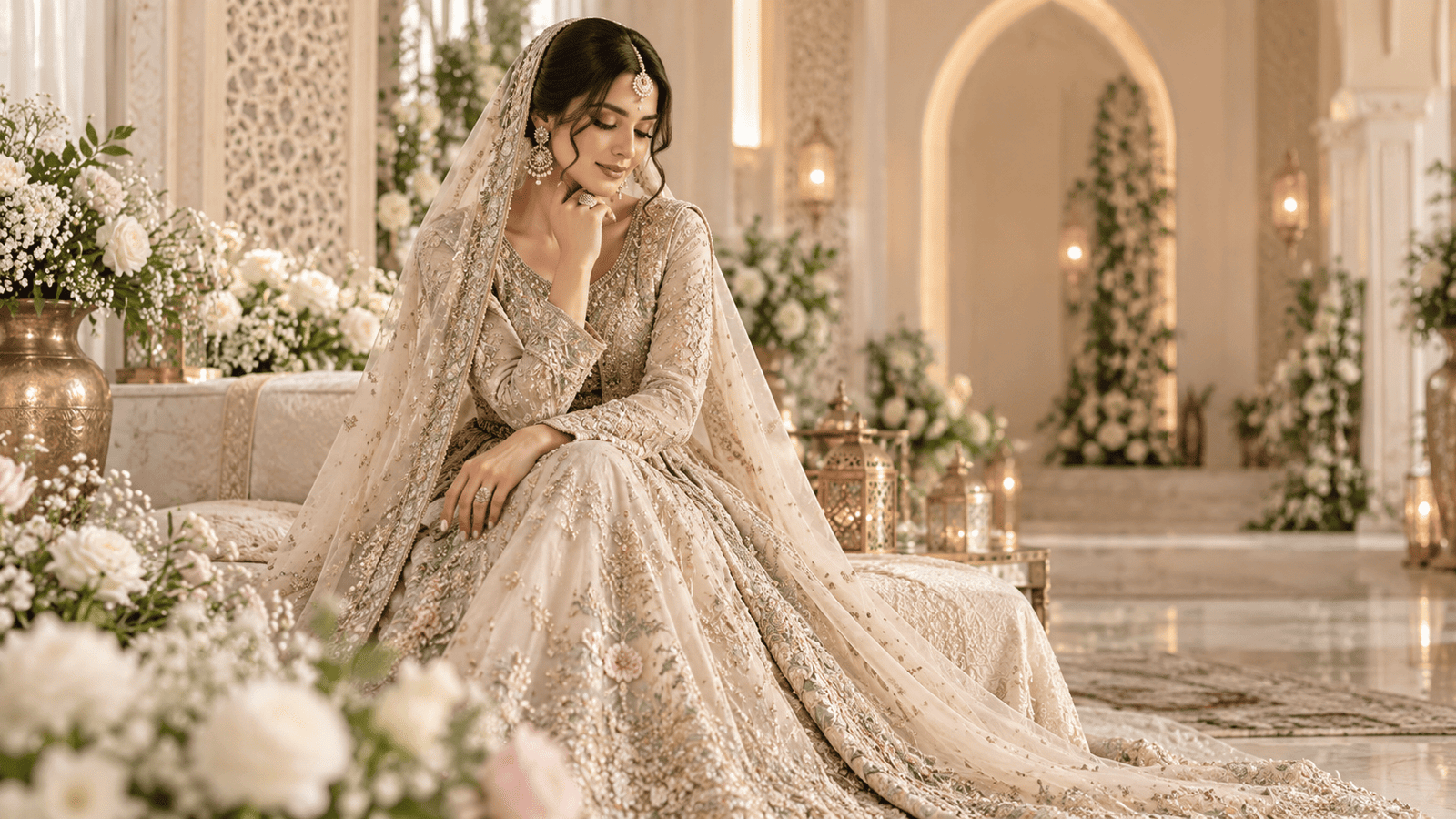
This Nikkah dress guide is designed for brides who want their outfit to feel unmistakably bridal without choosing a dress simply because it appears traditional, heavily embellished or fashionable online.
A Nikkah has its own atmosphere. It may be intimate or formal, held during the day or in the evening, and celebrated in a mosque, private setting or wedding venue. The right outfit needs to work within that setting while still feeling special enough for one of the most meaningful moments of the wedding.
For many UK brides, that means thinking carefully about coverage, fabric, colour, embroidery, silhouette and dupatta styling rather than beginning with one fixed idea of what a Nikkah bride is supposed to wear.
Ivory and pastels can look beautiful, but they are not the only options. A lehenga can work, but so can a gharara, sharara, pishwas or refined long shirt. Delicate embroidery can feel bridal, while richer handwork can also be appropriate when it reflects the scale and style of the ceremony.
The aim is not to follow a formula.
It is to choose a bridal outfit where the dress, bride and occasion feel naturally connected.
If you are beginning your search, explore Abdullah Bin Shahbaz’s hand embroidered bridal wear for UK brides before narrowing your preferred Nikkah direction.
Nikkah Dress Guide UK Brides Can Use Before Choosing a Design
Before choosing a Nikkah dress, decide what the garment needs to do.
Ask yourself where the ceremony will take place, how formal the celebration will be, how much time you expect to spend seated and whether you want your Nikkah outfit to feel noticeably different from the rest of your wedding wardrobe.
This immediately gives you a more useful starting point than colour alone.
A bride having an intimate daytime ceremony may prefer a softer silhouette and lighter handwork. Someone planning a larger formal Nikkah may want more structure, richer embroidery or a statement dupatta.
Neither is more correct.
The right Nikkah outfit is the one that suits the actual celebration you are planning.
That also means separating inspiration from requirements. Save photographs you genuinely like, but look at why you like them.
Is it the colour?
The neckline?
The embroidery?
The way the dupatta frames the face?
The silhouette?
Once you know the answer, you can make a much stronger design decision.
What Should a Nikkah Bride Wear in the UK?
There is no single garment that every bride should wear for her Nikkah.
A good bridal choice normally balances elegance, preferred coverage, comfort and enough detail to distinguish the outfit from ordinary formalwear.
Long shirts with ghararas or shararas can create a refined traditional look. Pishwas and flowing dresses introduce more movement. Lehenga-based outfits can provide greater bridal presence when that suits the scale of the ceremony.
The level of embellishment can also vary considerably.
Some brides want quiet threadwork and carefully positioned metallic details. Others want a visibly luxurious hand embroidered dress while still keeping the overall colour palette restrained.
The dress should ultimately feel like your bridal outfit rather than someone else’s idea of what a Nikkah should look like.
If you are ready to move from inspiration into actual designs, you can also browse bridal Nikkah dresses already published on Abdullah Bin Shahbaz.
Start With the Ceremony Setting
The setting can change which design decisions make the most sense.
If the ceremony will take place in a mosque and you personally prefer greater coverage in that setting, consider sleeve length, neckline, overall length and how securely the dupatta can be positioned over the head.
A private home ceremony may create a different atmosphere.
A formal venue may allow the outfit to carry more visual scale because the room itself is larger and the bride will often be photographed from greater distances as well as close range.
This is one area where many online inspiration photographs can be misleading.
An outfit photographed dramatically in a studio may not necessarily be the most practical choice for the setting in which you will actually wear it.
Think about the real ceremony.
Imagine sitting, standing, walking, signing documents, greeting family and taking photographs.
Your Nikkah dress needs to work through all of those moments.
Choosing the Right Nikkah Dress Silhouette
Silhouette changes the entire personality of the outfit.
A gharara can create a distinctly traditional bridal identity while remaining relatively easy to move in when proportioned correctly.
A sharara offers a softer flowing shape through the lower half.
A pishwas provides movement and graceful volume, particularly when the fabric has enough drape.
A lehenga can make the look more visibly bridal, especially when combined with a detailed blouse or long shirt and an embroidered dupatta.
A straight or slightly flared long shirt can feel more restrained and elegant.
Do not choose a silhouette because it happens to dominate your social feed.
Think about your height, proportions, preferred coverage and how formal you want the complete outfit to appear.
A made to order dress gives you more freedom to refine these proportions before the garment is completed.
If fit is an important concern, read our guide to getting the right fit for a made to order bridal dress.
Should a Nikkah Dress Be Ivory or White?
It can be, but it does not have to be.
Ivory, off-white, champagne and soft gold have become popular Nikkah choices because they create an elegant base for embroidery and jewellery.
They also photograph beautifully when fabric texture and handwork are strong enough to prevent the outfit from appearing flat.
But a Nikkah bride is not restricted to neutrals.
Sage green, powder blue, blush, dusty rose and muted gold can all create a refined bridal look.
Deeper colours can work too.
What matters is how the colour interacts with the embroidery, fabric, venue and bride.
If you are still deciding between ivory, pastel and stronger shades, our bridal dress colours guide explains how colour changes across Nikkah, Mehndi, Baraat and Walima styling.
How to Make an Ivory Nikkah Dress Look Bridal
An ivory dress can easily move between formalwear and bridalwear depending on how it is designed.
The distinction often comes from craftsmanship and composition rather than colour.
Hand embroidery around the neckline can immediately strengthen the bridal character. Detailed sleeves become particularly visible during close photographs. A carefully finished dupatta border frames the face and adds ceremony to the complete look.
The fabric matters as well.
Ivory tissue produces a different effect from ivory organza or silk.
One may catch more light, another may feel softer, while another provides greater structure.
For a live example of how an ivory fabric can be paired with measured proportions and hand-applied metallic detailing, explore Zarveen. Abdullah Bin Shahbaz
The goal should not be to make every centimetre of an ivory outfit heavy.
Well-placed detail can often create more bridal presence than indiscriminate embellishment.
Choosing Fabric for a Nikkah Dress
Fabric decides how the dress behaves before embroidery is even added.
Silk can create richness and structure.
Organza brings lightness and works particularly well for dupattas, overlays and softer silhouettes.
Tissue introduces a luminous quality that can make pale colours feel more formal.
The right choice depends on the silhouette and amount of embroidery.
If you want substantial metallic handwork, the fabric must support it.
If you want a softer Nikkah outfit with fine motifs and movement, a different material strategy may be more appropriate.
Season matters too.
A UK summer ceremony can feel very different from an autumn or winter wedding, particularly when several fabric layers and a head dupatta are involved.
For a more detailed comparison, use our guide to choosing bridal fabrics for a UK wedding.
How Much Embroidery Should a Nikkah Dress Have?
Enough to make the outfit feel special, but not simply as much as possible.
That distinction matters.
A bridal dress with smaller motifs, fine resham, selective zardozi and a carefully embroidered dupatta can feel extremely luxurious without becoming visually heavy.
Another bride may prefer stronger metallic work because she wants the Nikkah to be her main bridal event.
Both approaches can work.
Think about where you want the eye to go.
The neckline and upper bodice are especially important because they appear repeatedly in seated portraits and close photographs.
Sleeves deserve attention for the same reason.
Borders can create definition lower down the garment, while the dupatta can carry enough embroidery to complete the bridal frame around the face.
The question should therefore be where should the embroidery be strongest?, not simply how much embroidery should I add?
Zardozi, Dabka or Resham for a Nikkah Outfit?
Each creates a different mood.
Zardozi brings metallic richness and dimension.
Dabka can introduce stronger raised detail.
Resham gives the designer greater freedom with coloured thread and softer motifs.
Mukesh can create small points of reflected light across a fabric, while cutdana adds more defined sparkle within individual embroidered areas.
They do not need to compete.
Some of the most interesting bridal surfaces combine several techniques in different proportions.
For example, resham may establish the floral motif while metallic detailing defines its structure and reflective elements provide controlled highlights.
If you want to understand what you are seeing before discussing your dress with a designer, read our guide to Pakistani bridal embroidery techniques.
A Nikkah Dress Does Not Need to Be a Lighter Baraat Dress
This is an important distinction.
Reducing the embroidery on a Baraat-style outfit does not automatically turn it into a well-designed Nikkah dress.
The ceremony can have a different design language entirely.
A Nikkah outfit may use another silhouette.
It may have more refined proportions, a different dupatta treatment or a softer relationship between fabric and embroidery.
It may also place greater emphasis on the neckline, sleeves and close-range detailing because those elements are particularly visible during an intimate ceremony.
Treating the Nikkah as its own bridal event usually produces a more considered result than simply creating a reduced version of another wedding outfit.
Think About How Long You Will Be Seated
Bridalwear is often evaluated while the model is standing.
A Nikkah ceremony may involve considerable time seated.
That changes what comfort means.
The waist should remain comfortable when sitting. The bodice should not become restrictive. Sleeves need enough ease for natural arm movement.
The dupatta should also stay manageable.
If the lower garment is extremely voluminous or the embroidery is concentrated in uncomfortable areas, a dress that felt beautiful for five minutes in front of a mirror can become frustrating over several hours.
This does not mean choosing less elaborate bridalwear.
It means making sure its construction supports how you will actually use it.
Decide How You Want to Wear the Dupatta
The dupatta can change the complete Nikkah look.
If you intend to wear it over the head, tell the designer before the garment is finalised.
Fabric weight becomes important.
So does border density.
A beautiful but extremely heavy border can become difficult to secure comfortably for a long period.
The placement of embroidery near the face also matters because it will appear prominently in photographs.
Some brides prefer one detailed dupatta.
Others want a second lighter piece for layering.
If you are considering two, each should have a clear purpose. They should add dimension rather than simply adding weight.
Jewellery and Neckline Need to Work Together
A Nikkah outfit can lose balance when jewellery and neckline are chosen completely independently.
If you already have a significant necklace or family heirloom you intend to wear, consider it before finalising the neckline.
A richly worked high neckline may not need the same jewellery treatment as an open neckline.
Likewise, a dress with antique metallic embroidery may naturally work with a different jewellery finish from cool silver handwork.
The outfit does not need to be designed around jewellery entirely.
The two simply need to acknowledge one another.
This is particularly valuable when the Nikkah look is intentionally refined, because one oversized element can quickly change the overall balance.
Daytime Nikkah vs Evening Nikkah
Lighting changes bridalwear.
Natural daylight makes fabric texture, threadwork and softer colours especially visible.
Ivory, sage, champagne, powder blue and other restrained shades can therefore look very detailed during a daytime ceremony even when the embroidery is not extremely dense.
Evening lighting gives metallic handwork and reflective embellishment more opportunity to catch the light.
That may allow deeper tones or stronger zardozi and cutdana details to become more dramatic.
Neither time of day requires a particular palette.
It simply changes how the materials perform.
Whenever possible, assess your colour and fabric in lighting that resembles the conditions of the actual ceremony.
Consider the Nikkah Alongside Your Other Wedding Outfits
Your Nikkah dress does not exist in isolation when you are planning several wedding events.
If your Baraat outfit will be heavily embroidered in red or maroon, a lighter Nikkah palette can create a beautiful contrast.
If your Walima will already be ivory or silver, you may want the Nikkah to take a different direction.
The same applies to silhouette.
Wearing four similar long dresses in slightly different colours can make a bridal wardrobe feel repetitive even when each individual garment is beautiful.
Try to create visual progression across the wedding.
Change the silhouette.
Change the embroidery density.
Change the fabric mood.
The outfits can still feel connected through craftsmanship or recurring details without appearing like variations of the same dress.
Made to Order vs Ready Made for a Nikkah Dress
The best option depends on what you need.
If you find a ready made Nikkah outfit in the correct size, colour and silhouette, there may be no reason to complicate the process.
Made to order becomes particularly valuable when the design is close to what you want but requires adjustments.
You may need a different sleeve length.
You may prefer another neckline.
The colour might need changing.
You may want the embroidery lighter or richer.
Your measurements may also sit between standard sizes.
In these situations, producing the garment around agreed requirements can create a more coherent result than relying on extensive alterations afterward.
Read our comparison of ready made vs made to order bridal wear in the UK before deciding which process suits your wedding.
What Should You Customise on a Nikkah Dress?
Customisation is most useful when it solves a genuine design or fit requirement.
It should not be treated as a challenge to change as many parts of the original dress as possible.
The most useful changes commonly involve colour, measurements, neckline, sleeve length, dupatta treatment or embroidery density.
Before requesting a modification, ask why you want it.
Does it improve coverage?
Does it make the outfit more appropriate to your ceremony?
Does it help the silhouette suit you better?
Does it create meaningful distinction from your other wedding outfits?
When the answer is clear, customisation tends to improve the garment.
When every detail is changed independently, the original design can lose its balance.
Consider Naqsh for a Softer Nikkah Direction
Brides who prefer smaller motifs, softer colours and less visually dominant embellishment may naturally respond to the Naqsh collection.
Naqsh uses a quieter visual language than the heavier metallic expression found elsewhere in the brand’s collections, with pastel tones, fine threadwork and more delicate surface detail. Abdullah Bin Shahbaz
That kind of design direction can work particularly well when the bride wants the Nikkah outfit to feel luxurious at close range without depending entirely on dense embroidery for impact.
If your Nikkah is intended to be your main statement bridal event, you can equally explore stronger handwork and more formal silhouettes through the wider bridal collection.
The important point is choosing the level of visual presence deliberately.
When Should You Finalise Your Nikkah Dress?
Do not leave the wedding date until the end of the design conversation.
Made to order bridalwear requires time for measurements, fabric, embroidery, construction and finishing.
The exact production period depends on the garment.
A relatively restrained-looking outfit can still contain intricate handwork.
Likewise, significant colour or neckline customisation may affect more than one part of the production process.
The safest approach is to discuss the ceremony date before committing to a design.
If you have already shortlisted a garment, use our bridal wear consultation guide to prepare the questions worth asking before confirming your order.
A Simple Nikkah Dress Checklist Before You Order
Before confirming the design, make sure you have thought about:
- ceremony setting and time of day
- preferred silhouette and level of coverage
- base colour and embroidery colour
- fabric and season
- hand embroidery density
- neckline and sleeve preferences
- measurements and heel height
- dupatta style
- jewellery you definitely plan to wear
- how the outfit differs from your Baraat, Mehndi or Walima look
- wedding date and production requirements
If most of those decisions are clear, the consultation becomes far more productive.
Choose a Nikkah Dress That Still Looks Special Up Close
Nikkah photography often contains a large number of close moments.
Hands signing documents.
Jewellery portraits.
Dupatta details.
Family photographs.
Seated portraits where the upper half of the garment dominates the frame.
This makes workmanship particularly important.
Look closely at cuffs, neckline motifs, finishing and dupatta borders.
A dress that depends entirely on distant impact can lose much of its character in intimate photographs.
Hand embroidery works especially well here because the surface reveals more detail as the camera comes closer.
The quality of the work becomes part of the photograph rather than disappearing within it.
FAQs About Choosing a Nikkah Dress
What should a Nikkah bride wear in the UK?
A Nikkah bride can wear a lehenga, gharara, sharara, pishwas, long shirt or another formal South Asian silhouette. The most suitable choice depends on the ceremony setting, preferred coverage, personal style, fabric, embroidery and level of formality.
What colour should a Nikkah dress be?
There is no required Nikkah colour. Ivory, champagne, blush, sage, powder blue and soft gold are popular options, but deeper or brighter shades can also work beautifully when they suit the bride and ceremony.
Should a Nikkah dress be simple?
Not necessarily. A Nikkah dress can be lightly embellished or richly hand embroidered. The important consideration is whether the embroidery, fabric and silhouette feel balanced for the bride and the event.
Which fabric is best for a Nikkah outfit?
Silk, organza and tissue can all work well depending on the design. Silk offers richness and structure, organza is useful for light layers and dupattas, while tissue can introduce a more luminous formal finish.
Is a lehenga suitable for a Nikkah?
Yes. A lehenga can work beautifully for a Nikkah when its proportions, embroidery and styling suit the ceremony. Brides who prefer another direction can also consider ghararas, shararas, pishwas and long formal ensembles.
How much embroidery should a Nikkah dress have?
There is no fixed amount. Selective zardozi, resham, dabka, mukesh or cutdana can create strong bridal presence without covering the complete garment. Brides holding a larger or more formal Nikkah may also prefer richer handwork.
Can I customise my Nikkah dress?
Made to order bridalwear may allow adjustments to measurements, colour, neckline, sleeves, dupatta and embroidery depending on the design. Discuss all important changes before production begins.
Should I buy my Nikkah dress ready made or made to order?
Ready made can work well when you find the right design and fit immediately. Made to order is more useful when you need custom sizing, colour changes or other design adjustments.
Conclusion
A good Nikkah dress is not defined by one colour, silhouette or amount of embroidery.
It is defined by how naturally all of those decisions work together.
Begin with the ceremony itself. Then choose the silhouette, fabric and level of coverage that make sense for you. Decide where the handwork should have the greatest impact, how the dupatta needs to behave and how the outfit should differ from the rest of your bridal wardrobe.
Most importantly, choose craftsmanship that still feels special when viewed closely.
At Abdullah Bin Shahbaz, made to order bridalwear combines custom sizing, premium fabrics and traditional hand embellishment for brides who want their wedding outfit to feel considered rather than mass produced. Explore the UK bridal couture collection or contact the team to discuss your Nikkah date, preferred silhouette, colour and customisation requirements.