A Mehndi outfit should look beautiful when you enter the venue, but it should still feel comfortable when the music starts, the photographs continue and you have been wearing it for several hours.
That balance is what makes choosing a Mehndi bridal outfit different from choosing a Baraat dress.
A Mehndi naturally gives brides more freedom with colour, movement and styling. Yellow and green remain closely associated with the celebration, but modern brides are equally comfortable exploring mustard, emerald, orange, coral, pink, jewel tones and softer contemporary palettes.
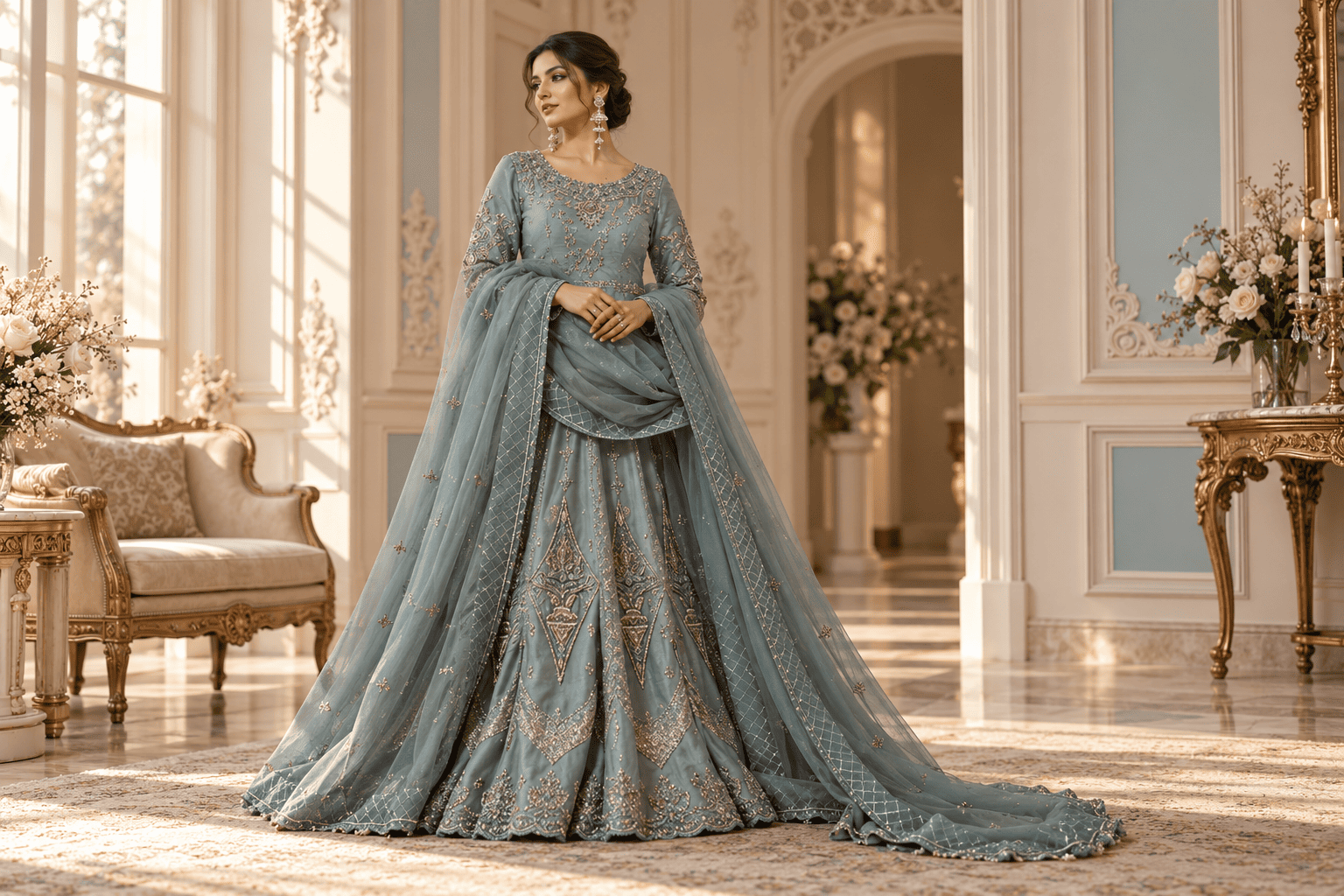
Silhouette matters just as much. A sharara can create movement without excessive volume. A lehenga gives the bride a stronger traditional presence. A pishwas or flowing frock can move beautifully during dancing, while a long shirt with culottes can offer a more contemporary interpretation.
This Mehndi outfit guide is designed for UK brides who want more than a list of trends. It explains how colour, fabric, hand embroidery, silhouette, venue and comfort should work together before you commission the dress.
For brides already exploring couture options, Abdullah Bin Shahbaz’s hand embroidered bridal wear in the UK includes made to order pieces that can be considered across Mehndi, Nikkah, Baraat and Walima celebrations.
What Should a Bride Wear for Her Mehndi?
A bride’s Mehndi outfit should feel festive, recognisably bridal and easy enough to wear through an energetic celebration.
That does not require one specific silhouette.
Lehengas remain popular because they create movement and a strong bridal shape. Shararas and ghararas bring a different South Asian identity while often providing greater freedom through the legs. A flowing pishwas can create volume without feeling overly rigid, while longer shirts paired with wide trousers or culottes can offer a cleaner contemporary look.
The key difference from Baraat dressing is often the mood.
A Mehndi tends to reward colour and movement more than ceremonial weight.
That means a bride can create considerable impact through embroidery placement, colour contrast, silhouette and dupatta styling without covering every part of the garment in dense embellishment.
Your dress should look impressive while you are standing for formal photographs, but it should also work when you sit, walk and dance.
Choosing the Best Mehndi Outfit Colours
Colour is usually the first thing people associate with Mehndi dressing.
Yellow remains a classic choice because it instantly communicates the celebratory mood of the event. Green is equally natural, particularly in shades ranging from bright lime through sage and deep emerald.
But those are starting points rather than rules.
Mustard can feel warmer and more luxurious than bright yellow. Emerald creates a richer evening look. Orange, coral and fuchsia can introduce energy, while multi-coloured resham embroidery can transform a relatively simple base fabric.
Pastels can also work when the bride wants a softer contemporary direction.
The question should not be, “Which colour is traditionally correct?”
Ask instead:
Which colour gives this particular Mehndi the feeling I want?
Your venue, décor, lighting and jewellery can all change the answer.
If you are comparing your colour story across several wedding functions, use our bridal dress colours guide before finalising your Mehndi palette.
Is Yellow Still the Best Colour for a Mehndi Bride?
Yellow remains one of the most recognisable Mehndi colours, but “yellow” itself covers a much wider range than one bright shade.
Lemon yellow can feel fresh and youthful.
Mustard introduces greater richness.
Golden yellow can work beautifully with metallic embroidery, while a softer pastel yellow can suit a daytime event.
The fabric also changes the result.
Yellow silk has more visual depth than sheer yellow organza. A mustard Korean silk outfit can support richer handwork, while a lighter fabric may give the same colour family more movement.
A useful real-world example is Zarnish, a mustard sharara ensemble worked by hand with sequins, crystals, dabka and cutdana. Its long shirt, sharara and tissue dupatta show how a traditional Mehndi colour can be interpreted through a more polished couture language.
The lesson is not that every Mehndi bride should wear mustard.
It is that colour becomes far more interesting when fabric, silhouette and handwork are considered with it.
Green Mehndi Dresses Can Feel Traditional or Contemporary
Green works particularly well because it can move between very different moods.
Bright green feels playful.
Olive appears more understated.
Deep emerald can look formal enough for an evening venue while still feeling completely appropriate for Mehndi dressing.
This makes green useful for brides who want the cultural association of the colour without creating an outfit that feels predictable.
Metallic embroidery changes it further.
Gold and antique metallic work can make emerald feel richer, while coloured resham can keep the outfit brighter and more festive.
For a more contemporary expression, Zumara combines rich emerald Korean silk with a halter-neck long shirt, flowing culottes and a mukesh-worked dupatta. The handwork includes cutdana, dabka, beads, stones, sequins and resham, demonstrating how green can move beyond the expected lehenga format.
Should a Mehndi Bride Wear a Lehenga?
A lehenga remains an excellent Mehndi silhouette when it suits the bride and the event.
Its greatest advantage is movement.
A well-proportioned skirt can create beautiful motion during photographs and dancing without requiring an extremely complicated upper garment.
The amount of flare matters.
More volume gives stronger visual movement, but it can also increase fabric weight and make crowded spaces more difficult to navigate.
Embroidery placement should therefore be considered carefully.
A bride may choose detailed borders and scattered motifs rather than dense work across every panel.
The blouse or shirt can then carry stronger embroidery near the neckline and sleeves, areas that are particularly visible during close photographs.
This keeps the complete look bridal without making the skirt unnecessarily heavy.
When a Sharara Works Better Than a Lehenga
A sharara can be especially practical when a bride wants movement but prefers trousers to a full skirt.
Because each leg moves independently, the silhouette can feel easier during dancing and walking.
A sharara also creates a distinctly South Asian bridal identity.
The flare can begin higher or lower depending on the design, which means the proportions can be adjusted around the bride and the length of the shirt.
This gives the designer considerable freedom.
A shorter shirt creates one balance.
A longer embroidered shirt creates another.
Zarnish demonstrates how this shape can be elevated through detailed handwork without losing the movement that makes the sharara particularly suitable for a Mehndi celebration.
Gharara, Pishwas or Long Shirt: Which Mehndi Silhouette Should You Choose?
Each silhouette creates a different personality.
A gharara brings traditional structure through the knee and dramatic flare below it.
A pishwas produces softer circular movement and can look especially beautiful when the bride wants a flowing, romantic appearance.
A long shirt creates a cleaner vertical line and can be paired with shararas, trousers or culottes depending on how contemporary the final look should feel.
Do not select the silhouette only because it appears repeatedly on social media.
Consider your height, comfort preferences and venue.
Also consider your other wedding outfits.
If your Baraat dress will already be a heavily embroidered lehenga, choosing a sharara or pishwas for Mehndi immediately creates more visual variety across the wedding.
Comfort Is Part of a Good Mehndi Outfit
Comfort should not be treated as something separate from luxury.
A bride constantly lifting her skirt, adjusting sleeves or repositioning an excessively heavy dupatta cannot enjoy the outfit in the way it was intended.
The fabric, embroidery and construction should anticipate movement.
Sleeves need enough ease for dancing.
The waist should remain comfortable while sitting.
The lower garment should allow natural steps.
The dupatta should feel secure enough that you are not fixing it between every photograph.
None of this requires making the dress simple.
It requires designing the detail intelligently.
A couture outfit that allows the bride to move confidently often looks better because the bride is actually comfortable wearing it.
How Heavy Should Mehndi Embroidery Be?
There is no correct weight of embroidery.
The right amount depends on the silhouette, fabric and how formal the event will be.
A large evening Mehndi in a formal UK wedding venue may support considerably richer handwork than an intimate daytime gathering.
Even then, placement matters more than simply adding coverage.
The bodice can carry detailed work while the lower garment remains more open.
Sleeves and cuffs can be embellished for close photography.
A border can give the outfit definition without covering the complete fabric.
The dupatta can carry mukesh or scattered motifs rather than dense embroidery from edge to edge.
This creates visual richness while preserving movement.
Hand Embroidery Can Make a Lighter Mehndi Outfit Feel Luxurious
A dress does not need to be physically heavy to look luxurious.
This is where genuine hand embroidery becomes particularly useful.
Zardozi can introduce small areas of metallic depth.
Dabka can define selected motifs.
Resham adds colour and softer thread detail.
Mukesh can scatter reflected light across a dupatta, while cutdana can add stronger points of brilliance around a neckline or border.
Several techniques can be combined without making every part of the outfit dense.
The quality of placement matters more.
If you want to understand these techniques before deciding how your Mehndi outfit should be worked, read our guide to Pakistani bridal embroidery techniques.
Mehndi Fabric Should Support Movement
Fabric becomes particularly important for an event where the bride expects to move.
Organza can create volume while remaining visually light.
Silk provides greater body and richness.
Tissue introduces luminosity and can work beautifully in borders, dupattas and more formal pieces.
The designer may use different fabrics across one outfit rather than forcing every piece to use the same material.
A structured shirt may require something different from a dupatta.
Likewise, a very full skirt needs another consideration from a pair of flowing culottes.
If you are uncertain about how these materials behave, our guide to choosing bridal fabrics for a UK wedding explains the differences in greater detail.
Choosing a Mehndi Outfit for a UK Summer Wedding
Summer weddings make weight and layering especially important.
The weather outside may be mild or warm, but crowded indoor venues, professional lighting and hours of movement can still make a heavily layered outfit uncomfortable.
This is where lighter dupattas and controlled embroidery become useful.
A dress can remain visually rich through colour and detailed handwork without depending on several heavy layers.
Sleeves deserve particular attention too.
Full sleeves can still work beautifully during summer when the fabric and construction are appropriate.
The objective is not necessarily less coverage.
It is better fabric and better weight distribution.
Choosing a Mehndi Outfit for Autumn or Winter
Colder seasons give brides more freedom to introduce richer fabrics and stronger layering.
Deep emerald, mustard, burnt orange, plum and jewel tones naturally suit this atmosphere.
Metallic handwork also looks particularly striking under warm indoor lighting.
However, do not design the outfit only around outdoor temperature.
Most UK Mehndi celebrations spend the majority of time inside a heated venue.
A dress designed as though you will remain outdoors for several hours can quickly become uncomfortable once dancing starts.
Choose the season visually, but design the garment for the real conditions in which it will be worn.
Your Mehndi Dupatta Should Not Fight the Outfit
A heavily decorated dupatta can look extraordinary while the bride is standing still.
It becomes less appealing when she has to keep adjusting it throughout the night.
For Mehndi, think carefully about how you actually want the dupatta to behave.
A lighter organza or similarly manageable fabric can carry an embroidered border, mukesh or smaller scattered motifs while remaining easy to drape.
If the main outfit is already richly worked, the dupatta may not need equal density everywhere.
Contrast often makes the complete design stronger.
A detailed border surrounding a lighter centre can frame the bride without adding unnecessary weight.
Floral Jewellery or Traditional Jewellery?
Both can work.
Floral jewellery naturally suits the playful identity associated with Mehndi and can create beautiful contrast against yellow, green and other vibrant colours.
Traditional jewellery can make the event feel more formal.
The choice depends on the outfit itself.
A very detailed neckline may require less jewellery around the neck.
A simpler upper garment may leave more visual space for a statement necklace.
Likewise, floral accessories around the wrists should be considered alongside embroidered cuffs.
The aim is to prevent beautiful individual details from competing when they appear together.
Think About Your Henna When Choosing the Sleeves
This is one of the more practical details that can easily be overlooked.
If your henna extends significantly up the arms, very narrow or rigid sleeves may become inconvenient.
Likewise, heavily embellished cuffs can compete visually with intricate hand and wrist designs during close photographs.
You do not need to expose your arms to show the henna.
The point is to think about how the sleeves, cuffs, jewellery and henna will share the same visual space.
A well-proportioned sleeve can frame the henna beautifully instead of making that area feel crowded.
How the Mehndi Outfit Should Differ From Your Nikkah Look
The two events benefit from having distinct identities.
If your Nikkah dress is ivory, pastel or deliberately restrained, Mehndi gives you an opportunity to introduce stronger colour and movement.
Silhouette can provide another contrast.
A pishwas or sharara at Mehndi can feel very different from a Nikkah lehenga or straight formal ensemble.
Embroidery can change too.
The Nikkah may rely on delicate metallic work while the Mehndi introduces colourful resham and brighter reflective detailing.
If you have not yet finalised the first event, our Nikkah dress guide for UK brides can help you plan the two outfits as part of the same wedding wardrobe rather than making isolated decisions.
Do Not Turn the Mehndi Into a Smaller Baraat
The Mehndi deserves its own design identity.
Simply taking a Baraat-style outfit and reducing the embroidery does not necessarily create the strongest result.
A Baraat dress is often built around ceremony, grandeur and formal bridal presence.
The Mehndi needs more energy.
Colour can be stronger.
Silhouettes can move more freely.
Embroidery can become more playful.
A bride may also want greater contrast between the two sets of photographs.
Treating each event independently while keeping an overall bridal story creates a more interesting wedding wardrobe.
Made to Order Mehndi Wear Gives You More Control
Ready made bridalwear can work perfectly when the existing dress already suits your measurements and preferences.
Made to order becomes more useful when several details need adjusting.
Maybe the colour is right but you want different sleeves.
Perhaps you love the embroidery but need another neckline.
You may want the same design with lighter handwork because you expect to dance throughout the evening.
Custom sizing can also help when standard sizes do not correspond well with your proportions.
The difference is that these decisions can be considered before the garment is completed rather than relying entirely on later alterations.
Read our guide to ready made vs made to order bridal wear in the UK before deciding which approach is right for you.
Publishing note: if that permalink differs from your live article, replace it with your published ready-made vs made-to-order URL before publishing this post.
Explore Zarposh for Stronger Mehndi Handwork
Brides who want richer metallic detailing and a stronger couture presence can explore the Zarposh collection.
The collection combines Korean silk, organza and tissue with genuine hand techniques including zardozi, dabka, mukesh and other individual embellishment. Abdullah Bin Shahbaz specifically positions Zarposh across occasions including Mehndi while designing its silhouettes for movement through long celebrations. Abdullah Bin Shahbaz
Within the collection, Zarnish and Zumara offer two useful but very different Mehndi directions.
Zarnish uses mustard, sharara proportions and rich handwork.
Zumara uses emerald, a longer shirt and flowing culottes.
Neither needs to be treated as a fixed “Mehndi uniform”.
They simply demonstrate how colour and silhouette can create completely different bridal personalities while still belonging to the same couture language.
Consider Naqsh for a Softer Mehndi Direction
Not every Mehndi bride wants strong metallic work.
For a daytime celebration, intimate function or softer personal aesthetic, Naqsh offers another direction.
The collection uses smaller motifs, softer colours and more delicate hand embellishment, while still being designed for formal South Asian occasions including Mehndi. Abdullah Bin Shahbaz
This can work especially well when the bride wants the colour of the fabric to remain highly visible rather than covering the surface with dense embroidery.
Again, luxury does not have one fixed embroidery weight.
The correct level is the one that suits the bride and the event.
What Should You Avoid in a Mehndi Outfit?
Avoid making decisions based only on photographs.
A very large lehenga can look extraordinary in a campaign but become difficult in a crowded venue.
A heavily worked dupatta may appear luxurious but feel frustrating during dancing.
An extremely fitted sleeve may photograph well while the arm is resting and become uncomfortable when you move.
Also avoid combining every trend you like into one outfit.
Multi-coloured embroidery, mirror-style shine, heavy metallic work, a contrasting dupatta and strong jewellery can all be beautiful individually.
They do not necessarily need to appear simultaneously.
Choose a visual hierarchy.
Decide what should be noticed first.
The strongest couture usually feels edited rather than overloaded.
When Should You Order Your Mehndi Dress?
The earlier the design becomes clear, the more freedom you have to make thoughtful decisions around colour, embroidery and customisation.
Made to order handwork requires production time.
More extensive embroidery naturally changes that requirement.
Custom colour decisions and significant silhouette adjustments can also affect the process.
Do not confirm a detailed outfit without first discussing the wedding date.
Our guide on how early to order your bridal dress in the UK explains how production planning, measurements and customisation should work together.
What to Discuss During Your Mehndi Consultation
Arrive with the wedding date and a clear idea of the event atmosphere.
Explain whether you expect significant dancing or movement.
Discuss your preferred colours and silhouettes.
If you have already chosen décor, jewellery or floral accessories, mention them.
Be clear about coverage preferences.
Ask how heavy the finished outfit is likely to feel.
If you want custom embroidery density, discuss which areas should remain highly detailed.
Do not focus entirely on the front of the dress.
Ask about the back, sleeves, borders and dupatta as well.
Our complete bridal wear consultation guide covers the questions worth resolving before any made to order bridal commission moves forward.
A Practical Mehndi Outfit Checklist Before You Order
Before confirming your dress, make sure you know:
- your wedding date and venue
- whether the Mehndi is daytime or evening
- your preferred colour family
- silhouette
- fabric
- expected embroidery density
- sleeve and neckline preferences
- measurements
- footwear height
- dupatta style
- jewellery direction
- whether you expect significant dancing
- how this outfit differs from your Nikkah, Baraat and Walima looks
If those details are reasonably clear, the designer has a much stronger brief to work from.
FAQs About Mehndi Outfits for UK Brides
What should a bride wear for her Mehndi?
A bride can wear a lehenga, sharara, gharara, pishwas, frock or another formal South Asian silhouette. The strongest choice combines festive colour, bridal detail and enough comfort for movement throughout the celebration.
Which colour is best for a Mehndi outfit?
Yellow and green remain classic Mehndi colours, but mustard, emerald, orange, coral, pink and multi-coloured palettes also work beautifully. The best colour depends on the bride, venue, fabric and embroidery.
Can a bride wear green to her Mehndi?
Yes. Green is one of the most natural Mehndi colour families. Bright green feels playful, while olive and emerald can create more refined or formal bridal looks.
Is a sharara suitable for a Mehndi bride?
Yes. A sharara can be particularly useful because it combines strong South Asian styling with comfortable lower-body movement. The shirt length, flare and embroidery can all be adjusted according to the bride’s preferred look.
Is a lehenga too heavy for Mehndi?
Not necessarily. The weight depends on fabric, layering and embroidery density rather than the silhouette alone. A well-designed lehenga can provide excellent movement without feeling excessively heavy.
Which fabric is best for a Mehndi dress?
Silk, organza, tissue and other formal fabrics can all work depending on the design. Brides expecting substantial movement should consider the complete weight of the fabric, lining and embroidery together.
Should Mehndi embroidery be lighter than Baraat embroidery?
It often is, but there is no requirement. Many brides prefer less overall weight for Mehndi because the event involves greater movement. Strategic handwork can still create a highly luxurious result without dense embellishment across the entire garment.
Can I customise a Mehndi dress?
Made to order bridalwear may allow changes to colour, measurements, sleeves, neckline, dupatta and embroidery depending on the design. These decisions should be confirmed before production.
When should I order my Mehndi outfit?
Start early enough to allow for design selection, measurements, hand embroidery, construction and any agreed customisation. The exact production period should be confirmed for the particular garment before ordering.
Conclusion
The best Mehndi outfit does not need to be the brightest dress, the widest lehenga or the most heavily embellished garment in the room.
It needs to feel right once the celebration actually begins.
Colour gives the Mehndi its energy. Silhouette creates movement. Fabric determines how the garment behaves, while hand embroidery provides the detail that makes the outfit feel genuinely special.
For UK brides, comfort deserves the same level of attention as appearance because the Mehndi is often one of the most active events of the wedding.
Choose a dress you can celebrate in rather than merely pose in.
At Abdullah Bin Shahbaz, hand embroidered bridal and formal pieces are made to order with custom sizing, premium fabrics and traditional artisan techniques. Explore the UK bridal couture collection, discover Zarnish and Zumara, or contact the team to discuss your Mehndi date, colour, measurements and preferred design.