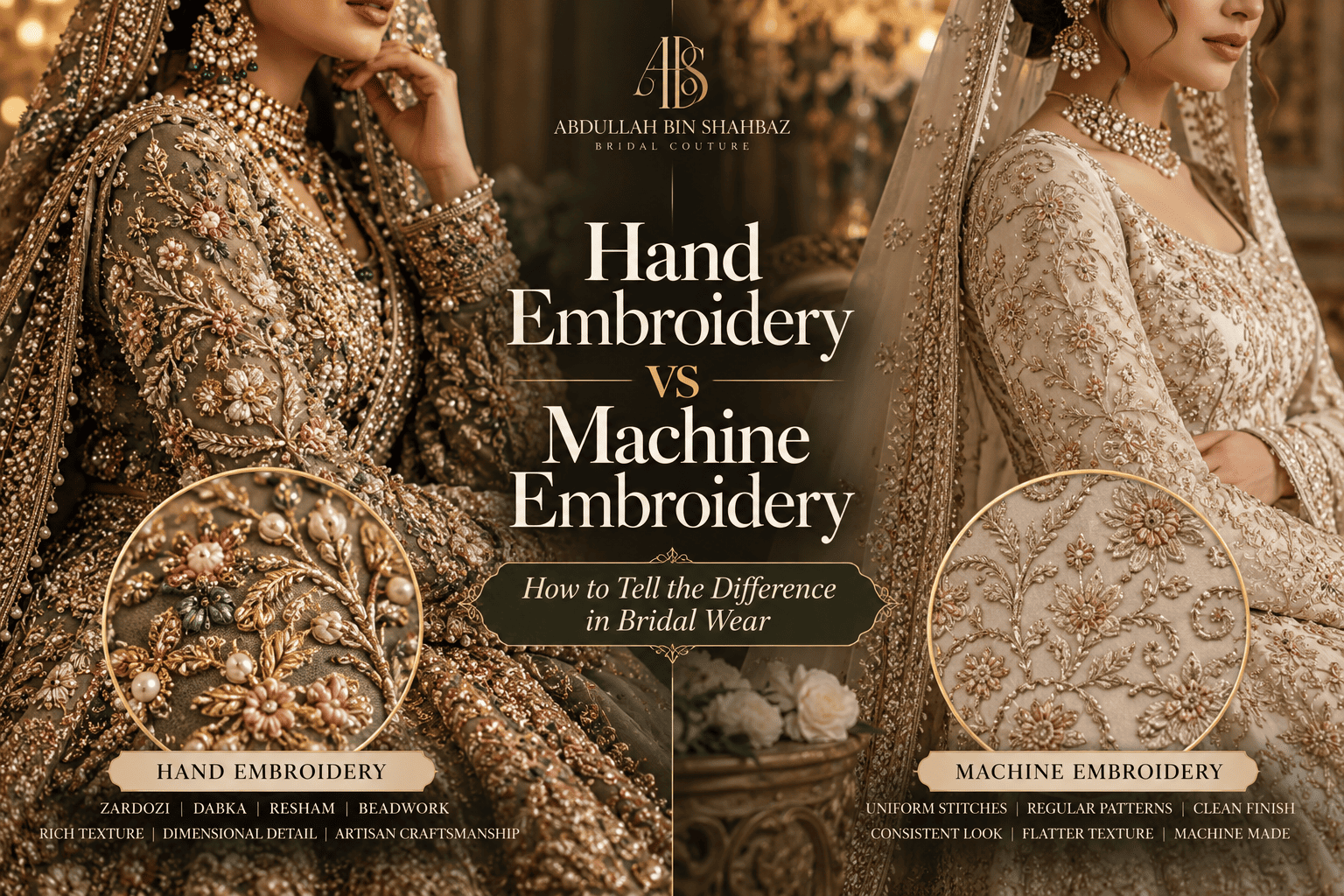
Understanding hand embroidery vs machine embroidery formal wear differences can completely change how you judge a formal outfit. Embroidery introduces texture, light, colour and detail, but not every embroidered garment is created in the same way. Two formal dresses can appear similarly elaborate in a photograph while involving very different levels of craftsmanship when viewed closely.
For wedding guests in the UK comparing Pakistani and South Asian formal wear, understanding the difference between hand embroidery and machine embroidery can make the buying process much clearer. It helps you look beyond the overall amount of embellishment and consider how the motifs have been created, how they interact with the fabric and how much artisan work sits behind the finished garment.
Machine embroidery can produce precise and attractive designs efficiently. Hand embroidery offers something different. Techniques such as zardozi, dabka, resham, mukesh and cutdana allow artisans to build the surface of the garment gradually, creating dimensional details that respond differently to light and movement.
Neither term should be judged from a label alone. The important question is what technique has been used, how well it has been executed and whether it suits the formal design you are choosing.
What Is Hand Embroidery in Formal Wear?
Hand embroidery is decorative work applied directly to fabric by an artisan using hand controlled tools, threads and embellishments.
In South Asian formal wear, this can involve metallic thread, beads, crystals, sequins, cutdana, resham and dabka. Each material brings its own texture and its own way of catching light.
Rather than being produced through an automated repeated stitch pattern, each section is developed through individual work. The artisan decides where each element sits and how densely the surface should be built.
This allows the embroidery to follow the architecture of the garment.
A motif around the neckline can be shaped according to the design. Borders can become richer towards the hem or ease off where the silhouette needs to stay light.
This relationship between embellishment and garment structure is one of the qualities that gives hand embroidered formal wear its character.
Wedding guests in the UK looking for this type of craftsmanship can explore Abdullah Bin Shahbaz’s hand embroidered formal wear for UK guests, where traditional artisan techniques are combined with made to order construction and custom sizing.
What Is Machine Embroidery?
Machine embroidery uses specialist equipment to create stitched designs according to predetermined patterns.
Modern embroidery machines can produce complex motifs with high levels of consistency. Once programmed, the same design can be repeated across many garments with very little variation.
This can make machine embroidery suitable for formal wear where repeatability and efficiency matter.
Machine embroidered formal wear can still be visually attractive. Detailed threadwork, patterns and decorative borders can look polished and refined.
The difference lies primarily in the method.
Hand embroidery allows artisans to build and place individual decorative elements directly onto the fabric. Machine embroidery reproduces a programmed design.
For a wedding guest, understanding this distinction is more useful than assuming one method automatically delivers better results.
Hand Embroidery vs Machine Embroidery at a Glance
| Feature | Hand Embroidery | Machine Embroidery |
|---|---|---|
| Production Method | Applied directly by artisans | Created through programmed machinery |
| Texture | Often dimensional and varied | Usually flatter and more uniform |
| Consistency | Small natural variations can appear | Highly consistent repetition |
| Techniques | Zardozi, dabka, resham, mukesh, cutdana and other handwork | Primarily stitched patterns produced by machine |
| Production Time | Depends on artisan work and design complexity | Generally faster for repeated patterns |
| Custom Placement | Can be adapted closely around garment details | Usually follows predetermined embroidery layouts |
| Visual Character | Individual, textured and artisan led | Precise, consistent and repeatable |
The table explains the production differences, but judging formal embroidery still requires looking closely at the garment itself.
Quality depends on execution.
Poorly finished handwork does not become luxury simply because it was done by hand, while well executed machine embroidery can still look refined.
How Can You Recognise Genuine Hand Embroidery?
When inspecting formal embroidery, start with the reverse side of the fabric if possible. Handwork usually shows knots, individual thread paths and small variations where each element was placed separately. Machine embroidery often looks cleaner on the reverse because the machine works through a uniform stitching sequence.
Look for slight irregularities that suggest human involvement. A dabka coil may sit at a slightly different angle from its neighbour. A sequin may be placed just differently enough to show it was positioned by hand.
These variations are not flaws. They are natural signs of handwork.
If the embroidery looks perfectly uniform across a large area, with every repeat identical, it is more likely to be machine work. If motifs contain small natural differences while still looking deliberate and controlled, you are probably looking at hand embroidery.
Well made hand embroidery balances artistry with precision. Irregularities should feel intentional and refined, not careless.
Look at the Embroidery From Different Angles
Hand embroidery usually responds to light in a way that changes as the garment moves. Threads, beads and cutdana sit at slightly different heights and angles, so the surface shifts character when viewed from different directions.
Tilt the fabric gently and watch how the embroidery catches light. Hand applied elements often show varied reflections, with some parts glowing more strongly than others depending on the angle.
Machine embroidered designs tend to reflect light more evenly because the stitches sit at a uniform level across the surface.
Texture can also reveal the method. Run your fingers lightly over the work if the garment is available to handle. Hand embroidery often feels dimensional, with raised motifs, layered materials and subtle irregularities. Machine embroidery usually feels smoother and more even.
These small physical tests can be more useful than photographs alone when choosing a formal outfit online or comparing brands.
Why Zardozi Creates a Different Effect
Zardozi is one of the most recognised hand embroidery techniques in South Asian formal wear. It uses metallic thread, often with beads and other embellishments, to create rich, raised designs.
Unlike standard stitched embroidery, zardozi is frequently worked in a raised or padded style. Threads are couched over a foundation or built into coils and motifs that rise above the fabric surface.
This gives zardozi a dimensional quality that can be difficult to reproduce through machine stitching. The metallic thread catches light in ways that feel organic and alive.
Zardozi can also be used with great control. It does not have to cover the entire garment. A well designed formal outfit may concentrate zardozi motifs around the neckline, bodice or borders while keeping other areas lighter.
This selective use is part of the artistry. It ensures the technique enhances the design rather than overwhelming it.
Dabka Adds Texture to Formal Embroidery
Dabka is a form of coiled wire or thread embroidery commonly used in Pakistani and South Asian formal wear. The coils are shaped and secured by hand, allowing artisans to create textured lines, scrolls and filled motifs.
Because each coil is handled individually, dabka work often shows small variations in angle and density. These differences give the embroidery a handmade character that is visible up close.
Dabka can be combined with zardozi, beads and sequins to create layered compositions. The wire coils provide structure, while the surrounding materials add sparkle and colour.
On formal wear for wedding guests, dabka is often used on bodices, sleeves and borders where dimensional detail makes the strongest impression.
Guests comparing the Zarposh and Naqsh collections will notice how these techniques are used selectively across formal designs. Browse the Zarposh collection and the Naqsh collection to see how hand embroidery is balanced with fabric and silhouette.
How Resham Embroidery Changes the Look
Resham embroidery uses silk or silk like thread to create smooth, lustrous designs. It can be worked by hand or machine, but the technique itself introduces colour and sheen rather than metallic texture.
Hand applied resham work allows artisans to blend colours gradually and vary stitch direction to follow the shape of each motif. Petals, leaves and floral forms can be shaded in ways that feel painterly and soft.
On formal wear, resham embroidery is often used for colourful accents, floral patterns and tonal detailing. It works particularly well on fabrics like chiffon and organza, where its smooth finish complements the lightness of the material.
Resham can also soften a heavily embellished design. Where zardozi or dabka create bold metallic effects, resham introduces colour and fluidity.
When comparing formal outfits, notice how resham is used. Carefully blended colour transitions and directional stitching are signs of thoughtful handwork.
Mukesh and Cutdana Add Controlled Light
Mukesh is a traditional technique that uses fine metallic wire to create delicate shimmering patterns. It is often scattered across the fabric to create a subtle, sparkling effect.
Cutdana refers to faceted beads or stones that are hand applied to create controlled points of light. Unlike sequins, which can feel uniform, cutdana pieces catch light from specific angles.
Both techniques add luminosity without adding the weight of heavy metallic threadwork. This makes them popular for formal wear where guests want an elegant finish that does not feel cumbersome.
Mukesh is often used as a background texture, creating a gentle shimmer across dupattas or bodices. Cutdana is typically used more sparingly, highlighting specific motifs or borders.
Together, these techniques show how hand embroidery can be refined rather than overwhelming. The goal is not maximum embellishment, but the right balance of light, texture and colour.
Why Perfect Repetition Can Suggest Machine Work
One of the simplest indicators of machine embroidery is perfect repetition. When every motif is identical down to the smallest stitch, and the same design repeats across a wide area without variation, machine production is likely.
Hand embroidery naturally produces subtle differences. Even when artisans work from the same design, slight changes in thread tension, bead placement or stitch direction will appear. These differences are usually only visible on close inspection.
This does not mean handwork should look uneven. Skilled artisans produce remarkably consistent work. The variations are small enough to feel organic rather than sloppy.
When comparing formal outfits, look at repeated motifs closely. If they are flawlessly identical, the work was probably produced by machine. If they are nearly identical but show small human touches, hand embroidery is more likely.
This test works best when combined with the other indicators. Repetition alone is not conclusive, but it is a useful starting point.
Is Hand Embroidery Always Heavier?
Hand embroidery is often assumed to be heavy, but this is not always true. The weight depends on the materials, the density of the work and the fabric, not simply on whether it was done by hand.
Dense zardozi work with thick metallic thread and heavy beads can add noticeable weight. Delicate resham work or scattered mukesh, by contrast, can feel light and fluid.
Skilled designers balance embellishment with wearability. They consider how the garment will move, how it will feel over several hours and how the embroidery interacts with the fabric.
Machine embroidery can also become heavy if dense stitching covers a large area. The production method alone does not determine comfort.
For wedding guests attending long celebrations, weight matters. Ask about how the embroidery is distributed and whether the design has been balanced for comfortable wear. Our guide on ready made vs made to order formal wear in the UK explains how made to order construction can help balance embellishment with fit.
Does Hand Embroidery Make a Formal Dress More Luxurious?
Hand embroidery can contribute to a sense of luxury, but luxury comes from the overall execution rather than the technique label alone.
A formal dress feels luxurious when the embroidery is well placed, the materials are good quality, the finishing is clean and the design is coherent. These qualities can be present in both hand and machine embroidered garments.
What hand embroidery adds is a sense of individuality. Knowing that artisans shaped each motif by hand gives the garment a story and a character that machine repetition cannot fully replicate.
For many wedding guests, this is part of the appeal. A hand embroidered formal outfit feels personal and distinctive, which suits occasions where you want to look and feel your best.
The key is to look for quality rather than relying on labels. Examine the embroidery, check the finishing and consider how the whole garment comes together.
Why Embroidery Placement Matters as Much as Embroidery Quantity
A common mistake when comparing formal wear is to judge embroidery by quantity alone. More embellishment does not automatically mean better design.
Thoughtful placement matters more. Hand embroidery allows artisans to concentrate detail where it will have the greatest effect, such as around the neckline, on the bodice, along borders or at the hem.
This selective approach creates visual interest without overwhelming the silhouette. It also allows the fabric itself to show, which can be just as important as the embellishment.
Machine embroidery tends to follow predetermined layouts, which can be less flexible. The design is programmed once and repeated, so it may not respond as closely to the specific shape of the garment.
When choosing a formal outfit, consider where the embroidery sits and how it relates to the design. Well placed hand embroidery often feels more refined than a garment that is simply covered in embellishment.
Hand Embroidery and Made to Order Formal Wear
Hand embroidery works particularly well with made to order formal wear. Because each garment is constructed for a specific customer, the embroidery can be planned around the individual’s measurements and preferences.
This allows for customisation that goes beyond standard sizing. Motif placement can be adjusted, density can be varied and specific techniques can be chosen to suit the design.
Made to order construction also means the embroidery is applied with the final fit in mind. The artisan knows how the garment will sit, so the embellishment can be placed to flatter the wearer.
For UK wedding guests who want something distinctive, this combination of hand embroidery and made to order construction offers a level of personalisation that ready made garments cannot easily match.
If you are unsure which approach suits you, our guide to what to ask during a formal wear consultation in the UK covers the questions that help you discuss embroidery, fit and customisation with confidence.
What Should You Ask a Designer About Formal Embroidery?
When discussing a formal outfit with a designer or brand, asking the right questions can reveal a great deal about the embroidery.
Start by asking which techniques have been used. Is the embroidery zardozi, dabka, resham, mukesh or a combination? Each technique has different qualities, and knowing what you are looking at helps you judge it fairly.
Ask whether the embroidery is hand applied, machine produced or a combination of both. Many formal garments use both methods, with machine work providing structure and handwork adding detail.
Enquire about the materials. Good quality threads, beads and embellishments make a significant difference to the finished result, regardless of the method.
Finally, ask about finishing. Clean edges, secure attachment and careful backing all indicate quality craftsmanship. These details are easy to overlook but essential for a garment that will be worn and admired.
Can You Mix Hand Embroidery and Machine Embroidery?
Yes, many formal garments combine both methods. This is not a compromise. It is a deliberate design choice that uses each method where it performs best.
Machine embroidery can create the structural foundation, such as repeated background patterns or stitched outlines. Hand embroidery can then add the detailed finishing, with artisans placing beads, sequins, dabka or zardozi over and around the machine worked base.
This combination allows designers to balance efficiency with artistry. The garment benefits from the consistency of machine work and the character of handwork.
When a formal dress combines both methods, the hand applied details often make the strongest impression. They add the dimensional highlights and individual touches that catch the eye.
There is no rule that a formal outfit must use only one method. What matters is how thoughtfully the two are combined.
How Hand Embroidery Influences Formal Dress Cost
Hand embroidery generally increases the cost of a formal dress because it involves skilled artisan labour. The more intricate and extensive the handwork, the more time and expertise it requires.
Several factors affect how much hand embroidery contributes to cost. Dense zardozi or dabka work takes longer than delicate resham detailing. Premium materials such as quality beads and metallic threads add to the expense. Complex custom designs require more artisan hours than simpler patterns.
Machine embroidery can reduce production costs because it is faster and more repeatable. This is one reason why heavily machine embroidered formal wear is often more accessible.
For wedding guests deciding where to invest, it helps to understand what the embroidery cost represents. With hand embroidery, you are paying for artisan skill, individual work and materials. With machine embroidery, you are paying for efficient production of a consistent design.
Our guide on what affects the hand embroidered formal wear cost explains these factors in more detail. For current pricing, browse the Zarposh and Naqsh collections directly.
Which Type of Embroidery Is Better for Formal Wear?
Neither type is automatically better. The right choice depends on the design, the occasion and your personal priorities.
Hand embroidery suits formal wear where individuality, texture and artisan character matter. It is ideal for statement pieces, heirloom quality garments and designs where dimensional detail makes the difference.
Machine embroidery suits formal wear where consistency, clean lines and efficiency are priorities. It can produce beautiful results for contemporary designs and for garments where a uniform finish is desired.
Many guests find that a combination works best. Machine embroidered structure with hand applied finishing can deliver both polish and personality.
Rather than asking which is better in absolute terms, ask which is better for the specific formal outfit you are choosing. Consider the design, the techniques involved and how the embroidery has been executed.
How to Inspect Formal Embroidery Before Ordering
If you are ordering formal wear online, you cannot always handle the garment before buying. There are still ways to assess the embroidery quality from a distance.
Start by reading the product description carefully. Does it specify which embroidery techniques have been used? Does it mention handwork, and does it describe the materials? Detailed descriptions suggest the brand understands its own craftsmanship.
Look at product photographs closely. Zoom in on the embroidery if the website allows it. Look for dimensional detail, varied textures and the small natural variations that suggest handwork.
Check customer reviews for comments about embroidery quality, finishing and how the garment looked in person compared to photographs.
Finally, do not hesitate to contact the brand with questions. Asking about embroidery techniques, materials and finishing is entirely reasonable, and a knowledgeable brand will welcome the conversation.
Why Artisan Craftsmanship Matters to Abdullah Bin Shahbaz
Abdullah Bin Shahbaz has built its reputation on hand embroidered Pakistani formal wear that combines traditional artisan techniques with contemporary design. The brand works with skilled artisans who specialise in zardozi, dabka, resham and related handwork.
This craftsmanship is not decorative alone. It is part of a broader approach to formal wear that values made to order construction, custom sizing and thoughtful design.
For UK wedding guests, this means formal outfits where the embroidery has been planned around the garment and the wearer, rather than applied as an afterthought.
You can read more about the brand’s approach on the Abdullah Bin Shahbaz story page, which explains the philosophy behind its hand embroidered formal wear.
Choosing hand embroidered formal wear from a brand that understands the craft means choosing a garment with character, individuality and lasting quality.
FAQs About Hand Embroidery vs Machine Embroidery
Q: What is the main difference between hand and machine embroidery?
A: Hand embroidery is applied directly by artisans using hand controlled tools, threads and embellishments, which creates dimensional texture and small natural variations. Machine embroidery uses specialist equipment to reproduce predetermined patterns with high consistency. The difference lies in the method and the character of the finished work.
Q: How can I tell if a formal dress is hand embroidered?
A: Look at the reverse side of the fabric for knots and individual thread paths, check for small natural variations in repeated motifs, tilt the fabric to see how the embroidery catches light from different angles, and feel the texture for dimensional detail. Perfectly uniform repetition across a large area is more likely to be machine work.
Q: Is zardozi always hand embroidered?
A: Zardozi is traditionally a hand embroidery technique using metallic thread, often worked in a raised or padded style with beads and embellishments. While machine processes can imitate its appearance, genuine zardozi involves artisans shaping and securing the metallic work by hand, which creates the dimensional quality the technique is known for.
Q: Is hand embroidery better than machine embroidery for formal wear?
A: Neither is automatically better. Hand embroidery suits formal wear where individuality, texture and artisan character matter, while machine embroidery suits designs where consistency and clean lines are priorities. Many formal garments combine both methods deliberately. Judge each garment on the quality of its execution rather than the technique label alone.
Q: Is hand embroidered formal wear always very heavy?
A: No. Weight depends on the materials, the density of the work and the fabric, not simply on whether the embroidery was done by hand. Delicate resham work or scattered mukesh can feel light and fluid, while dense zardozi with heavy beads adds more weight. Skilled designers balance embellishment with comfortable wear.
Q: Can machine embroidery look luxurious?
A: Yes. Well executed machine embroidery with good quality materials, thoughtful design and clean finishing can look polished and refined. Luxury comes from the overall execution, including embroidery placement, material quality and finishing, rather than from the production method alone.
Q: Can formal dresses combine machine and hand embroidery?
A: Yes, many formal garments combine both methods deliberately. Machine embroidery can create the structural foundation with repeated patterns, while hand embroidery adds detailed finishing such as beads, sequins, dabka or zardozi. This combination balances efficiency with artistry.
Q: Why does hand embroidered formal wear take longer to produce?
A: Hand embroidery involves skilled artisans applying each element individually, which takes more time than reproducing a programmed machine pattern. The more intricate and extensive the handwork, the more artisan hours it requires. For current making times, check the Shipping Policy page.
Conclusion
Learning to tell the difference between hand embroidery and machine embroidery gives you a clearer way to judge formal wear. Look at the texture, check for natural variations, observe how the embroidery catches light and consider how the embellishment has been placed around the garment.
Hand embroidery offers individuality and artisan character through techniques like zardozi, dabka, resham, mukesh and cutdana. Machine embroidery offers precision and consistency. Many of the finest formal garments combine both, using each method where it performs best.
For UK wedding guests who value craftsmanship, hand embroidered formal wear remains a distinctive choice. Explore the Zarposh collection and the Naqsh collection to discover formal outfits where traditional artisan techniques meet contemporary made to order design.