
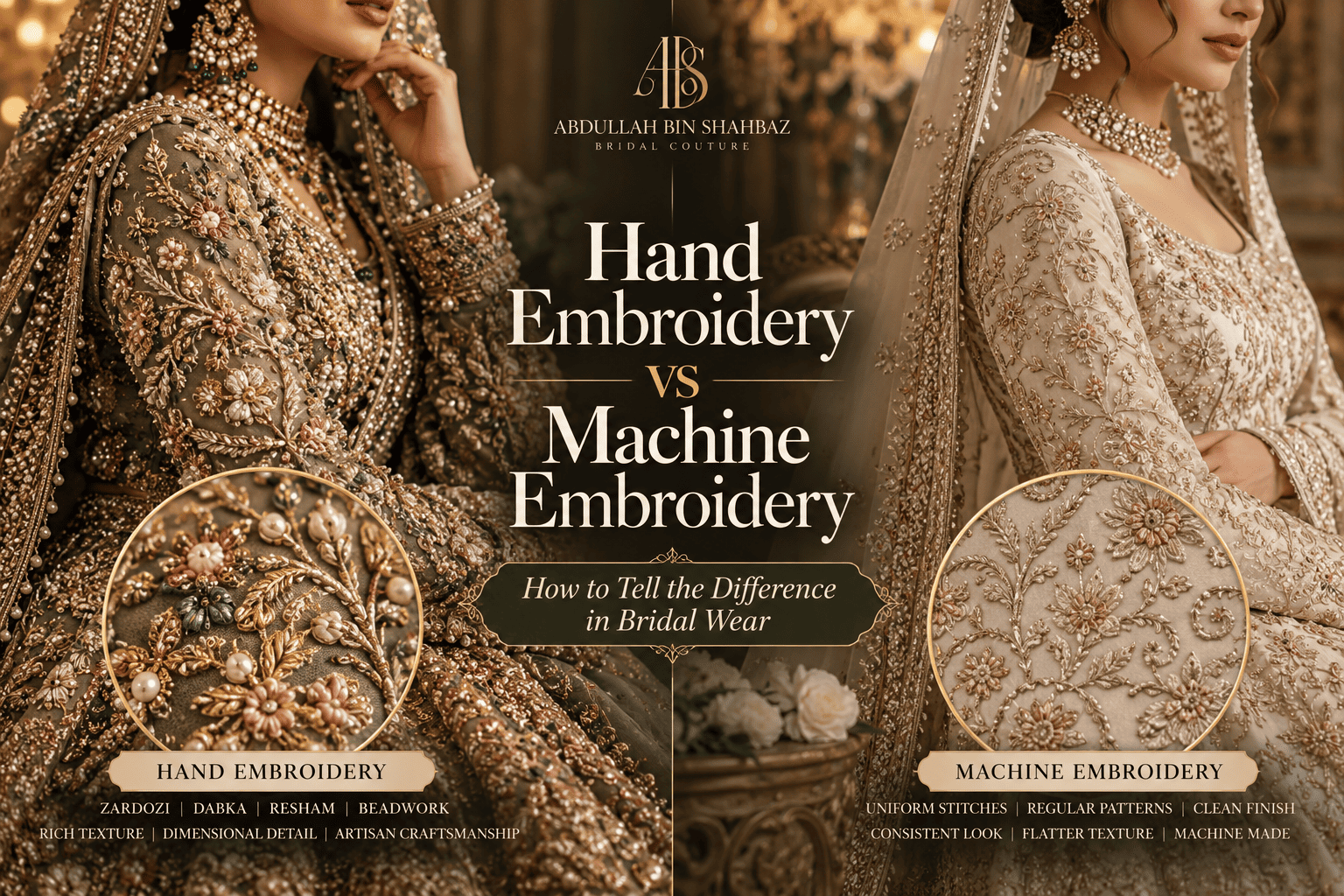
Embroidery can completely change the character of a bridal outfit. It introduces texture, light, colour and detail, but not every embroidered garment is created in the same way. Two bridal dresses can appear similarly elaborate in a photograph while involving very different levels of craftsmanship when viewed closely.
For UK brides comparing Pakistani and South Asian bridalwear, understanding the difference between hand embroidery and machine embroidery can make the buying process much clearer. It helps you look beyond the overall amount of embellishment and consider how the motifs have been created, how they interact with the fabric and how much artisan work sits behind the finished garment.
Machine embroidery can produce precise and attractive designs efficiently. Hand embroidery offers something different. Techniques such as zardozi, dabka, resham, mukesh and cutdana allow artisans to build the surface of the garment gradually, creating dimensional details that respond differently to light and movement.
Neither term should be judged from a label alone. The important question is what technique has been used, how well it has been executed and whether it suits the bridal design you are choosing.
What Is Hand Embroidery in Bridal Wear?
Hand embroidery is decorative work applied directly to fabric by an artisan using hand controlled tools, threads and embellishments.
In South Asian bridalwear, this can involve metallic thread, beads, crystals, sequins, cutdana, resham and specialist techniques such as zardozi and dabka.
Rather than being produced through an automated repeated stitch pattern, each section is developed through individual artisan work.
This allows the embroidery to follow the architecture of the garment.
A motif around the neckline can be shaped according to the design. Borders can become richer towards the hem. Sleeve details can be balanced with the bodice, while a dupatta can carry its own pattern without appearing disconnected from the rest of the outfit.
This relationship between embellishment and garment structure is one of the qualities that gives hand embroidered bridalwear its distinctive character.
UK brides looking for this type of craftsmanship can explore Abdullah Bin Shahbaz’s hand embroidered bridal wear in the UK, where traditional artisan techniques are combined with made to order construction and custom sizing.
What Is Machine Embroidery?
Machine embroidery uses specialist equipment to create stitched designs according to predetermined patterns.
Modern embroidery machines can produce complex motifs with high levels of consistency. Once programmed, the machine can repeat the same design across several pieces of fabric with relatively little variation.
This can make machine embroidery suitable for garments where repeatability and efficiency are important.
Machine embroidered bridalwear can still be visually attractive. Detailed threadwork, patterns and decorative surfaces can all be produced using modern machinery.
The difference lies primarily in the method.
Hand embroidery allows artisans to build and place individual decorative elements directly onto the fabric. Machine embroidery follows a programmed stitch structure.
For a bride, understanding this distinction is more useful than assuming one method automatically determines whether a garment is beautiful.
Hand Embroidery vs Machine Embroidery at a Glance
| Feature | Hand Embroidery | Machine Embroidery |
|---|---|---|
| Production Method | Applied directly by artisans | Created through programmed machinery |
| Texture | Often dimensional and varied | Usually flatter and more uniform |
| Consistency | Small natural variations can appear | Highly consistent repetition |
| Techniques | Zardozi, dabka, resham, mukesh, cutdana and other handwork | Primarily stitched patterns produced by machine |
| Production Time | Depends on artisan work and design complexity | Generally faster for repeated patterns |
| Custom Placement | Can be adapted closely around garment details | Usually follows predetermined embroidery layouts |
| Visual Character | Individual, textured and artisan led | Precise, consistent and repeatable |
The table explains the production differences, but judging bridal embroidery still requires looking at the garment itself.
Quality depends on execution.
Poorly finished handwork does not become luxury simply because it was done by hand, while well executed machine embroidery can still create an attractive formal garment.
How Can You Recognise Genuine Hand Embroidery?
The easiest way to begin is to look closely rather than judging the dress from a full length photograph.
Hand embroidery often has visible depth.
Metallic elements, beads and threads sit at slightly different levels above the fabric rather than creating one completely flat surface.
Look at how the light interacts with the garment.
Dabka and zardozi can produce raised areas that catch light differently as the wearer moves. Mukesh creates small reflective details, while resham introduces thread texture without necessarily producing the same metallic shine.
Small variations may also be visible.
Because artisans are working directly with the material, two repeated motifs may not be mathematically identical in every tiny detail. These differences should not look careless. Instead, they can reveal the human process behind the work.
Close photographs and video are far more useful than relying exclusively on distant campaign imagery.
Look at the Embroidery From Different Angles
One photograph can hide much of the information you need.
Front facing lighting can make almost every embellished garment appear more reflective. Viewing the dress from different angles shows whether the surface has genuine physical texture.
Hand embellished metallic work changes as the angle of the garment changes.
Raised elements cast subtle shadows. Beads and crystals reflect light individually. Threadwork becomes easier to distinguish from metallic embellishment.
Video can be especially helpful because it shows the relationship between the embroidery and movement.
As the bride walks or turns, the surface of a hand worked garment can reveal considerably more dimension than it does in one static photograph.
When shopping for luxury bridalwear, ask to see detail imagery whenever available.
Why Zardozi Creates a Different Effect
Zardozi is one of the most recognised techniques in luxury South Asian bridalwear.
The technique traditionally uses metallic materials to create elaborate decorative surfaces. In contemporary couture, zardozi can be combined with beads, sequins, thread and other elements to develop detailed motifs.
Its greatest visual characteristic is dimension.
The embroidery sits above the fabric rather than appearing simply printed or stitched into a flat surface.
This makes zardozi particularly suited to formal bridal pieces where the designer wants richer detail around the neckline, bodice, sleeves or borders.
However, the presence of metallic work alone does not confirm high quality.
Look at the precision of the motifs, the consistency of the finishing and how the embellishment relates to the shape of the garment.
A good bridal design uses zardozi intentionally rather than covering every available part of the fabric simply to create visual weight.
Dabka Adds Texture to Bridal Embroidery
Dabka is another technique frequently associated with Pakistani bridal couture.
It uses coiled metallic elements that can create a distinctly raised surface.
When combined with other embroidery techniques, dabka adds richness without relying entirely on crystals or sequins for impact.
Its texture is especially noticeable around decorative motifs and borders.
Because dabka has a physical presence, placement matters.
Too much dense metallic work can add significant weight to a garment. Used thoughtfully, it can emphasise the most important parts of a bridal silhouette.
This is one reason luxury embroidery should be evaluated according to composition rather than quantity alone.
The most heavily embellished dress is not automatically the best designed dress.
How Resham Embroidery Changes the Look
Resham provides a softer visual language than metallic embroidery.
Fine coloured threads can be used to create floral designs, vines, borders and intricate motifs.
It can appear on its own or alongside zardozi, dabka, beads and other forms of embellishment.
Resham is particularly useful when a designer wants to introduce colour into the embroidery rather than relying entirely on metallic tones.
The technique can also create beautiful contrast against silk, organza and other bridal fabrics.
This makes it suitable for everything from restrained Nikkah dressing to richly detailed formal outfits depending on the density and design.
For brides comparing different styles, the important question is not whether one technique is superior. It is how the techniques have been combined to achieve the intended character of the outfit.
Mukesh and Cutdana Add Controlled Light
Not all bridal sparkle comes from large crystals.
Mukesh can create small points of reflected light across fabric, while cutdana introduces faceted embellishment that catches light from different directions.
Both can be used selectively.
A designer may scatter reflective details across a dupatta or use them around more complex motifs to increase visual depth.
This can create a more sophisticated result than simply covering the entire dress in uniform shine.
When evaluating the garment, consider whether reflective embellishments support the embroidery or dominate it.
Luxury bridalwear usually feels most considered when threadwork, metallic elements and reflective details have distinct roles within the design.
Why Perfect Repetition Can Suggest Machine Work
One characteristic of machine embroidery is its ability to repeat a programmed pattern with exceptional consistency.
If identical motifs repeat across a garment with exactly the same stitch formation, spacing and appearance, this can indicate machine production.
Hand embroidery can also follow repeated patterns, but individual artisan work may create very subtle variation.
This should not be confused with poor workmanship.
Luxury hand embroidery still requires precision. Motifs should feel balanced and intentional.
The difference is that handwork has been individually constructed rather than reproduced automatically from the same machine programme.
Again, this is easier to understand in close detail than in a full length image.
Is Hand Embroidery Always Heavier?
No.
Hand embroidery can range from extremely delicate to very dense.
A refined Nikkah dress may feature small hand worked motifs, light resham embroidery and controlled embellishment. A formal Baraat outfit may use extensive zardozi, dabka and richly developed borders.
The technique tells you how the decorative work has been produced, not automatically how much of it has been used.
This distinction is important for brides who want genuine hand craftsmanship without an extremely heavy bridal outfit.
You can choose hand embroidery with restraint.
Likewise, a heavily decorated garment does not automatically prove that the work has been completed entirely by hand.
Always examine the technique separately from the amount of embellishment.
Does Hand Embroidery Make a Bridal Dress More Luxurious?
Hand craftsmanship can contribute significantly to the luxury character of a bridal garment, but it is only one part of the complete design.
Fabric quality matters.
Fit matters.
The silhouette, finishing, construction and relationship between individual embellishment techniques also contribute to the result.
A hand embroidered garment created on poor fabric or without careful finishing will not automatically feel luxurious.
The strongest couture brings all of these elements together.
This is why the Zarposh collection uses richer hand embellishment as part of a complete formal design language, while Naqsh takes a more delicate approach to motifs and surface detail.
Different levels of embroidery can both communicate luxury when the craftsmanship and overall garment are coherent.
Why Embroidery Placement Matters as Much as Embroidery Quantity
Where embroidery is positioned can have a greater visual effect than how much of it exists.
A carefully developed neckline can frame the face and jewellery. Sleeve details become visible during portraits and hand photographs. Borders influence the entire lower silhouette, while dupatta embroidery affects how the garment appears both from the front and back.
Strategic placement also helps control garment weight.
Instead of covering every part of the fabric with dense handwork, the designer can create areas of visual concentration and areas where the material itself remains visible.
This balance gives the eye somewhere to rest.
It can also make individual motifs more noticeable because they are not competing against an equally dense background everywhere else.
When comparing dresses, ask yourself whether the embroidery feels designed around the garment or simply added onto its surface.
Hand Embroidery and Made to Order Bridal Wear
Hand embroidery becomes particularly interesting when combined with made to order production.
If the garment is being developed according to personal measurements, the embroidery can be considered in relation to those proportions before the piece is completed.
Neckline motifs can work with the final neckline.
Sleeve embroidery can correspond with the intended sleeve length. Borders can be planned around garment proportions, while the dupatta can be developed as part of the complete ensemble.
This reduces the need for major later alterations that might disturb decorative areas.
If you are deciding whether this approach suits you, read our guide to ready made vs made to order bridal wear in the UK.
The production method and embroidery method are separate decisions, but they work particularly well when considered together.
What Should You Ask a Designer About Bridal Embroidery?
You do not need specialist embroidery knowledge to ask useful questions.
Begin by asking which parts of the garment are embroidered by hand.
Find out which techniques are being used.
Ask whether the embroidery shown in photographs will remain the same if you change the base colour or fabric.
If you are requesting lighter or heavier embellishment, ask how that change will affect the balance of the original design.
You should also discuss garment weight.
Dense metallic embroidery can influence how the outfit feels during several hours of wear.
These questions help you understand what you are commissioning rather than relying on broad words such as handcrafted or luxury.
For a fuller pre-order checklist, read what to ask during a bridal wear consultation in the UK.
Can You Mix Hand Embroidery and Machine Embroidery?
Yes. Some garments combine several production techniques.
Machine embroidery may be used to develop part of a base pattern, while hand embellishment can be added afterward to introduce beads, metallic work or other decorative details.
The important consideration is transparency.
If genuine hand craftsmanship is important to your purchase, understand which parts of the garment involve handwork rather than assuming the entire surface has been produced through one technique.
There is nothing inherently wrong with mixed production.
It simply represents a different garment from one where extensive embroidery has been worked entirely by artisans.
The distinction matters because buyers should understand what they are purchasing.
How Hand Embroidery Influences Bridal Dress Cost
Hand embroidery can influence the scope of a bridal commission because detailed artisan work requires time, specialist skills and materials.
However, it would be misleading to assume that every hand embroidered garment should have the same pricing structure.
The technique, density, size of the embroidered area and complexity of the motifs all matter.
A relatively small section of extremely intricate handwork can demand considerable attention. A larger repeated motif may have a different production requirement.
Fabric, silhouette, customisation and additional garment pieces also influence the overall commission.
For this reason, embroidery should be assessed as part of the complete garment rather than treated as the only factor affecting value.
Which Type of Embroidery Is Better for Bridal Wear?
There is no universal answer.
The better choice depends on what you value in the garment.
If you want dimensional artisan work, individual detail and traditional techniques, hand embroidery may align more closely with your priorities.
If your main concern is a precise repeated stitched pattern, machine embroidery can achieve that efficiently.
Many brides choose luxury hand embroidered bridalwear because they want the craftsmanship itself to form part of the significance of the wedding outfit.
The garment is not only something to wear for one event. Its surface records the work of artisans through individual motifs, borders and details.
That craftsmanship can give the outfit an identity that extends beyond current trends.
How to Inspect Bridal Embroidery Before Ordering
Begin with detailed images.
Look closely at the neckline, bodice, sleeves, borders and dupatta.
Then look at the garment as a whole.
Good embroidery should make sense from both perspectives.
From close range, you should see careful workmanship and finishing. From a distance, those details should combine into a coherent bridal silhouette.
Look at video where possible.
Movement reveals texture, reflective details and fabric behaviour that photographs can hide.
Ask questions when something is unclear.
A luxury bridal purchase should not require you to guess whether the quality shown in marketing language matches the garment itself.
Understanding the craftsmanship before ordering creates greater confidence in the final decision.
Why Artisan Craftsmanship Matters to Abdullah Bin Shahbaz
Hand craftsmanship is central to the Abdullah Bin Shahbaz design approach rather than being treated only as decorative finishing.
The collections draw on traditional embellishment techniques while applying them to contemporary formal and bridal silhouettes.
This approach allows heritage techniques to remain visible without requiring the garment to feel like a reproduction of historical clothing.
For brides, the result is a balance between tradition and personal expression.
The wedding outfit can carry recognisable South Asian craftsmanship while still reflecting an individual choice of colour, silhouette and styling.
You can learn more about this approach through the Abdullah Bin Shahbaz story.
FAQs About Hand Embroidery vs Machine Embroidery
Q: What is the main difference between hand embroidery and machine embroidery?
A: Hand embroidery is developed directly by artisans using hand controlled tools, threads and embellishments. Machine embroidery is created through programmed machinery that can repeat stitched patterns consistently. Both can be decorative, but their production methods and visual characteristics differ.
Q: How can I tell if a bridal dress is hand embroidered?
A: Look closely for dimensional texture, individually placed embellishments and subtle natural variations. Detailed photographs and video can make handwork easier to assess than distant full length images. You can also ask the designer which specific techniques are used.
Q: Is zardozi always hand embroidered?
A: Traditional zardozi is a form of hand embroidery using metallic decorative materials. When purchasing bridalwear, ask how the technique has been applied to the particular garment rather than relying on the term alone.
Q: Is hand embroidery better than machine embroidery for bridal wear?
A: It depends on what you value. Hand embroidery offers artisan character, texture and traditional craftsmanship, while machine embroidery provides precise and consistent stitched patterns. Brides seeking couture craftsmanship may place greater value on extensive handwork.
Q: Is hand embroidered bridal wear always very heavy?
A: No. Hand embroidery can be used lightly or densely. A garment with carefully spaced resham or metallic motifs can remain relatively refined, while another dress may contain extensive zardozi and dabka work.
Q: Can machine embroidery look luxurious?
A: Yes. High quality machine embroidery can create precise and attractive decorative work. Luxury, however, also depends on fabric, construction, fit, finishing and overall design rather than embroidery technique alone.
Q: Can bridal dresses combine machine and hand embroidery?
A: Yes. Some designs use machine embroidery as a base and add hand embellishment afterward. Brides who specifically want hand craftsmanship should ask which areas of the garment have been worked by hand.
Q: Why does hand embroidered bridal wear take longer to produce?
A: Artisan embroidery is developed through individual handwork rather than automatic repetition. Production time depends on the techniques, motif complexity, embroidery density and total area being embellished.
Conclusion
The difference between hand embroidery and machine embroidery is not simply a question of which dress looks more elaborate.
It is a difference in how the decorative surface has been created.
Machine embroidery offers consistency and efficient repetition. Hand embroidery allows artisans to develop texture, dimension and individually worked detail through techniques such as zardozi, dabka, resham, mukesh and cutdana.
For brides choosing luxury couture, understanding that distinction makes it easier to evaluate craftsmanship rather than relying solely on campaign photography or words such as premium and handcrafted.
Look closely at the embroidery. Consider its placement, finishing and relationship with the fabric. Ask how the garment has been created and whether the handwork continues across the neckline, sleeves, borders and dupatta.
Most importantly, choose the level of craftsmanship that matters to you.
At Abdullah Bin Shahbaz, traditional hand embellishment is combined with premium fabrics, custom sizing and made to order construction. Explore the hand embroidered bridal wear collection for UK brides to discover Nikkah, Mehndi, Baraat and Walima designs created around detailed artisan workmanship and contemporary bridal silhouettes.