
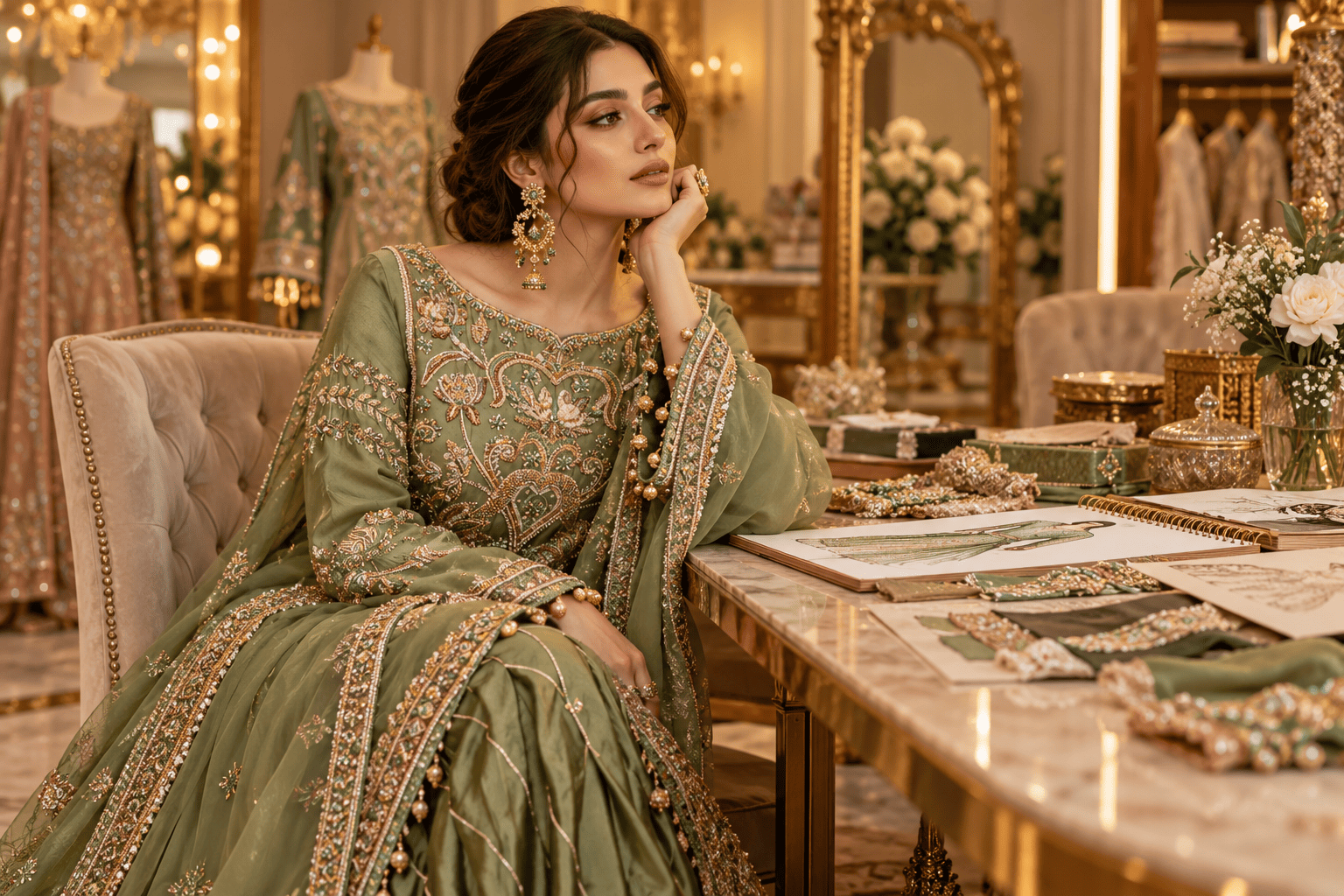
A bridal consultation should give you more than an opportunity to look at beautiful dresses. It should help you understand exactly what you are commissioning, how the garment will be created and whether the design is right for your wedding, measurements and personal style.
This becomes particularly important when choosing hand embroidered or made to order bridalwear. Unlike purchasing an existing garment from a rail, commissioning bridal couture involves decisions about fabric, fit, embroidery, colour, sleeves, neckline, dupatta styling and production requirements. Each of those decisions can influence the final outfit.
For UK brides planning a Nikkah, Mehndi, Baraat or Walima, asking the right questions early can make the process considerably clearer. It allows expectations to be established before production begins and gives you an opportunity to understand the craftsmanship behind the garment rather than making a decision from photographs alone.
A good consultation should leave you feeling informed about what is being created, what can be customised and what needs to be confirmed before your order moves forward.
What Should You Prepare Before a Bridal Wear Consultation?
You do not need to arrive with every detail decided.
In fact, part of the purpose of a bridal consultation is to help refine your ideas. However, having some information ready allows the conversation to become much more useful.
Start with your wedding date and the event for which you need the outfit. A designer needs to know whether the garment is intended for a Nikkah, Mehndi, Baraat or Walima because the event can influence fabric, embroidery density, silhouette and overall design direction.
It is also useful to know which colours and silhouettes you are naturally drawn towards.
You may already know that you prefer a lehenga, gharara, sharara, pishwas or another formal silhouette. If you are unsure, bringing a few examples of shapes you like can help communicate your preferences without requiring you to design the outfit yourself.
Think about coverage as well.
Sleeve length, neckline depth, blouse length and dupatta styling are all easier to discuss before production than after the garment has been completed.
Your consultation should begin with the wedding and the bride rather than simply with a dress.
Ask Whether the Bridal Outfit Is Ready Made or Made to Order
One of the first questions should establish exactly how the garment will be produced.
A ready made outfit already exists in a predetermined design and size. A made to order piece is created after the order has been confirmed and may allow personal measurements and agreed design adjustments to become part of the production process.
This distinction affects fitting, customisation and timing.
At Abdullah Bin Shahbaz, bridal pieces are created on a made to order basis, allowing brides to discuss measurements, colour and design requirements before production. UK brides can explore the brand’s hand embroidered bridal wear collection before beginning that conversation.
If you are still deciding which purchasing route suits you, read our guide to ready made vs made to order bridal wear in the UK.
Understanding the production model before anything else makes the remaining consultation questions much easier to answer.
Ask Exactly What Can Be Customised
Made to order does not necessarily mean that every element of a garment can be changed without affecting the original design.
Ask specifically which customisations are available.
Colour may be adjustable. Sleeve length or neckline shape may be changed. Dupatta detailing, garment length or embroidery density may also offer flexibility depending on the piece.
More extensive changes can involve a different level of design work.
For example, changing the colour of an existing outfit is very different from changing its silhouette, neckline, embroidery placement and dupatta simultaneously. At that point, several parts of the original design may need to be reconsidered together.
A useful bridal consultation should establish where personalisation adds value and where preserving the original design may produce a stronger result.
The objective should not be to change as much as possible. It should be to create an outfit that feels personal while retaining a balanced design.
Ask Which Hand Embroidery Techniques Are Used
If hand craftsmanship is one of the reasons you are considering luxury bridalwear, ask about it directly.
Terms such as handcrafted and hand embellished can be used broadly in fashion, so understanding the actual techniques gives you a clearer idea of what you are commissioning.
Traditional South Asian bridal embroidery may include zardozi, dabka, resham, mukesh, cutdana and other forms of detailed embellishment.
Each creates a different effect.
Zardozi can introduce rich metallic dimension. Dabka gives embroidery raised texture. Resham allows softer threadwork and detailed motifs, while mukesh and cutdana can bring controlled light and sparkle to the garment.
The more useful question is not simply, “Is this dress hand embroidered?”
Ask which techniques are used, where they appear on the garment and how they contribute to the overall design.
This helps distinguish genuine craftsmanship from decorative language used only for marketing.
Ask How Heavy the Embroidery Will Feel When Worn
Embroidery has visual weight and physical weight.
A dress may look spectacular in photographs while still feeling very different once it is worn for several hours.
Ask how the embroidery affects the garment’s overall weight and movement.
This is particularly relevant for a Baraat outfit with dense metallic work or a heavily bordered dupatta. A bride who will spend several hours standing, greeting guests and moving through a venue needs to consider comfort alongside visual impact.
For a Mehndi, movement may become even more important.
A richly detailed outfit can still be comfortable when the embroidery placement, fabric and construction have been considered together.
The consultation is the right time to explain how you expect to wear the garment rather than discovering its practical limitations later.
Ask Which Fabric Best Suits the Design
Choosing fabric should not be treated as a separate decision from choosing embroidery.
Silk, organza, tissue and other bridal fabrics respond differently to embellishment. Some provide stronger structure while others create greater softness and movement.
Ask why a particular fabric has been selected for the outfit you are considering.
A heavily embellished garment needs a material capable of supporting its surface work. A flowing silhouette needs fabric with an appropriate drape. The bride’s wedding season and venue may also influence which materials are more practical.
For UK weddings, this can be particularly useful because celebrations take place across very different seasons.
A winter evening reception may support heavier layering and fabric choices, while a summer Nikkah may benefit from a different balance between structure and comfort.
The best fabric is the one that supports the design rather than simply the material with the most luxurious name.
Ask How Your Measurements Will Be Taken
Fit should be discussed before production rather than treated as an issue to solve afterward.
Ask which measurements are required and how they should be taken.
Bridalwear may require more detailed measurements than everyday clothing because the shoulder line, sleeve length, bodice, waist, garment length and overall proportions must work with structured fabrics and embroidery.
The silhouette also matters.
A lehenga requires different considerations from a gharara, pishwas or straight formal ensemble.
Do not assume that your normal clothing size provides enough information for a made to order bridal garment.
If the designer provides a measurement guide or specific instructions, follow those carefully. Accurate measurements become especially important when embroidery surrounds fitted areas because substantial alterations after production can interfere with motifs, borders or seams.
Ask What Happens if Your Measurements Change
Wedding planning can take several months, and body measurements may change during that period.
This is worth discussing during the consultation rather than assuming adjustments will always be straightforward later.
Ask when the final measurements need to be confirmed and what the process is if your measurements change significantly before the wedding. The answer may depend on how far production has progressed.
Minor adjustments may be manageable, while larger changes to heavily embroidered sections can become more complicated once embroidery and construction have been completed.
If you already expect your measurements to change, communicate that early.
It allows the designer to advise you according to the particular garment and production schedule rather than relying on assumptions.
Ask Whether the Colour Can Be Customised
Colour is one of the most personal bridal decisions.
Traditional reds and deeper jewel tones remain important in South Asian bridalwear, while ivory, champagne, blush, sage, powder blue and softer palettes have expanded the options available for Nikkah and Walima dressing.
If you love a design but would prefer another colour, ask whether the fabric and embroidery can support that change.
Not every embroidery composition looks identical on every background colour.
Gold handwork placed over deep red creates a different level of contrast from the same metallic detailing over ivory or sage. Resham colours, crystals and other embellishments may also need to be reconsidered when the base shade changes.
A successful colour customisation therefore involves more than replacing one fabric shade with another.
The designer should consider how the complete surface of the garment will respond.
Ask What Is Included in the Complete Bridal Outfit
Never assume that everything visible in a styled campaign photograph is automatically included.
Ask which individual pieces form part of the outfit.
A bridal look may include a blouse or kameez, lehenga or trousers, one dupatta, a second dupatta, decorative accessories or styling pieces used only for the photography.
Understanding exactly what is included avoids confusion later.
This question becomes particularly important if you want an additional dupatta.
A second dupatta can require its own fabric, borders and embroidery, which means it should be discussed as part of the design rather than added casually at the end.
Similarly, if the outfit includes a heavily embellished lower garment or separate handcrafted accessory, confirm whether it forms part of the same commission.
Clarity at this stage makes both design planning and the final quotation easier to understand.
Ask How the Dupatta Should Be Planned
The dupatta can transform the complete bridal silhouette.
Ask how it has been designed to be worn and whether its length, fabric and embroidery work with your preferred draping style.
A head dupatta needs different practical consideration from one intended mainly over the shoulder.
If you want a double dupatta look, tell the designer during the consultation.
The two pieces should work together rather than compete. One may carry richer borders while the other remains lighter and easier to manage.
You should also consider how the dupatta interacts with the neckline and jewellery.
A heavily embroidered border positioned near an already detailed neckline can create a very rich appearance, while a more restrained edge may allow the garment’s main embroidery to remain dominant.
These are styling decisions, but they begin with how the bridal outfit itself has been designed.
Ask About the Production Timeline Before Confirming the Order
Your wedding date should be discussed before the order is confirmed.
Hand embroidered couture is not produced according to one universal timeframe. The amount of handwork, fabric, garment construction and customisation can all influence production requirements.
A heavily embellished Baraat piece may require a different schedule from a refined Nikkah ensemble.
Do not assume that because one garment appears visually lighter it will automatically be quicker to produce. Intricate smaller motifs can also require significant artisan attention.
Ask whether your preferred design can realistically be produced within the available period before agreeing to extensive customisation.
If you are still planning your wedding schedule, our guide on how early to order your bridal dress in the UK explains how embroidery, measurements and customisation can affect the planning process.
An honest conversation about timing is more valuable than choosing a dress first and discussing the deadline afterward.
Ask What Can Affect the Final Bridal Quotation
A couture quotation should make sense in the context of the garment being commissioned.
Ask what design elements influence it.
Fabric choice, embroidery technique, embroidery density, silhouette, additional pieces and customisation can all affect how much work is involved.
This is particularly important when comparing two visually similar outfits.
A dress with intricate hand embroidery may involve considerably more artisan workmanship than another design that creates a similar impression through different production methods.
Likewise, adding a heavily embellished second dupatta or substantially modifying an existing silhouette changes the scope of the commission.
You do not need the designer to reduce every decision to an individual cost. The objective is simply to understand which parts of your requested design are affecting the overall quotation.
For a deeper explanation, read our guide to what affects the cost of hand embroidered bridal wear.
Ask to See the Embroidery Up Close
Full length photographs show the complete bridal silhouette, but close detail reveals the workmanship.
Ask to see detailed images or video of embroidery, borders, sleeves, neckline and dupatta work when available.
This allows you to examine how the embellishment sits on the fabric and how motifs are constructed.
Look for texture.
Hand embroidery should reveal depth when viewed from different angles. Metallic elements, beads, threadwork and individual details interact differently with light than a completely flat decorative surface.
Also look beyond the most heavily photographed area.
The quality of a luxury bridal garment should continue through the cuffs, borders, hem and less prominent parts of the design.
A dress should remain convincing when viewed closely, not only from across a room.
Ask How the Outfit Will Move
Movement is rarely visible in a static product photograph.
During a consultation, ask how the selected silhouette behaves when walking and sitting.
This matters for bridal lehengas, ghararas, shararas and pishwas because volume, fabric and embellishment all affect movement.
If possible, look at video of the outfit or a similar silhouette.
A bride should understand whether the skirt has significant structure, whether the dupatta is particularly heavy and whether the embroidery restricts movement in fitted areas.
Your wedding is not a photoshoot that lasts ten minutes.
You may be wearing the outfit for several hours, moving between photographs, ceremonies and guests.
The most successful bridalwear combines presence with wearability.
Ask Whether the Design Suits Your Specific Wedding Event
Do not choose bridalwear only because the design itself is beautiful.
Ask whether its weight, embroidery, fabric and silhouette suit the event you are planning.
A Nikkah may call for a softer interpretation of bridal dressing. A Mehndi can prioritise movement and colour. Baraat couture can support a richer ceremonial presence, while Walima styling may move towards a different palette and level of formality.
These are not rules.
A bride can choose heavy embroidery for her Nikkah or something more restrained for her Baraat.
The value of discussing the occasion is that it gives the designer context.
You are not asking what brides traditionally “must” wear. You are helping the designer understand the atmosphere in which the garment needs to work.
Ask How Jewellery Should Work With the Neckline
Jewellery does not need to be chosen before the bridal dress, but it should not be forgotten during the design conversation.
If you already own a significant family necklace, heirloom jewellery or a bridal set you definitely intend to wear, show it during the consultation.
The neckline can then be considered alongside that piece.
A densely embroidered high neckline may not need the same jewellery as an open neckline with more visual space. Similarly, antique gold handwork can interact differently with jewellery from cool silver or pearl embellishment.
This does not mean the dress must be designed around accessories.
It simply prevents important visual elements from being considered independently when they will ultimately appear together.
Ask What You Should Avoid Changing After Production Begins
This is one of the most useful questions a bride can ask.
Some decisions are easy to reconsider early and much more difficult once production has progressed.
Changing embroidery placement, garment length, neckline or silhouette can affect work that has already been completed.
Ask which parts of your order need to be treated as final once approved.
This helps you understand when you still have room to reconsider and when further changes could affect the garment’s construction or embroidery.
A bridal consultation should establish these expectations clearly.
The aim is not to make the process rigid. It is to prevent avoidable last minute decisions from compromising a carefully developed outfit.
Ask About the Designer’s Craftsmanship and Design Philosophy
A luxury bridal purchase involves more than choosing one photograph.
Understanding the brand’s design language can help you decide whether its approach genuinely suits your own taste.
Ask how the collections are developed and what inspires the embroidery, silhouettes and materials.
At Abdullah Bin Shahbaz, Zarposh explores a richer expression of hand embellishment and formal dressing, while Naqsh moves towards more delicate motifs and a softer visual language.
The Abdullah Bin Shahbaz story also provides greater context around the brand’s emphasis on artisan handwork and made to order formalwear.
Understanding these differences helps a bride choose a design because she connects with its aesthetic rather than selecting only according to how heavily embellished it appears.
What Should You Know Before Leaving the Consultation?
By the end of a productive bridal consultation, you should understand the direction of the garment.
You should know which design you are considering, whether it is made to order, which measurements are required and which customisations have been discussed.
You should also understand the proposed fabric, colour direction, embroidery level and included garment pieces.
Your wedding date should have been mentioned.
Any significant additional requirements, such as a second dupatta or major neckline change, should also be part of the conversation.
You do not necessarily need every final detail confirmed during the first consultation.
However, you should leave with fewer questions than you arrived with.
The purpose of the consultation is to create clarity before commitment.
Read Also: Choosing Between Ready Made and Made to Order Bridal Wear
If you have not yet decided whether a custom commission is the right approach for you, start with our guide to ready made vs made to order bridal wear for UK brides.
It explains the differences in fit, personalisation, timing and embroidery planning so you can enter your consultation with a clearer understanding of the type of bridalwear you are considering.
FAQs About Bridal Wear Consultations
Q: What should I bring to a bridal wear consultation?
A: Bring your wedding date, event details and any useful inspiration for colours, silhouettes or styling. If you already have jewellery you definitely plan to wear, photographs of it can also help. You do not need a fully developed design before speaking with the designer.
Q: What should I ask a bridal designer before ordering?
A: Ask whether the garment is made to order, how measurements are handled, which customisations are available, what hand embroidery techniques are used, which pieces are included and how the wedding date affects production planning.
Q: Should I know my exact bridal dress design before the consultation?
A: No. It is useful to understand your general preferences, but the consultation can help refine the final silhouette, fabric, embroidery and customisation. Bringing a few references can be more useful than trying to design the complete outfit yourself.
Q: Can I ask for colour changes during a bridal consultation?
A: Colour changes may be possible depending on the design and production process. The designer should consider how the new base colour works with the embroidery, threadwork and embellishments rather than changing the fabric colour in isolation.
Q: Should I discuss my wedding date at the first bridal consultation?
A: Yes. The wedding date helps the designer assess whether your chosen design, embroidery level and requested customisation are realistic within the available production period.
Q: Can I customise the neckline and sleeves of a made to order bridal dress?
A: This may be possible depending on the garment. These changes are best discussed before production because altering the neckline or sleeves can affect embroidery placement and overall design balance.
Q: Should I ask about bridal dress pricing during the consultation?
A: Yes. Rather than focusing only on a number, ask what is included in the quotation and which elements of the design influence it. Fabric, handwork, additional garment pieces and extensive customisation can all affect the scope of the commission.
Q: Is a bridal consultation useful if I have not chosen between Nikkah, Baraat or Walima styling?
A: Yes. Discussing the event, venue and level of formality can help establish the right fabric, silhouette and embroidery direction. A consultation can be particularly useful when you know what you like visually but are unsure how it should translate into a particular wedding function.
Conclusion
A bridal consultation is one of the most useful opportunities to understand a garment before committing to it.
The most important questions go beyond whether the dress is beautiful. Ask how it will be made, which hand embroidery techniques are involved, how measurements are handled and which customisations are realistic. Discuss the fabric, colour, dupatta, wedding event and timeline before production begins.
Those conversations create clarity.
They also allow the designer to understand the bride rather than treating the commission as a standard order.
For UK brides considering made to order couture, Abdullah Bin Shahbaz creates bridal pieces using custom sizing, premium fabrics and traditional hand embellishment. Explore our hand embroidered bridal wear for UK brides and then speak with the Abdullah Bin Shahbaz team about your wedding event, preferred design and customisation requirements.
A considered consultation gives both bride and designer the same goal before the first stage of production begins.