
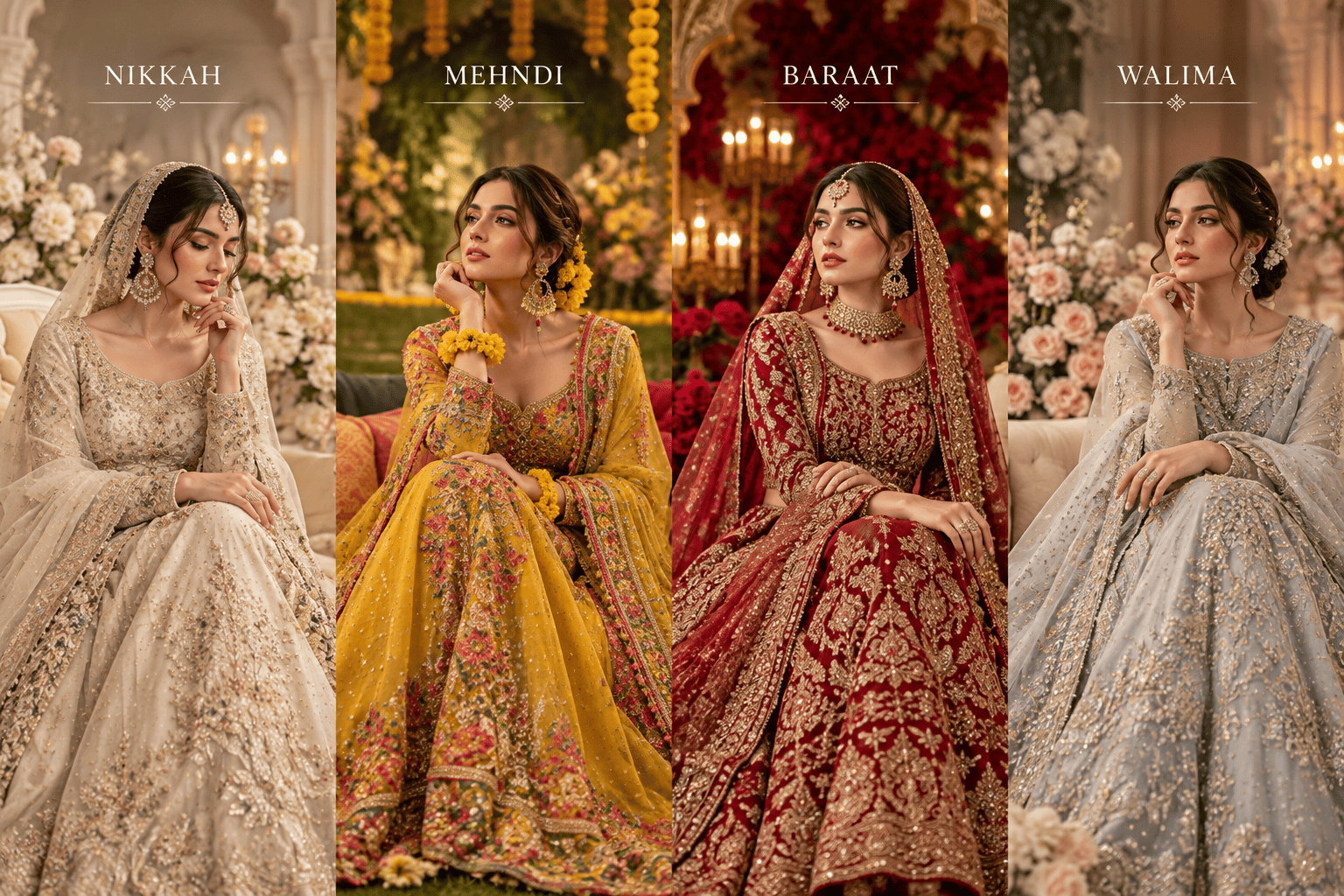
Choosing bridal dress colours can be one of the most enjoyable parts of planning a wedding, but it can also become surprisingly difficult once you begin looking at dozens of shades, fabrics and embroidery combinations.
Red may feel perfect for one bride’s Baraat, while another feels more herself in ivory, emerald or antique gold. A soft sage Nikkah outfit can look understated in daylight but completely different once hand embroidery and jewellery are added. Even two dresses in the same colour can create very different impressions when one is made in silk and the other in organza or tissue.
For UK brides planning several South Asian wedding events, the question is not simply, “Which bridal colour is fashionable?”
A better question is: which colour suits this particular event, fabric, embroidery, venue and bride?
There are no fixed rules requiring a bride to wear one colour for Nikkah and another for Walima. Tradition provides useful inspiration, but the strongest bridal wardrobe feels connected across the wedding while still allowing each event to have its own identity.
If you are currently exploring hand embroidered bridal wear in the UK, thinking about your colour story early can make decisions around embroidery, fabric and customisation much easier.
How to Choose Bridal Dress Colours
The right colour needs to do more than look attractive on a screen.
Begin by considering five things: the wedding event, time of day, venue, fabric and embroidery.
A shade that looks beautiful in natural daylight may appear richer under warm evening lighting. Metallic embroidery can also change how a colour is perceived. Gold handwork tends to add warmth, while silver or crystal embellishment can give the same base shade a cooler character.
Fabric matters just as much.
Deep red silk can feel formal and regal. The same colour used on a sheer organza layer can appear softer. Ivory tissue can reflect light differently from ivory silk, even though both garments may technically belong to the same colour family.
Your jewellery and dupatta add another layer.
This is why bridal colour should be considered as part of the complete look rather than chosen from a swatch in isolation.
Bridal Colour Ideas for Each Wedding Event
The following combinations are useful starting points rather than strict dress codes.
| Wedding Event | Popular Colour Direction | Overall Feeling |
|---|---|---|
| Nikkah | Ivory, champagne, blush, sage, powder blue, soft gold | Refined, graceful and romantic |
| Mehndi | Yellow, green, coral, orange, pink, jewel tones | Joyful, expressive and energetic |
| Baraat | Red, maroon, ruby, deep gold, burgundy, emerald | Ceremonial, rich and statement-making |
| Walima | Ivory, silver, dusty rose, powder blue, sage, lilac, champagne | Polished, elegant and sophisticated |
A bride can comfortably move outside these palettes.
The purpose of the guide is to understand the mood different colours can create, then adapt that mood to your own wedding.
Choosing Nikkah Dress Colours
Nikkah bridalwear often gives brides the opportunity to explore a quieter colour story.
Ivory remains a beautiful choice because it creates a clean backdrop for hand embroidery, jewellery and dupatta detailing. Champagne and warm cream provide a similar softness but can feel slightly richer under indoor lighting.
Pastels are another natural direction.
Powder blue, blush pink, sage green and muted gold can all create an elegant Nikkah look without becoming visually heavy.
The embroidery determines how subtle the final outfit remains.
An ivory dress with delicate resham work can feel soft and intimate. Add dense gold zardozi and the same ivory base becomes considerably more formal.
If your Nikkah takes place during the day, consider looking at fabric and colour samples in natural light before making the final decision.
Studio photographs can make pale colours appear warmer or cooler than they will look at the actual venue.
Ivory Is Not the Only Choice for a Nikkah
It is easy to assume that a Nikkah dress must be ivory or white because those colours have become highly visible in contemporary bridal photography.
They are beautiful choices, but they are not the only choices.
A muted green can feel equally graceful. Dusty rose can create warmth. Powder blue can look sophisticated with silver or antique metallic handwork.
Even deeper colours can work if they reflect the bride’s personal aesthetic and the atmosphere of the ceremony.
The key is restraint in the complete composition.
If the base colour is strong, embroidery can be used selectively. If the shade is very soft, more detailed handwork may help create the required bridal presence.
Choosing Mehndi Outfit Colours
A Mehndi naturally allows more freedom with colour.
Yellow and green remain closely associated with the celebratory mood of the event, but modern bridal styling does not need to stop there.
Coral, fuchsia, orange, lime, turquoise and contrasting jewel tones can all work beautifully.
Multi-coloured resham embroidery can be particularly effective for Mehndi dressing because the threadwork introduces additional colour without relying only on the base fabric.
Movement also matters.
A vibrant colour can become even more expressive when used in a flowing silhouette or lighter dupatta.
For brides who expect to dance or move throughout the event, the colour and embroidery should feel lively without making the garment unnecessarily difficult to wear.
The goal is celebration rather than visual overload.
Should Your Mehndi Dress Be Multicoloured?
It can be, but it does not need to be.
A multicoloured outfit can create a very festive look, particularly when floral threadwork and contrasting borders are involved.
A single strong colour can be equally effective.
For example, an emerald or mustard base with carefully chosen embroidery may feel more sophisticated than combining several competing shades.
Think about what your photographs will already contain.
Mehndi décor often introduces flowers, colourful seating, lighting and other visual elements.
Your outfit should stand out from that environment without becoming disconnected from it.
Choosing Baraat Bridal Dress Colours
For many South Asian brides, the Baraat carries the strongest traditional bridal identity.
Red remains powerful for good reason.
It has visual presence, works beautifully with gold handwork and remains immediately recognisable as a traditional bridal colour.
But red itself is not one colour.
Ruby, scarlet, deep maroon, burgundy and warmer red tones can all produce different results.
A deeper maroon can feel regal and mature. A clearer red can look more traditional and vibrant. Burgundy introduces greater depth, particularly for evening weddings.
Gold and antique metallic embroidery can strengthen this richness even further.
Brides who prefer something outside the red family can also explore emerald, deep plum, burnished gold or other jewel tones.
The most important consideration is whether the colour can support the level of embroidery and formality you want for the main wedding event.
How to Make a Red Bridal Dress Feel Personal
Choosing red does not mean accepting a predictable bridal look.
The individuality comes from the shade, fabric, embroidery and styling.
A red silk base with antique gold zardozi creates a different mood from brighter red paired with more reflective embellishment.
The dupatta can also introduce contrast.
Some brides keep the complete outfit within one red family, while others use a complementary second dupatta or border to create more dimension.
Jewellery changes the result again.
The objective should not be to avoid traditional colours simply because they are traditional.
A familiar colour can feel highly individual when the craftsmanship and design are considered carefully.
Choosing Walima Dress Colours
Walima bridalwear often moves towards a more polished and romantic colour palette.
Dusty rose, silver, ivory, champagne, powder blue, sage and lilac can all work beautifully for a reception.
These shades respond particularly well to evening lighting and refined embellishment.
Silver embroidery can create a cool, contemporary finish.
Gold can warm a pastel base and make it feel more traditional.
Pearls, crystals and cutdana can introduce light without changing the underlying colour story dramatically.
The Walima is also a good occasion to choose a colour that contrasts with the Baraat.
If the main wedding outfit is deep red or maroon, a pastel Walima dress creates a clear visual transition between the two events.
For brides drawn towards softer colours and detailed motifs, the Naqsh collection offers a useful direction for exploring more restrained formal dressing.
How Fabric Changes Bridal Dress Colours
A bridal colour cannot be judged accurately without considering the fabric underneath it.
Silk generally gives colours greater depth.
Organza can soften them because of its sheer quality.
Tissue introduces its own luminosity, which can make neutral and metallic shades especially interesting under evening lighting.
This means that choosing “sage green” is only the beginning.
A sage silk outfit may feel richer and more grounded. A sage organza layer can appear airy and delicate.
The same principle applies to ivory, gold, blue and almost every other bridal shade.
If you have not chosen your fabric yet, read our guide to choosing the right bridal fabric for a UK wedding before confirming a colour.
How Hand Embroidery Changes the Colour Story
Embroidery introduces its own colours into the outfit.
Gold zardozi warms a fabric.
Silver detailing can cool it.
Resham allows several complementary colours to be introduced within one motif, while mukesh and cutdana affect how the surface responds to light.
This becomes particularly important when customising an existing design.
If you change a dress from one colour to another, the original embroidery palette may no longer produce the same effect.
A motif designed for ivory may need adjustment when moved onto emerald.
The base colour and embroidery should therefore be considered together.
For more detail on how different forms of handwork behave, read our guide to Pakistani bridal embroidery techniques including zardozi, dabka, resham, mukesh and cutdana.
How to Choose Bridal Colours for Your Skin Tone
There is no colour that a bride is automatically forbidden from wearing because of her skin tone.
The more useful approach is to compare undertones and contrast.
Some brides prefer colours that harmonise closely with their complexion. Others look their best when the dress creates stronger contrast.
Warm metallics may flatter one colour combination, while cooler silver embroidery works better with another.
Instead of relying on rigid online rules, place the colour close to your face in realistic lighting.
Consider it alongside the jewellery and makeup direction you plan to use.
If possible, compare more than one shade from the same colour family.
A bride who dislikes one pastel pink may discover that a slightly warmer dusty rose works beautifully.
Small shifts in tone can make a large difference.
Consider the Venue Before Finalising Your Colour
Venue colours can influence how your dress appears in photographs.
A ballroom filled with warm golden lighting may make champagne and gold tones appear richer.
A bright modern venue can give ivory, silver and cool pastels a cleaner finish.
Outdoor greenery can provide beautiful contrast with red, ivory, pink and metallic colours.
The décor matters as well.
You do not need your dress to match the flowers or stage exactly.
In fact, too close a match can cause the outfit to disappear into the background.
Aim for harmony or deliberate contrast rather than perfect colour matching.
Your bridal dress should remain the focal point.
Day Wedding vs Evening Wedding Colours
Daylight reveals colour very honestly.
Pastels, ivory, sage and softer embroidery can look particularly beautiful when photographed naturally.
Evening weddings allow deeper colours and reflective detailing to become more dramatic.
Ruby, maroon, emerald, gold and richer jewel tones can gain greater depth under artificial lighting.
This does not mean pale colours belong only to daytime celebrations.
An ivory or powder blue Walima outfit can look exceptional at night when paired with carefully chosen handwork.
Likewise, a deep colour can work beautifully during the day.
Time of day should influence the styling rather than dictate it.
Your Dupatta Does Not Have to Be Exactly the Same Colour
A dupatta can either continue the main colour story or introduce contrast.
A matching dupatta creates a more seamless look.
A second colour can frame the face and make the embroidery more noticeable.
For heavily embroidered bridalwear, even a slight tonal difference can add depth without making the outfit look mismatched.
You can also use embroidery to connect contrasting pieces.
For example, the metallic border or resham motifs on the dupatta can repeat colours from the main garment.
This creates continuity even when the fabrics are not identical shades.
Jewellery Should Be Considered With Colour, Not After It
Jewellery and bridal colour share the same visual space around the face.
If your dress already contains rich antique gold embroidery, gold jewellery can create a cohesive traditional finish.
A cooler pastel with silver or crystal embellishment may support another jewellery direction.
Family heirlooms deserve special consideration.
If you already know you will wear a significant jewellery piece, show it during the design consultation before finalising colour and neckline.
You do not need every accessory chosen before commissioning the dress.
But important pieces should not become an afterthought.
Creating a Colour Story Across Several Wedding Events
One of the easiest mistakes when planning several outfits is choosing each dress completely independently.
The result can be four beautiful garments that feel strangely repetitive.
Instead, think about the wedding wardrobe as a sequence.
You might choose:
Soft ivory or sage for Nikkah.
A brighter yellow, green or coral direction for Mehndi.
Deep red or maroon for Baraat.
Powder blue, champagne or dusty rose for Walima.
This creates contrast from event to event while maintaining an overall sense of progression.
You can also repeat small elements.
A particular metallic embroidery tone may appear across two outfits. A floral colour introduced on the Mehndi may return more subtly on the Walima.
The wardrobe feels connected without becoming identical.
Should You Follow Bridal Colour Trends?
Trends can be useful for inspiration, but a bridal outfit should survive longer than a trend cycle.
Wedding photographs will remain long after a particular colour stops appearing frequently on social media.
Choose a shade because it suits the garment and feels right to you.
That may be a traditional red.
It may be ivory.
It may be sage green, blue or something entirely different.
A well-designed bridal dress does not need to prove that it belongs to one particular season.
Craftsmanship, fit and colour balance tend to age better than an outfit built entirely around a short-lived trend.
Customising the Colour of a Made to Order Bridal Dress
Made to order bridalwear can offer greater flexibility when a bride loves a design but wants another colour direction.
However, colour changes should be discussed before production begins.
Fabric availability matters.
Embroidery colours may need to change.
The dupatta and lining may also need adjustment to preserve the balance of the original design.
If several other elements are also being modified, it becomes even more important to consider the complete outfit rather than approving changes one at a time.
Our guide to ready made vs made to order bridal wear in the UK explains where this extra flexibility can become valuable.
Look at Finished Designs Before Choosing From a Swatch
A small fabric swatch cannot show you how an entire bridal outfit will behave.
Whenever possible, look at completed garments in similar colours.
Notice how the embroidery changes the shade.
Observe the dupatta.
Look at how the colour responds under both close photography and full-length views.
For product inspiration, you can explore Nayla and Noorie to see how colour, hand embellishment and silhouette work together in finished Abdullah Bin Shahbaz designs.
Use these references for direction rather than trying to copy a look exactly.
Your own wedding event, styling and customisation should guide the final decision.
Discuss Colour During Your Bridal Consultation
Colour should be one of the first meaningful design conversations, not a final detail added after everything else has been decided.
Tell the designer which shades you are considering.
Explain the wedding event and venue.
Discuss whether you prefer warm gold, antique metallic work, silver embellishment or more colourful resham.
If you already know the jewellery direction, mention that too.
The clearer your colour brief is, the easier it becomes to make decisions about fabric and embroidery.
Before your consultation, read our complete guide to questions to ask during a bridal wear consultation in the UK.
FAQs About Bridal Dress Colours
Q: What are the most popular bridal dress colours?
A: Red, maroon, ivory, champagne, blush, sage, powder blue, gold and other pastel or jewel tones are all used in contemporary South Asian bridalwear. The best choice depends on the wedding event, fabric, embroidery and bride’s personal style.
Q: What colour is best for a Nikkah dress?
A: Ivory, champagne, blush, sage and powder blue are popular choices because they create a refined look, but a Nikkah dress can be any colour that suits the bride and ceremony. There is no requirement to choose a pale shade.
Q: Which colours work well for a Mehndi outfit?
A: Yellow, green, orange, coral, pink and vibrant jewel tones naturally suit the celebratory mood of a Mehndi. Multi-coloured resham embroidery can also add colour without requiring several base fabrics.
Q: Is red still a good colour for a Baraat dress?
A: Yes. Red remains one of the strongest traditional Baraat colours and works beautifully with gold and metallic handwork. Maroon, ruby, burgundy, emerald and deep gold are also strong alternatives.
Q: What are good Walima dress colours?
A: Ivory, champagne, dusty rose, powder blue, sage, silver and lilac can all create an elegant Walima look. The final choice should consider evening lighting, embroidery and jewellery.
Q: Should my bridal colour match the wedding décor?
A: It does not need to match exactly. A complementary or contrasting shade can actually help the bride stand out more clearly in photographs.
Q: Can the colour of a made to order bridal dress be changed?
A: Colour customisation may be possible depending on the design and fabric. Changes should be discussed before production because embroidery, lining, dupatta and embellishment colours may also need adjustment.
Q: Does fabric change how a bridal colour looks?
A: Yes. Silk can give a colour greater richness, organza can make it appear softer and more transparent, while tissue can introduce luminosity. The same named shade can look noticeably different across fabrics.
Conclusion
Choosing bridal dress colours is not about finding one shade that every bride should wear.
It is about creating the right relationship between colour, fabric, embroidery, wedding event and personal style.
A soft ivory can become highly formal through metallic handwork. Red can feel traditional or contemporary depending on its shade and silhouette. Sage, powder blue and dusty rose can create beautifully refined bridal looks when the fabric and embroidery support them.
For brides planning several wedding events, thinking about the complete colour story also helps each outfit feel distinct.
Your Nikkah, Mehndi, Baraat and Walima can each have their own personality without looking like four unrelated choices.
At Abdullah Bin Shahbaz, bridal pieces are made to order with custom sizing, premium fabrics and traditional hand embellishment. Explore our hand embroidered bridal wear for UK brides and discuss your preferred colour, fabric, embroidery and wedding event with the team before finalising your bridal design.