
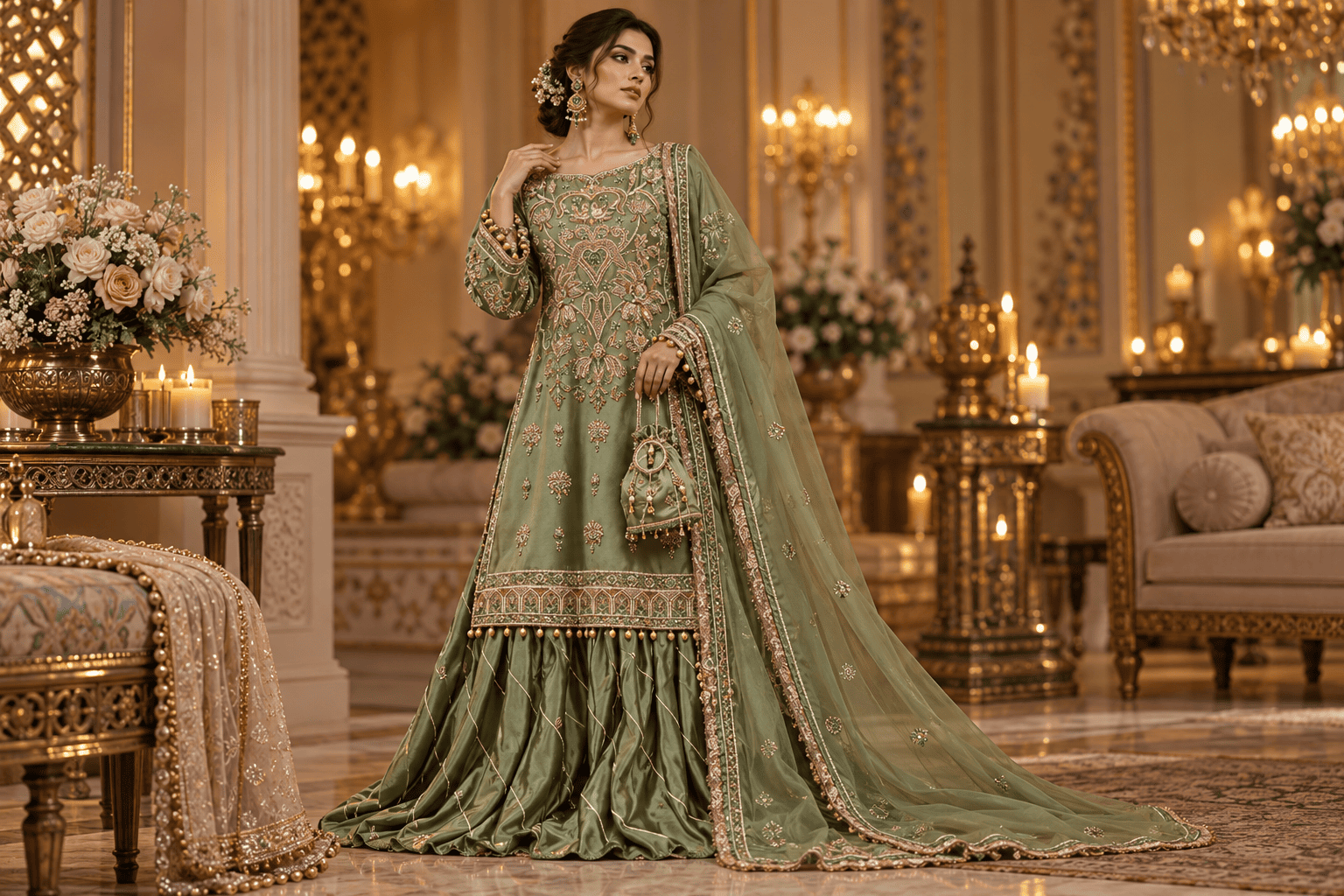
Choosing between ready made and made to order bridal wear is one of the first decisions many brides face when they begin looking for their wedding outfit. Both options can produce a beautiful result, but they offer very different levels of flexibility, fit, craftsmanship and involvement in the design process.
For a UK bride planning a Nikkah, Mehndi, Baraat or Walima, the right choice depends on more than convenience. The wedding event, preferred silhouette, measurements, embroidery expectations, timeline and level of customisation should all be considered before deciding which route suits you best.
A ready made bridal outfit allows you to choose from a garment that already exists. Made to order bridalwear, by contrast, is produced after the order is confirmed and can often be developed around personal measurements and agreed design details.
Neither option is automatically better for every bride.
The important question is whether you want to select an existing garment that already meets your requirements or commission an outfit that can be shaped more closely around your measurements, wedding event and design preferences.
What Is Ready Made Bridal Wear?
Ready made bridal wear refers to garments that have already been produced in predetermined designs and standard sizes.
The main advantage is immediacy. A bride can see the finished outfit, understand its colour and embroidery and often determine quickly whether the available size works for her.
This can be useful when the wedding date is approaching or when a bride finds a design that already matches what she wants without substantial alteration.
Ready made bridalwear may include everything from lightly embellished occasionwear to heavily worked formal dresses. The fact that a garment is ready made does not automatically indicate its quality. The important distinction is simply that the main design, sizing and construction have already been decided before the bride purchases it.
The level of alteration available depends on the garment.
Small changes may be possible, but substantial adjustments to an embroidered bodice, neckline or fitted sleeve can be more difficult once the garment has already been completed.
What Is Made to Order Bridal Wear?
Made to order bridal wear is produced after the bride confirms her chosen design and requirements.
The garment may be created according to personal measurements rather than relying entirely on a standard size. Depending on the designer, brides may also be able to discuss colour, sleeves, neckline, dupatta details, embroidery density or other aspects of the original design.
This approach is particularly relevant for hand embroidered couture.
When techniques such as zardozi, dabka, resham, mukesh and cutdana are being developed directly onto the fabric, planning the garment before production allows the embroidery and construction to work together more naturally.
Abdullah Bin Shahbaz creates hand embroidered bridal wear for UK brides on a made to order basis, combining traditional artisan techniques with custom sizing and individual design considerations.
Ready Made vs Made to Order Bridal Wear: A Quick Comparison
The differences become easier to understand when the two options are compared directly.
| Feature | Ready Made Bridal Wear | Made to Order Bridal Wear |
|---|---|---|
| Production | Garment already exists before purchase | Garment is produced after the order is confirmed |
| Sizing | Based mainly on standard sizes | Can be developed around personal measurements |
| Customisation | Usually limited | May include colour, sleeves, neckline, dupatta or embroidery changes |
| Embroidery Planning | Already completed | Can be considered alongside the final garment requirements |
| Timeline | Usually faster if the correct size is available | Requires production time |
| Design Flexibility | Bride chooses from existing options | Greater opportunity to personalise an existing design |
| Fitting | Alterations may be required | Fit can be considered before construction |
| Best For | Brides who find the right existing outfit or have a shorter timeline | Brides prioritising fit, craftsmanship and personalisation |
The most important point is that convenience and customisation sit at opposite ends of the comparison.
Ready made garments offer speed and certainty because the finished design already exists. Made to order bridalwear offers more opportunity to shape the garment before it is completed.
Which Option Gives a Better Bridal Fit?
Fit is one of the strongest reasons a bride may prefer made to order bridalwear.
A standard size must accommodate a wide range of body proportions. Two brides may both wear the same nominal clothing size while having different shoulder widths, sleeve lengths, waist positions or overall heights.
These differences become more noticeable in formal bridalwear.
A heavily embroidered bodice needs to sit correctly across the shoulders and waist. Sleeve embroidery should finish at the intended point. A lehenga or pishwas needs the right length to work with the bride’s footwear and overall proportions.
Made to order construction allows measurements to influence the garment before it is completed.
This can reduce the need for major alterations later, particularly in areas where embroidery has already been positioned around seams or borders.
Ready made bridalwear can still work beautifully when the bride finds a size that suits her proportions. The difference is that the fit must be assessed after the garment already exists.
How Hand Embroidery Changes the Decision
The distinction between ready made and made to order becomes particularly important when hand embroidery is involved.
Hand embellished bridalwear is developed gradually. Artisans apply motifs, metallic work, beads and thread directly onto the fabric according to the intended design.
If the garment is being produced around the bride’s measurements, the designer can consider how the embroidery should sit within those proportions.
For example, the neckline embroidery can be positioned according to the final bodice. Borders can be planned around the intended garment length. Sleeve motifs can be arranged according to the sleeve design rather than altered significantly after completion.
With a ready made heavily embroidered garment, major alterations may be more complicated because changing the shape of the garment can disturb existing motifs.
This does not make alteration impossible, but it is worth considering before purchase.
How Much Customisation Do You Actually Need?
Not every bride who chooses made to order bridalwear needs a completely original design.
In many cases, the bride already loves an existing collection piece and simply wants it adapted more naturally to her requirements.
Useful customisation might include a different colour, adjusted sleeve length, an alternative neckline, more or less embroidery, custom measurements or changes to dupatta detailing.
These adjustments can make a significant difference without replacing the central identity of the garment.
The key is to decide which changes have a genuine purpose.
If you like the silhouette, embroidery and colour of a ready made dress exactly as they are and the fit works well, extensive customisation may offer little additional value.
If you love a design but need changes to its proportions, coverage, colour or overall level of handwork, made to order becomes more relevant.
Ready Made vs Made to Order for Different Wedding Events
The wedding occasion can also influence which option feels more appropriate.
| Wedding Event | Ready Made May Suit You If | Made to Order May Suit You If |
|---|---|---|
| Nikkah | You find a refined outfit in the right colour and fit | You want a specific neckline, colour or delicate embroidery direction |
| Mehndi | You need an existing colourful outfit with comfortable movement | You want personalised colour combinations or embellishment |
| Baraat | A completed heavily embroidered outfit already fits your requirements | You want richer handwork, custom measurements or a statement bridal silhouette |
| Walima | You find an elegant finished design that coordinates with your styling | You want a particular pastel, fabric, silhouette or embroidery balance |
These are practical examples rather than strict rules.
A made to order Nikkah dress can be heavily embellished, while a Baraat bride may deliberately choose something more restrained.
The bride’s own style should remain more important than convention.
When Ready Made Bridal Wear Makes Sense
Ready made bridalwear can be the right choice when three things already align: the design, fit and timing.
If you discover a completed bridal outfit that reflects your personal style, suits the wedding event and fits well, there may be little reason to make the process more complicated.
Ready made can also be useful when the wedding is relatively close and there is insufficient time for extensive made to order production.
Another advantage is certainty.
You can usually see exactly how the finished embroidery, fabric and colour work together before committing to the purchase. For brides who prefer to make decisions from a completed garment rather than imagine how custom changes will appear, this can be reassuring.
The important step is to inspect the outfit carefully.
Look at the handwork, seams, lining, borders and dupatta. Assess how much alteration is required and whether those changes could interfere with the original embroidery.
When Made to Order Bridal Wear Makes More Sense
Made to order becomes particularly useful when fit and personalisation matter as much as the original design.
A bride may love the embroidery of a collection piece but want another colour. She may require longer sleeves, a different neckline or adjusted proportions. She may also want to modify the embroidery density according to the scale of her wedding event.
These are all situations where planning the garment before production can offer greater flexibility.
Made to order bridalwear is also relevant when the bride is investing in extensive hand craftsmanship.
If detailed embroidery is going to require significant artisan work, developing the garment around accurate measurements from the beginning can help protect that workmanship.
Brides drawn to richer formal handwork can explore the Zarposh collection, while those who prefer a softer design language can explore Naqsh.
Does Made to Order Mean Bespoke?
Made to order and bespoke are sometimes used interchangeably, but they do not necessarily describe exactly the same service.
A made to order garment is generally produced after the order has been placed, often using an existing design as the starting point. Measurements and selected details may then be adapted for the bride.
A fully bespoke garment usually involves a more extensive design process in which the outfit is developed specifically for one client.
The exact meaning depends on the designer, so brides should ask what is included rather than relying entirely on terminology.
If you are selecting an existing bridal design but changing the colour, measurements or certain details, that may still be a made to order commission rather than a completely new bespoke design.
Clarity is more important than the label.
Which Option Is Better for Bridal Dress Alterations?
Ready made garments may require alterations after purchase, while made to order garments aim to reduce the amount of adjustment required by incorporating measurements earlier.
However, neither process guarantees that no final checking will ever be needed.
Bridalwear is more complex than everyday clothing. The weight of embroidery, fabric structure, footwear and styling can affect how the finished garment sits.
The important difference is where the major fitting decisions occur.
With made to order bridalwear, measurements become part of the production brief.
With ready made clothing, the garment has already been constructed and must be adjusted around the bride afterward.
For lightly decorated garments, those changes may be straightforward. For heavily hand embroidered couture, alterations can require greater care.
Does Made to Order Bridal Wear Take Longer?
Yes, made to order bridalwear generally requires more planning because the garment still needs to be produced.
The timeframe depends on the embroidery density, silhouette, fabric, customisation and number of garment pieces.
A heavily worked Baraat ensemble involving detailed embroidery across a lehenga, bodice and dupatta has different production requirements from a more restrained outfit with selective handwork.
This is why the wedding date should be discussed before the commission is confirmed.
Read also: If you are beginning your bridalwear planning, see our guide on how early to order your bridal dress in the UK to understand how production, embroidery and customisation can affect your timeline.
Is Made to Order Bridal Wear Always More Expensive?
Not necessarily.
The final cost of bridalwear depends on considerably more than whether the garment is ready made or made to order.
Fabric, embroidery technique, embroidery density, silhouette, additional pieces, finishing and customisation all influence the amount of work involved.
A very heavily embellished ready made couture piece can involve more craftsmanship than a relatively restrained made to order outfit.
This is why brides should avoid comparing bridal dresses using a single label.
Instead, compare what is actually included in the garment.
Consider the quality of the fabric, whether the embroidery is worked by hand, how much customisation is involved and whether the garment is being produced around individual measurements.
Read also: Learn more about what affects the cost of hand embroidered bridal wear before comparing bridal quotations.
How to Decide Which Option Is Right for You
A useful decision begins with your priorities rather than with terminology.
Ask yourself whether you already know exactly what you want or whether you need flexibility.
If your ideal garment exists in the right size, colour and silhouette, ready made bridalwear may provide everything you need.
If the design is close but not quite right, made to order gives you more opportunity to refine it.
Also think about how important precise fit is to you. Consider whether you want authentic hand embroidery and whether modifications to the neckline, sleeves or dupatta are important.
Your wedding date matters too.
The most beautiful made to order option is not useful if the production requirements cannot realistically work with your timeline.
The strongest decision is the one that balances design, craftsmanship, fit and practical planning.
Questions to Ask Before Buying Ready Made Bridal Wear
Before buying a ready made bridal dress, inspect the garment rather than judging it from photographs alone.
Ask whether the displayed piece is the exact garment you will receive and whether any alterations have already been made to it.
Find out which areas can safely be adjusted.
If the bodice is heavily embroidered, changing its size significantly may affect the motif placement. If the hem has an elaborate border, shortening the garment may require specialist work.
You should also confirm what is included.
A photograph may show jewellery, an additional dupatta or styling accessories that are not part of the garment itself.
Knowing exactly what you are buying makes comparison easier.
Questions to Ask Before Ordering Made to Order Bridal Wear
Made to order bridalwear requires a different conversation.
Ask how your measurements will be collected and which customisations are available.
Confirm the fabric, colour, neckline, sleeves, dupatta and embroidery level before production begins. If you are changing an existing collection design, make sure the agreed changes are clearly understood.
Discuss your wedding date at the beginning rather than at the end.
You should also understand which garment pieces are included in the commission and whether any requested additions affect the design or production requirements.
A clear bridal brief creates a smoother process and gives the designer a better understanding of what you expect from the finished outfit.
Why the Designer’s Craftsmanship Matters in Either Option
Whether you choose ready made or made to order bridalwear, craftsmanship remains important.
The garment should be evaluated through its fabric, embroidery, finishing and overall construction.
Look at how borders align, how the neckline has been finished and whether the sleeve embroidery feels connected to the rest of the design.
Examine the dupatta closely.
These areas often reveal the level of attention given to the garment more clearly than the main front photograph.
Luxury bridalwear should remain convincing when viewed from close range.
You can learn more about the hand embellishment and design philosophy behind the collections through the Abdullah Bin Shahbaz story.
FAQs About Ready Made vs Made to Order Bridal Wear
Q: What is the main difference between ready made and made to order bridal wear?
A: Ready made bridalwear is produced before the bride purchases it and normally follows standard sizing. Made to order bridalwear is produced after the order is confirmed and can often incorporate personal measurements and agreed customisation.
Q: Is made to order bridal wear better than ready made?
A: Neither option is automatically better. Ready made can be ideal when the existing design and size already suit the bride. Made to order is particularly useful when custom sizing, colour changes, design adjustments or greater personalisation are required.
Q: Can a ready made bridal dress be altered?
A: Many ready made garments can be altered, but the amount of adjustment depends on the construction and embroidery. Extensive alterations to heavily embellished areas may be more complicated because they can disturb motifs, seams or borders.
Q: Can I change the colour of a made to order bridal dress?
A: Colour customisation may be available depending on the designer and garment. Any change should be confirmed before production because the colour needs to work with the selected fabric, embroidery and embellishment.
Q: Does made to order bridal wear take longer?
A: Made to order bridalwear requires production time because the garment is created after the order is placed. The exact timeframe depends on the fabric, embroidery, silhouette and level of customisation.
Q: Is made to order the same as bespoke bridalwear?
A: Not always. Made to order often begins with an existing design that is produced according to selected measurements and agreed changes. Bespoke can involve creating a more extensively individual design from the beginning. The exact service should always be confirmed with the designer.
Q: Which option is better for heavily embroidered bridal dresses?
A: Made to order can be particularly useful for heavily embroidered garments because measurements and construction can be considered before the handwork and finishing are completed. However, a ready made heavily embroidered dress can also work well if the existing fit and design already suit the bride.
Conclusion
The choice between ready made and made to order bridal wear is ultimately a choice between selecting an existing garment and having greater involvement before the garment is completed.
Ready made bridalwear offers convenience, a visible finished result and a shorter purchasing process when the right size and design are already available.
Made to order bridalwear offers greater flexibility around measurements, colour, embroidery and other design details. For brides investing in hand craftsmanship, it also allows the construction of the garment to be considered alongside the embroidery from an earlier stage.
For UK brides planning a Nikkah, Mehndi, Baraat or Walima, neither option should be chosen simply because one sounds more luxurious. The better choice is the one that suits your wedding, timeline, preferred level of craftsmanship and personal requirements.
At Abdullah Bin Shahbaz, bridal pieces are created on a made to order basis using custom sizing, premium fabrics and traditional hand embellishment. Explore our hand embroidered bridal wear for UK brides and speak with the team about your preferred design, measurements and wedding event before commissioning your bridal outfit.