
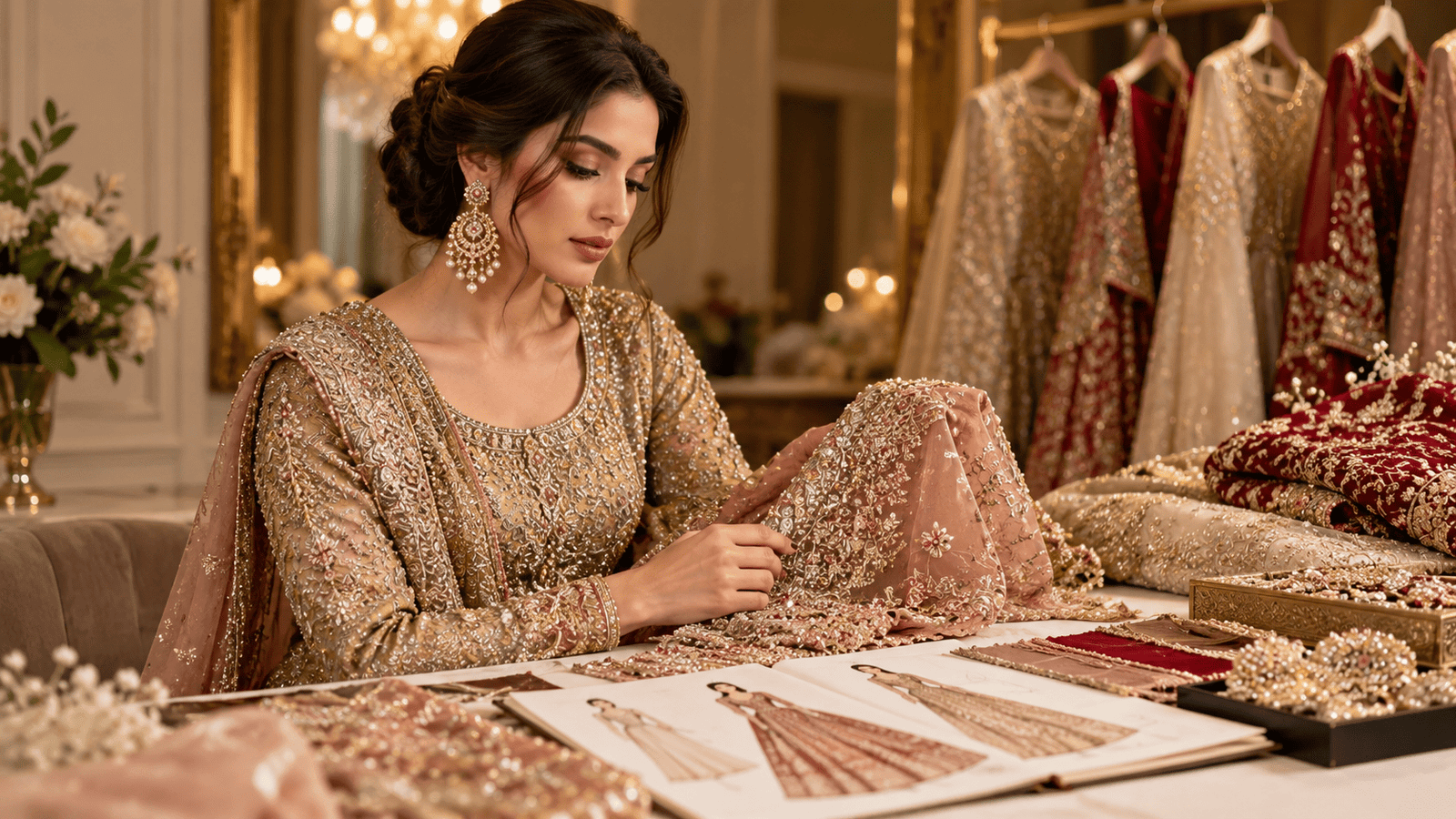
Buying your bridal outfit is one of the most considered fashion decisions you are likely to make. An Asian bridal dress is rarely chosen for a few hours of wear alone. It becomes part of the visual identity of your wedding, appears throughout photographs and films, carries cultural references and often represents many hours of specialist craftsmanship.
For UK brides, there is also an unusually wide choice. You may find ready made bridal outfits, made to order collections, heavily embellished Pakistani bridalwear, contemporary South Asian couture and dresses described as handmade even when only part of the embellishment has been completed by hand.
That variety is useful, but it makes it important to understand exactly what you are buying.
A beautiful campaign photograph can introduce you to a dress, but photographs alone should not determine a bridal purchase. Before commissioning your outfit, look more closely at the craftsmanship, fabric, fit, customisation process, communication and finishing. These details are what separate a bridal dress that simply looks impressive online from one that continues to feel exceptional when it arrives.
Understand What You Are Actually Buying
Terms such as luxury, couture, bespoke, handcrafted and designer are widely used in bridal fashion, but they do not always mean the same thing.
Before placing an order, establish whether the garment is ready made, made to order or being substantially customised for you.
A ready made piece has already been produced in a predetermined size and design. A made to order outfit is produced after your order is confirmed and can often be created according to your measurements. A more extensively customised piece may also allow changes to colour, sleeves, neckline, silhouette, embroidery density or other design elements.
None of these approaches is automatically right or wrong. What matters is knowing which service you are paying for.
If you expect an outfit to be made according to your measurements, confirm that before ordering. If you want colour changes or adjustments to the embroidery, establish whether those changes are possible before production begins.
Clear expectations at the beginning are especially important when purchasing luxury bridalwear because highly embellished garments can be much more difficult to alter after the handwork has been completed.
Look Closely at the Quality of the Hand Embroidery
One of the first things to evaluate when buying premium Asian bridalwear is whether the embroidery genuinely supports the luxury positioning of the dress.
Traditional techniques such as zardozi, dabka, mukesh, resham and cutdana create physical texture. When worked carefully by hand, embroidery develops dimension because threads, metallic elements, beads and embellishments are individually positioned across the fabric.
Look beyond a distant full length photograph.
Close images of the neckline, sleeves, bodice, dupatta and borders can tell you considerably more about the workmanship. You should be able to see how motifs have been constructed, how embellishments sit against the fabric and whether detailed areas maintain the same level of finishing as the most visible parts of the outfit.
Machine embroidery can also produce attractive garments, but it has a different production process and visual character. If authentic hand craftsmanship matters to you, the distinction should be clear before you make the purchase.
Brides comparing premium options can explore Abdullah Bin Shahbaz’s hand embroidered bridal wear in the UK, where made to order pieces are developed using traditional artisan techniques and custom sizing.
Do Not Judge Quality Only by How Heavy the Dress Looks
A heavily embellished dress is not automatically a better made dress.
This is particularly important when shopping for Asian bridalwear because dense embroidery can create an immediate visual impression. However, the quantity of embellishment and the quality of embellishment are two different things.
A well designed bridal outfit should have a clear relationship between its silhouette, fabric, motifs and embroidery placement. Some dresses need concentrated metallic work to achieve the intended formality. Others become more sophisticated when individual motifs have room to breathe.
Examine whether the embroidery enhances the structure of the dress rather than merely covering its surface.
Borders should feel proportionate to the garment. Neckline work should frame rather than overwhelm. Sleeve embroidery should work with movement, and dupatta embellishment should complement the rest of the outfit rather than appearing disconnected from it.
Luxury is often visible in restraint and precision as much as in quantity.
Ask What Fabrics Are Being Used
The fabric underneath the embroidery has a direct impact on how a bridal outfit looks, moves and lasts.
Silk, organza, tissue and other premium fabrics behave differently when embellished. Some create structure and presence, while others give the garment a softer movement. The weight and density of embroidery should also make sense for the material supporting it.
When considering a bridal dress online, look for clear information about the fabric rather than relying solely on words such as premium or luxury.
Ask how the material behaves when worn. Consider whether it suits the season, your venue and the amount of time you will spend in the outfit.
A fabric can look beautiful in a static photograph while feeling very different after several hours of sitting, standing and walking. Bridalwear has to perform during the event as well as photograph well before it.
The Abdullah Bin Shahbaz Zarposh collection uses richer metallic handwork and formal silhouettes, with fabrics selected to support the depth and structure of the embellishment.
Check Whether the Outfit Can Be Made to Your Measurements
Fit has an enormous influence on how expensive bridalwear looks when worn.
Even exceptional embroidery can lose its impact if the shoulder line, sleeve length, waist, neckline or overall proportions are incorrect.
This is why made to order bridalwear can offer an important advantage for brides who want a more precise result. Instead of purchasing the nearest standard size and expecting extensive alterations afterward, the outfit can be developed according to measurements supplied before production.
Ask how measurements are collected and whether the designer reviews them before the garment is cut.
The process should also account for the type of outfit being created. A lehenga, gharara, sharara, pishwas or straight formal ensemble will not necessarily require exactly the same fit considerations.
Do not assume that knowing your ordinary clothing size provides enough information for a bridal commission. Bridalwear often has more structure, layering and detailed surface work, so precision becomes considerably more important.
Understand Which Customisations Are Possible
Customisation can make a bridal outfit feel personal, but it should be approached carefully.
Many brides do not need to redesign an entire outfit. A change to colour, sleeve length, neckline, dupatta, measurements or embroidery density may be enough to make an existing design work beautifully for the wedding.
Ask which parts of the design can reasonably be changed without compromising its original balance.
If you request several significant alterations simultaneously, you are no longer making a small adjustment. You are moving closer to a new couture commission, which may affect the design process and production requirements.
It is also useful to distinguish between functional customisation and purely decorative changes.
Accurate sizing can improve how the garment sits on the body. Changing a neckline may make the design more appropriate for your preferred level of coverage. Adjusting embroidery density may make an outfit better suited to a particular wedding event.
Those decisions can provide more meaningful value than changing details simply for the sake of making the piece different.
Make Sure the Dress Matches the Wedding Event
Asian weddings often involve several celebrations, and each one can support a different bridal identity.
A Nikkah outfit may be intimate and refined. Mehndi dressing can introduce more movement and colour. Baraat bridalwear often carries greater visual weight and ceremonial presence, while Walima dressing can move toward softer palettes or another interpretation of formal luxury.
Consider the outfit within the context of the event rather than assessing it in isolation.
The venue, time of day, jewellery, styling and photography all influence how the dress will ultimately appear.
A bridal outfit that looks spectacular in a campaign may still be the wrong choice if its weight, colour or formality does not suit the celebration you are planning.
This is one reason consultation matters. A good bridal discussion should begin with the occasion and the bride rather than simply with whatever garment happens to be available.
Examine the Dress From More Than One Angle
Front facing campaign photography gives only part of the picture.
Before committing to a significant bridal purchase, try to understand the back of the dress, sleeve work, side profile, dupatta border, hem and close embroidery details.
Video can be particularly useful because it shows how the fabric and embellishment respond to movement and changing light.
Metallic threadwork, crystals, mukesh and other reflective details can appear very different when the wearer moves compared with a still image.
This also helps you assess the silhouette more accurately. You can see whether a skirt falls naturally, whether the dupatta has enough fluidity and whether the outfit maintains its shape while being worn.
The goal is to reduce the distance between what you expect from the photographs and what you experience when the outfit is eventually in front of you.
Look for a Clear Design Identity
Strong bridalwear should feel designed rather than assembled.
When viewing a designer’s collection, look for continuity in the craftsmanship, motifs, silhouettes and overall design language. This can tell you whether the garments come from a deliberate creative direction or simply follow whatever visual trend happens to be popular.
At Abdullah Bin Shahbaz, the collections intentionally take different approaches.
Zarposh draws from Timurid architectural references and uses richer metallic surfaces, while the Naqsh collection turns toward softer Mughal inspired motifs, refined threadwork and a more delicate visual expression.
Understanding that difference helps a bride choose according to her own aesthetic rather than simply asking which collection appears more heavily embellished.
Some brides naturally respond to grandeur and structure. Others prefer a quieter level of detail that reveals itself gradually.
Neither is inherently more luxurious. The better choice is the one that feels coherent with the bride and her event.
Research the Craftsmanship Behind the Brand
For a premium bridal purchase, it is reasonable to want to understand where and how the garments are being created.
Look for information about the artisans, production process, materials and design philosophy.
A brand that places craftsmanship at the centre of its positioning should be able to explain what that craftsmanship actually involves.
Abdullah Bin Shahbaz describes its production around authentic hand embellishment, artisan skills developed in Gujranwala and premium fabrics, with the brand’s background and approach explained in the Abdullah Bin Shahbaz story.
For a bride, this information provides context. You are not simply looking at a finished product. You can understand something about the people, methods and standards behind it.
That becomes particularly valuable when comparing two outfits that may appear similarly impressive on a screen but have been produced in very different ways.
Assess Communication Before You Place the Order
The quality of communication before an order can tell you a great deal about what the purchasing experience may be like afterward.
A bridal consultation should make room for specific questions.
You should be able to discuss your wedding event, measurements, preferred colour, level of embellishment and any customisation you are considering. If there are aspects of the design that cannot reasonably be changed, it is better to understand that clearly before committing.
Avoid making assumptions about production or customisation simply because something appears possible in a photograph.
Written confirmation of important details can also be useful, particularly when several changes have been discussed.
The purpose is not to make the process overly complicated. It is to ensure that both bride and designer have the same understanding of the final garment.
Confirm the Production Process Before Ordering
Made to order bridalwear requires time because the garment does not simply come from existing stock.
Fabric preparation, cutting, embroidery, stitching and finishing may take place across several stages, particularly when the surface work is being completed by hand.
Before placing the order, provide your wedding date and ask whether the chosen design can realistically be completed within the available period.
Do not choose an elaborate bridal piece and leave the timing discussion until afterward.
This article is deliberately not giving a universal number of weeks because production depends on the actual design, embroidery density and customisation required. The most reliable timeframe is the one confirmed for your particular commission.
Your wedding date should therefore be treated as part of the design brief rather than an administrative detail.
Think About How the Dress Needs to Feel, Not Only How It Needs to Look
A wedding outfit is worn, not displayed.
Imagine how the garment will behave during the actual celebration. Will you be sitting for a long ceremony? Walking through a large venue? Taking outdoor photographs? Wearing a second dupatta? Dancing later in the evening?
These questions can influence the right skirt volume, embroidery weight, sleeve structure and dupatta arrangement.
Luxury bridalwear should create visual impact without making the bride spend the entire wedding managing the garment.
A dress that allows confident movement often appears more beautiful because the bride is comfortable wearing it.
This consideration becomes especially important with heavily hand embellished outfits, where fabric choice and embroidery placement can significantly change the overall weight.
Do Not Let Trends Make Every Decision for You
Bridal trends can be useful for discovering colours, silhouettes and styling ideas, but they should not replace personal judgement.
Wedding photographs remain long after a particular bridal trend disappears.
Consider which design elements genuinely feel connected to your own style and cultural preferences. A classic red, antique gold or jewel toned outfit can remain meaningful regardless of changing colour trends. Equally, an ivory or pastel bridal palette can work beautifully when it reflects the bride and the atmosphere of the event.
The same applies to silhouettes.
Choose a lehenga, gharara, sharara, pishwas or another form because it supports the overall bridal look you want, not simply because it is receiving more attention during the current season.
The most successful couture usually balances contemporary refinement with enough design integrity to remain beautiful beyond a single trend cycle.
A Bridal Purchase Should Give You Confidence Before the Wedding Day
Buying Asian bridal wear should not require you to choose between beautiful design and confidence in what you are ordering.
The strongest purchase begins with information.
Understand whether the garment is made to order. Examine the handwork closely. Ask about the fabric. Confirm how measurements and customisation are handled. Think about the wedding event, inspect more than the front photograph and make sure the production process is understood before your order begins.
When those elements are clear, the decision becomes much easier.
You are no longer choosing between photographs. You are comparing craftsmanship, design, fit and the experience behind the garment.
For brides looking for handcrafted South Asian couture, Abdullah Bin Shahbaz creates made to order bridal and formal pieces with custom sizing and traditional hand embellishment. Explore the collections according to the level of craftsmanship, silhouette and visual character that best suits your wedding, then discuss your preferred design and requirements with the team before commissioning your piece.
Frequently Asked Questions About Buying Asian Bridal Wear in the UK
What should I check before buying Asian bridal wear?
Check whether the outfit is ready made or made to order, what fabric is used, whether the embroidery is genuinely hand worked, how measurements are handled and which customisations are possible. You should also discuss your wedding date before confirming a made to order commission.
Is made to order Asian bridal wear better than ready made?
Neither option is automatically better for every bride. Ready made bridalwear may suit someone who finds the right design and fit without significant changes. Made to order can be particularly valuable when you require custom sizing, colour adjustments or other design modifications.
How can I judge bridal embroidery when shopping online?
Look for detailed close photographs and, where available, video showing the embroidery under different angles and lighting. Examine the neckline, sleeves, borders and dupatta as well as the main bodice. Genuine handwork usually has physical texture and slight variation that becomes easier to appreciate in close views.
What questions should I ask before ordering a custom bridal dress?
Discuss the fabric, measurements, colour, embroidery level, permitted customisations, wedding event and production expectations. If changes are being made to an existing design, make sure both you and the designer are clear about exactly what will remain the same and what will change.
Which Asian bridal style should I choose for my wedding?
The right style depends on the occasion, venue, personal aesthetic and level of formality. Nikkah, Mehndi, Baraat and Walima celebrations can each support different colours, silhouettes and embroidery levels, so the outfit should be chosen in the context of the event rather than in isolation.
Is heavier embroidery always more luxurious?
No. Embroidery density and embroidery quality are different. Luxury is also influenced by the skill of the handwork, fabric quality, motif placement, finishing, silhouette and the way all of those elements work together.