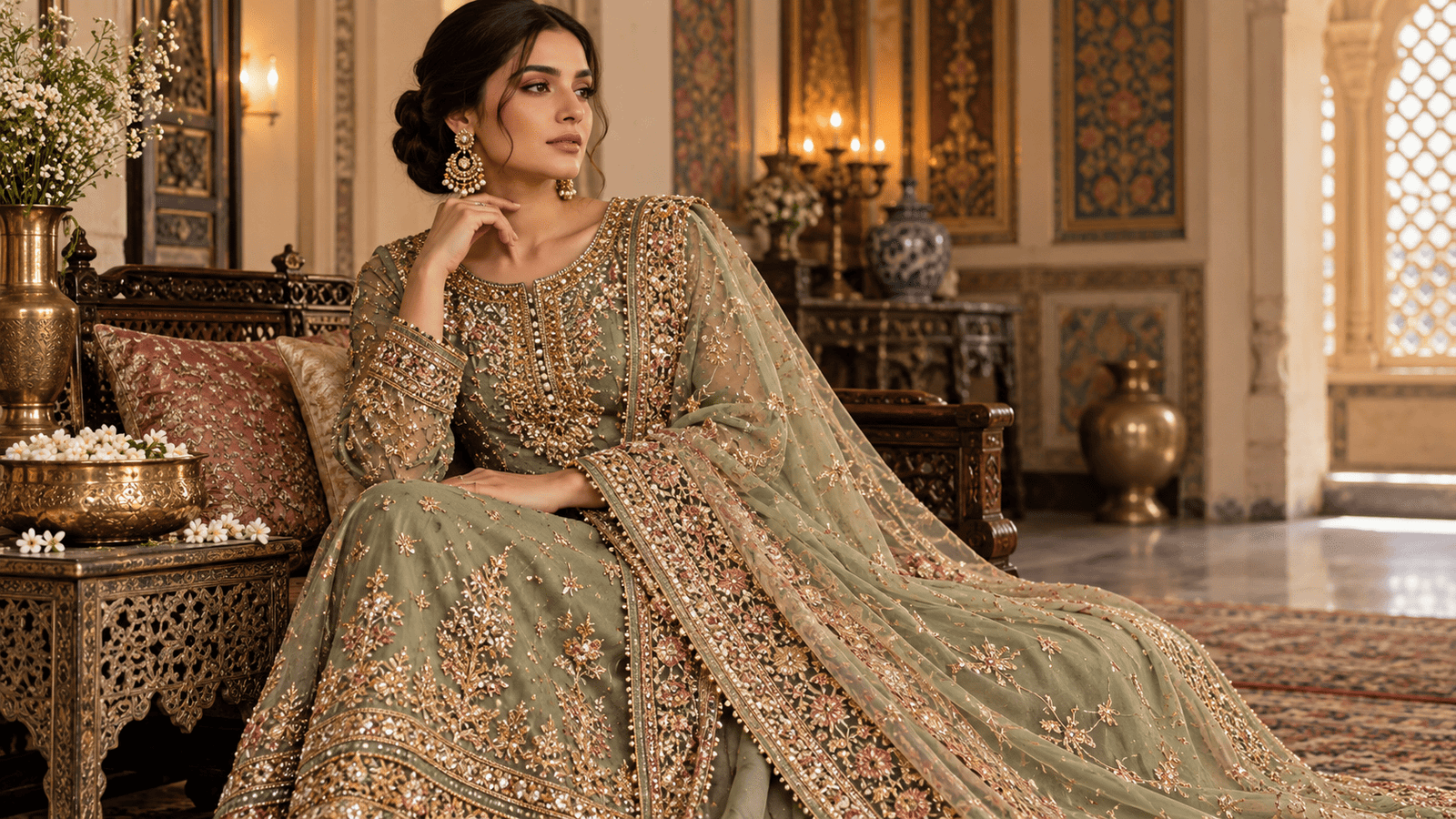
Buying genuine hand embroidered Pakistani dresses is very different from choosing an outfit based only on colour, silhouette or photographs. The real value is often in details that are easy to miss online, such as how the embroidery sits on the fabric, whether individual embellishments have been applied by hand, how dense the work is, how cleanly borders are finished and whether the product description clearly explains what has actually been handcrafted.
This matters even more when shopping for premium formal wear. Terms such as embroidered, hand embellished, hand worked and hand embroidered are often used close together, but they do not always describe the same construction. Understanding those differences helps you judge quality more confidently and decide whether a dress genuinely justifies its craftsmanship and price.
If you are looking for formal occasion wear created around traditional handwork, explore Abdullah Bin Shahbaz hand embroidered Pakistani formal wear UK.
What Does Hand Embroidered Actually Mean?
Hand embroidery means that decorative work has been created or applied manually rather than produced entirely through automated machine embroidery. However, modern Pakistani formal wear can combine more than one process, so it is important to understand exactly what a product description is telling you.
A dress may have a machine embroidered base with hand applied zardozi around the neckline. Another may use resham embroidery with hand embellished dabka and cutdana. A third may feature much more extensive handwork across multiple panels. None of these descriptions should automatically be treated as inferior, because the important issue is clarity. A good product description should help you understand which parts of the outfit are hand worked and which techniques have been used.
Hand Embroidered, Hand Embellished and Machine Embroidered Are Not the Same
These terms can sound similar when shopping online, but they usually describe different levels or types of craftsmanship. Machine embroidery is produced primarily through embroidery machinery, while hand embellishment often refers to decorative materials added manually to an existing embroidered base. Hand embroidered work, by contrast, involves embroidery or decorative detail created by artisans by hand, while mixed technique garments combine machine embroidery with hand-applied details.
The point is not that machine embroidery is automatically poor quality. Well produced machine embroidery can look beautiful. The issue is whether a garment described and priced as premium handwork actually contains the level of hand craftsmanship you expect.
| Description | What It Usually Means | What to Check |
|---|---|---|
| Machine embroidered | Motifs produced primarily by embroidery machinery | Repetition, flatness and product wording |
| Hand embellished | Decorative materials added manually to an existing embroidered base | Which areas are hand finished |
| Hand embroidered | Embroidery or decorative work created by artisans by hand | Technique, coverage and finishing |
| Mixed technique | Machine embroidery combined with handwork | Exact balance between both processes |
How to Identify Hand Embroidered Pakistani Dresses Online
When shopping online, start with close up images rather than full length photographs. A model image tells you how the outfit looks as a complete silhouette, but a detailed close up tells you much more about craftsmanship.
Look carefully at the neckline, sleeve borders, hemlines, motif edges, dupatta borders, individual stones and beads, metallic embroidery and the relationship between the embroidery and the fabric beneath it. Good handwork usually reveals depth and texture when viewed closely.
Look for Dimension, Not Just Shine
One of the easiest mistakes is assuming that anything reflective must be premium hand embroidery. Shine can come from sequins, metallic thread, crystals, printed effects or machine applied embellishment, so reflection alone is not enough to judge quality.
Instead, look for dimension. Techniques such as zardozi and dabka often create a raised surface rather than appearing completely flat against the fabric. The details should look like they physically sit on the garment, and this is often easiest to see around necklines, borders and larger motifs.
Small Variations Can Be a Sign of Handwork
Hand craftsmanship is created by people, not identical automated repetitions, so tiny variations between motifs can sometimes be visible. One flower may sit fractionally differently from another, the spacing around metallic coils may vary slightly, or individual beads may not be positioned with machine-perfect uniformity.
These small differences do not automatically mean poor workmanship. In genuine handcrafted clothing, they can be part of the character of the work. Variation alone is not proof of authenticity, though, because high quality hand embroidery can be extremely precise. It is better to judge several signals together.
Check the Reverse Side When Possible
If a retailer provides detailed interior photographs, the reverse side of embroidered fabric can reveal useful information. Hand worked areas may show thread paths, knots or attachment points that reflect the way embellishment has been secured, while machine embroidered areas often appear more uniform.
This is not always visible once a dress has been lined, so you should not expect every finished garment to expose the back of the embroidery. If you are buying a premium piece and the craftsmanship matters to you, asking for additional detail images can still be useful.
Read Product Descriptions Carefully
Do not treat phrases such as “embroidered”, “hand embellished”, “hand embroidered”, “hand worked”, “fully hand worked” and “embroidered with hand embellishment” as interchangeable. Each phrase suggests something slightly different about how the garment has been made.
If the product description simply says embroidered, do not automatically assume the entire dress has been embroidered by hand. If it says hand embellished neckline, the handwork may be concentrated specifically around that area. Transparent wording allows you to understand what you are actually purchasing.
What Is Zardozi?
Zardozi is associated with rich metallic embroidery and is often used to create a more formal, dimensional finish. On Pakistani formal wear, it may appear around necklines, borders, sleeves, statement motifs, dupattas and panels.
Good zardozi can give a garment immediate depth without needing the entire outfit to be densely covered. That makes it particularly effective for formal and party wear. If you prefer richer metallic craftsmanship, explore the Zarposh collection, where statement handwork forms an important part of the collection’s visual identity.
What Is Dabka?
Dabka is commonly used to create raised metallic detail. Because the technique has more physical depth than flat thread embroidery, it can make embroidered motifs feel more substantial and is often combined with zardozi, resham, beads or other decorative elements.
When inspecting dabka work, look at how securely the detailing appears to sit on the fabric and how cleanly it has been integrated into the surrounding motif. The quality of finishing is just as important as the richness of the material.
What Is Resham Embroidery?
Resham work creates a softer visual effect through fine thread embroidery. It can be used for floral motifs, vines, borders and intricate surface detail, and compared with heavier metallic techniques it often allows the base fabric and colour palette to remain more visible.
This makes it especially useful for refined formal dressing. Women who prefer elegant motifs and softer handwork can explore the Naqsh collection.
What Are Mukesh and Cutdana?
Mukesh introduces small reflective accents that can create light across the surface of a garment, while cutdana consists of faceted decorative elements that catch light more sharply. Both can be used to add dimension and sparkle without covering the entire outfit in heavy embroidery.
The quality of these details depends on how they are positioned and secured. Random sparkle is not the same as thoughtful embellishment, so the placement should support the overall motif and silhouette.
Embroidery Density Matters More Than Technique Names
Two dresses can both claim to use zardozi and still be completely different in craftsmanship and visual impact. One may have small embroidered borders, while another may have heavily worked front panels, sleeves and dupatta detailing.
That is why technique names alone do not tell you the complete story. You also need to understand embroidery coverage. Light scatter work uses small motifs spaced across the fabric, border work concentrates embroidery around hems, sleeves, necklines or dupatta edges, panel work creates greater richness across larger sections, and all over work covers substantial areas of the garment. When comparing two dresses, always compare density as well as technique.
Look at How the Embroidery Works With the Fabric
Good hand embroidery should feel connected to the base fabric. The most expensive embellishment in the world will not create a beautiful garment if the fabric cannot support it properly.
Organza works well for structured embroidery because it provides a relatively crisp surface. Silk can carry embroidery while still allowing rich movement, chiffon is softer and often works better with lighter detailing, and tissue can enhance metallic techniques through its natural luminosity. A good designer considers fabric and embroidery together.
Look at Motif Placement
Quality craftsmanship is not only about how a motif is made. It is also about where it is placed and how it supports the overall design.
Ask yourself whether the embroidery frames the neckline naturally, whether borders follow the shape of the garment, whether motifs are balanced across visible panels, whether the dupatta complements the main outfit and whether the embroidery is concentrated where it creates the most impact. Thoughtful placement makes a formal dress feel designed rather than simply decorated.
Inspect the Finishing Around Borders
Borders often reveal the quality of a formal dress. Sleeve edges, hemlines and dupatta finishing should look neat and integrated with the main garment rather than added as an afterthought.
Loose decorative elements, untidy edges or inconsistent border alignment can affect the overall appearance even when the main embroidery is beautiful. Premium craftsmanship should continue into the finishing.
Check Whether the Back and Sleeves Are Worked
Product photographs often focus heavily on the front, so before buying you should understand what happens elsewhere. Check whether the sleeves are embroidered, whether the back contains motifs, whether the dupatta is worked on all sides or only one border and whether the lower garment carries matching details.
A close up of one heavily worked neckline should not lead you to assume the entire outfit carries the same embroidery density.
Do Not Judge Quality From Weight Alone
Heavier does not automatically mean better. A dress covered in metallic components can feel physically heavy without necessarily demonstrating better design, while refined threadwork can involve significant skill without creating the same weight.
The better question is whether the embroidery is appropriate for the fabric and occasion. Formal wear should still be wearable.
Price Can Reflect Labour, But Price Alone Proves Nothing
Hand craftsmanship usually requires more labour than automated production, and that can contribute to a higher price. However, price alone cannot prove that a garment is genuinely hand embroidered because brand positioning, fabric, design, finishing and other factors also affect cost.
Use price as one signal rather than your only test. Look for transparency in product descriptions, close up imagery and clear explanations of the techniques used.
Hand Embroidery vs Machine Embroidery Pakistani Dresses
Neither process should automatically be dismissed. Machine embroidery can provide precision, repeatability and more accessible pricing, while hand embroidery can create texture, individuality and artisan detail. Some of the strongest formal garments use both.
The important thing is knowing what you are buying. A combination of machine and handwork can still produce beautiful formal wear when it is described honestly and the craftsmanship is clear.
| Factor | Handwork | Machine Work |
|---|---|---|
| Motif repetition | May show tiny variations | Usually highly consistent |
| Surface character | Often dimensional | Often more uniform |
| Labour | Artisan intensive | Faster production |
| Coverage | Can vary significantly | Easily repeated |
| Price impact | Often higher | Usually more accessible |
| Best use | Premium detail and focal craftsmanship | Consistent decorative coverage |
Why Hand Embroidery Works So Well for Formal Wear
Formal clothing needs enough detail to feel special without necessarily becoming bridal. This is where hand embroidery can be particularly effective because a carefully worked neckline, statement cuff or embroidered border can elevate an outfit without requiring extreme coverage.
Hand craftsmanship can therefore create luxury through detail rather than simply through quantity. This is particularly useful for wedding guest wear, engagement parties, Eid celebrations, receptions and formal dinners. For occasion specific advice, read our Pakistani wedding guest outfits UK guide.
Questions to Ask Before Buying Hand Embroidered Formal Wear
If the product information is unclear, ask practical questions about which parts of the dress are hand embroidered, whether the base fabric is machine embroidered, which embellishment techniques are used, whether the sleeves and back are worked, how the dupatta is finished and whether close up images are available.
You can also ask what fabric is used and whether the garment includes custom sizing options. A good retailer should be able to explain the product clearly.
How to Judge Hand Embroidery From Product Photography
When shopping online, do not rely on one model photograph. A full length image shows the silhouette and overall embroidery balance, while a close up reveals texture, beads, metallic detailing and motif quality.
Side and back images help you see whether craftsmanship continues beyond the front, dupatta detail images show border quality and overall coordination, and video can reveal shine, texture and dimensionality that still photography may flatten. A strong product page should help you see more than the overall colour.
Beware of Vague Craftsmanship Claims
Words such as luxury, premium and designer are marketing terms. They do not explain construction.
More useful product descriptions tell you the fabric, techniques, areas embroidered, type of embellishment, garment components and level of customisation. Specific information is more valuable than vague claims.
Genuine Hand Embroidered Pakistani Dresses Should Still Feel Wearable
Formal craftsmanship should not come at the expense of comfort. Consider whether the outfit allows you to sit comfortably, whether the dupatta is too heavy, how the embroidery feels against the arms or neckline and whether heavily embellished borders will make movement difficult.
A beautiful formal outfit should work throughout the occasion, not only during photography.
Choose Craftsmanship You Can Wear Again
One of the best reasons to invest in quality formal wear is repeat use. A refined hand embroidered dress can often work across wedding celebrations, engagement dinners, Eid gatherings, formal receptions, family events and evening functions.
Changing jewellery, shoes and dupatta styling can create a completely different look. That gives good craftsmanship value beyond a single occasion. Explore Abdullah Bin Shahbaz Pakistani formal dresses UK if you are looking for elevated formal and party wear built around traditional handwork.
Zarposh or Naqsh: Two Different Expressions of Hand Craftsmanship
Abdullah Bin Shahbaz uses different approaches to formal dressing across its signature collections. Zarposh is suited to women who prefer richer metallic detail and a stronger formal presence, making it especially suitable for evening occasions, wedding celebrations and statement party wear. Explore the Zarposh collection.
Naqsh takes a softer direction through refined motifs and elegant handwork. It works particularly well for engagement dinners, Nikkah events, Walima celebrations and women who prefer understated sophistication. Explore the Naqsh collection.
A Quick Hand Embroidery Buying Checklist
Before purchasing a premium Pakistani formal dress, check whether the description clearly explains which areas are hand worked, whether close up images are available, whether you can see real surface texture and whether the embroidery density is clear.
You should also check whether the borders look neatly finished, whether the sleeves and back are shown, whether the dupatta detailing is visible, whether the fabric suits the embroidery, whether the seller explains the techniques used, whether the outfit still looks comfortable enough to wear, whether the craftsmanship feels appropriate for the price and whether you can imagine wearing the dress again.
Frequently Asked Questions About Genuine Hand Embroidered Pakistani Dresses
How can I tell if a Pakistani dress is hand embroidered?
Look at several signals together, including surface dimension, slight natural variation, embroidery placement, finishing, detailed product descriptions and close up photographs. No single visual sign is enough on its own.
Is machine embroidery lower quality than hand embroidery?
Not necessarily. Machine embroidery can be well made and visually attractive. The important issue is whether the product description accurately explains the construction and whether the price reflects what you are buying.
What is the difference between hand embroidered and hand embellished?
Hand embroidery refers to decorative work created by hand, while hand embellishment can describe manually applied beads, metallic elements or other details added to an existing embroidered base.
What is zardozi embroidery?
Zardozi is a rich metallic embroidery technique commonly used in South Asian formal and ceremonial clothing. It can create raised, reflective detail around borders, motifs and necklines.
What is dabka embroidery?
Dabka uses coiled metallic detailing to create dimension and texture. It is often combined with other embroidery and embellishment techniques.
Is resham embroidery suitable for formal wear?
Yes. Resham creates refined threadwork and works especially well for softer formal outfits, floral motifs and elegant occasion wear.
Where can I explore hand embroidered Pakistani dresses in the UK?
Explore Abdullah Bin Shahbaz hand embroidered Pakistani formal wear UK for formal and party wear created around traditional craftsmanship. For richer metallic handwork, browse Zarposh, and for softer embroidered formal wear, discover Naqsh.
Final Thoughts
The best way to identify genuine hand embroidered Pakistani dresses is not to search for one perfect sign. Look at the complete picture by reading the product description, inspecting the embroidery closely, understanding which techniques are used, considering how dense the work is and checking the sleeves, back, borders and dupatta.
Pay attention to finishing as well. Most importantly, make sure the craftsmanship supports the complete design. Hand embroidery should add depth, character and individuality to formal wear rather than simply make the garment heavier.
If you are ready to explore handcrafted occasion wear, browse Abdullah Bin Shahbaz Pakistani formal dresses UK, discover statement handwork in Zarposh, or explore the refined formal direction of Naqsh.